- Animals
- ›Arthropods
- ›Hexapods
- ›Insects
- ›Winged and Once-winged Insects
- ›Butterflies and Moths
- ›Curved-horn Moths
- ›Concealer Moths
- ›Tingena
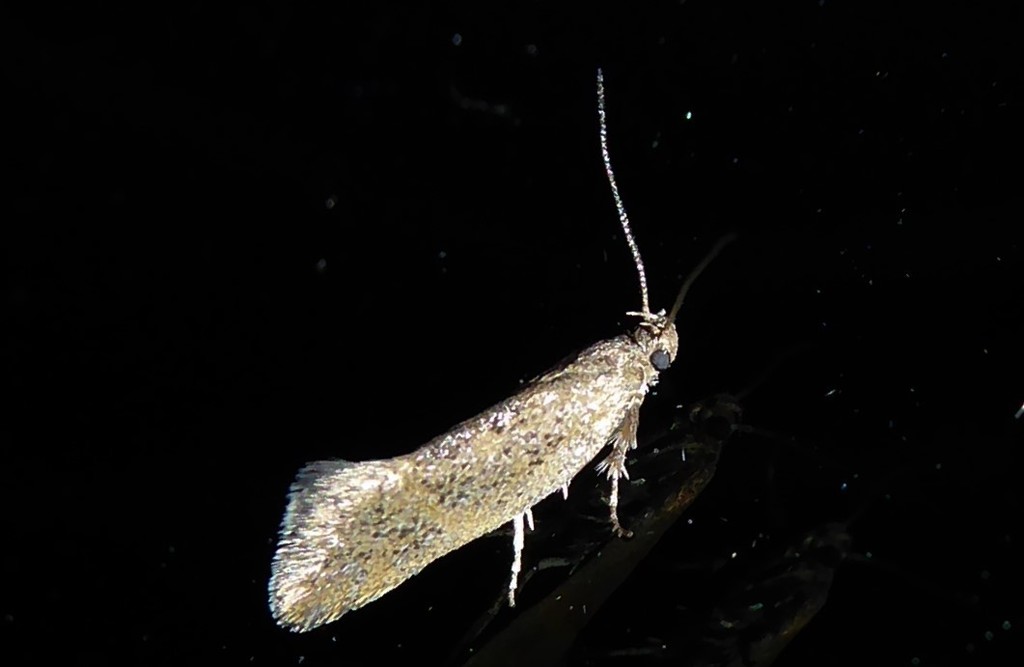
Tingena siderodeta
Tingena siderodeta is a species of moth in the family Oecophoridae. It is endemic to New Zealand and is found throughout the country. This species prefers to inhabit native forest and scrubland but has also been found to be common in cultivated landscapes. The larvae are litter feeders and have been observed in Kanuka and Manuka forest. The adult moths are on the wing from October to February and are day flying but have also been trapped at night.
From the article Tingena siderodeta on Wikipedia (CC BY-SA), quoted section by section
Description
Meyrick first described this species as follows:
Fore wings narrow, ochreous, suffused with dark fuscous, sometimes with three obscure fasciae, inner margin generally paler; hind wings dark grey. Meyrick, in his more detailed description, stated:
Male, female. — 12-14 mm. Head, palpi, and thorax ochreous, densely mixed with dark fuscous. Antennas dark fuscous. Abdomen grey. Legs dark fuscous, central ring of tibiae, hairs of posterior tibiaa, and apex of all joints whitish. Forewings elongate, narrow, costa gently arched, more strongly near base, apex pointed, hindmargin extremely obliquely rounded; brownish-ochreous, densely irrorated with dark fuscous, which tends to form three broad oblique cloudy fasciae, but these are often wholly suffused and confluent; generally there is a more or less distinctly clear brownish-ochreous space towards base of inner margin : cilia ochreous-whitish, with numerous irregular rows of dark fuscous points, tips clear whitish. Hindwings dark fuscous; cilia grey, towards base dark fuscous.Philpott stated that specimens of this species collected in Stewart Island / Rakiura are larger than those from other locations.
Range & habitat
This species is endemic to New Zealand and is found throughout the country. This species has also been found in a site of ecological significance in Christchurch as set out in the Christchurch District Plan.
Wikipedia: “Distribution”
What it does
Adults of this species are on the wing from October until February. It can be found flying in daylight hours and has been collected when resting on fence posts or tree trunks. This species has also been collected at night via a Malaise trap. When idle this species resembles a small pointed twig as its body position ensures its antennae are held backwards, the wings encircle the body and the rear end of the insect is lifted with the head lowered.
Wikipedia: “Behaviour”
Listen
Looking for field recordings…
Where it lives
Recorded sightings
—
geo-referenced records in GBIF, from museums, herbaria and field observers.
Drag the globe to turn it. Dots are where records exist, not a range map; darker means more records.
In the stacks
Searching the stacks…
Every page naming Tingena siderodeta in the Biodiversity Heritage Library →
This page is assembled live from iNaturalist, GBIF, Wikipedia, the Source Library and the Internet Archive. It is not yet part of the hand-edited codex. iNaturalist taxon 514733.