- Animals
- ›Arthropods
- ›Hexapods
- ›Insects
- ›Winged and Once-winged Insects
- ›Butterflies and Moths
- ›Curved-horn Moths
- ›Concealer Moths
- ›Atomotricha
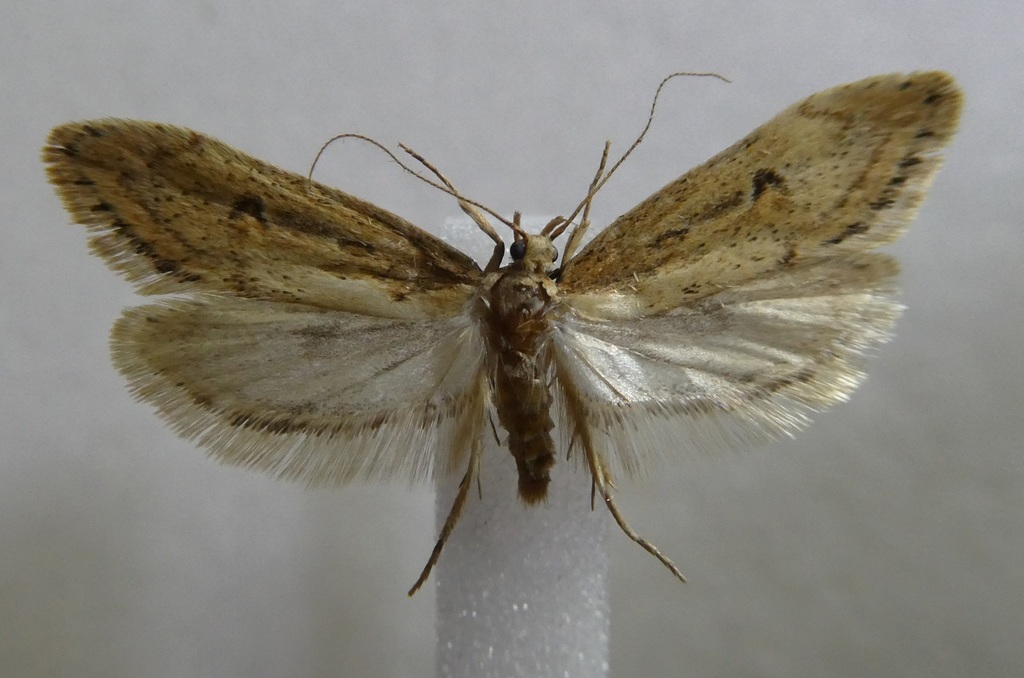
Atomotricha ommatias
Atomotricha ommatias is a moth in the family Oecophoridae first described by Edward Meyrick in 1883. It is endemic to New Zealand and has been observed in the South Island. This species inhabits shrubland. The adults are out in the spring months of August and September and are attracted to sugar traps. The female of the species os brachypterous and is incapable of flight. Both the male and female of the species have been observed resting on fences during cold nights. The female, if touched, will hop two or three inches.
From the article Atomotricha ommatias on Wikipedia (CC BY-SA), quoted section by section
Description
Meyrick described this species as follows:
Fore wings fuscous, clouded with darker, three arched discal marks, and a posterior transverse line obscurely darker; hind-wings whitish-grey. Meyrick, in a later 1883 publication, went on to state: ♂ broader - winged than versuta, ground-colour always fuscous, stigmata not ochreous. ♀ with forewings not acuminate, hindwings partially developed, ovate-lanceolate. Meyrick gave a fuller description of the species in 1884: Male. — 21-24 mm.; female. — 13-18 mm. Head, palpi, and thorax pale fuscous, more or less suffused with dark fuscous. Antennae pale fuscous, slenderly annulated with dark fuscous. Abdomen ochreous-whitish. Legs ochreous-whitish, tarsal joints suffused with dark fuscous towards base. Forewings elongate, somewhat dilated posteriorly, costa moderately arched, apex round-pointed, hindmargin very obliquely rounded; light fuscous, irregularly or wholly suffused with dark fuscous; a large tuft of raised scales almost at base, and two or three much smaller in disc; an obscurely indicated pale dot in disc before 1⁄3, partially surrounded by a dark ring, and a similar one on fold obliquely beyond it; a dark fuscous crescentic spot in disc slightly beyond middle, extremities directed downwards, anteriorly and posteriorly distinctly margined with paler; a slender dark fuscous transverse line from 2⁄3 of costa obliquely outwards, …
Range & habitat
This species is endemic to New Zealand. This species has been observed in the South Island, at Canterbury, including at Riccarton Bush and Cass. It has also been observed at the West Plains in Southland.
Wikipedia: “Distribution”
What it does
The adults of this species are on the wing in the New Zealand spring months of August and September and are attracted to sugar traps. It can be observed resting on fences during cold nights. If touched the female of the species will hop two or three inches.
== References ==
Wikipedia: “Behaviour”
Listen
Looking for field recordings…
Where it lives
Recorded sightings
—
geo-referenced records in GBIF, from museums, herbaria and field observers.
Drag the globe to turn it. Dots are where records exist, not a range map; darker means more records.
In the stacks
Searching the stacks…
Every page naming Atomotricha ommatias in the Biodiversity Heritage Library →
This page is assembled live from iNaturalist, GBIF, Wikipedia, the Source Library and the Internet Archive. It is not yet part of the hand-edited codex. iNaturalist taxon 514741.