 NL·0363
Herbarium of the Nature Library
- Name
- Birgus latro
- Family
- Coenobitidae
- Native to
- Islands of the Indian and Pacific Oceans, from Zanzibar, Aldabra and the Chagos through Christmas Island and Indonesia to Micronesia and Polynesia
- Habitat
- Coastal forest, Island forest, Coral atolls
Coconut crab
Birgus latro
Also calledRobber crab (English) · Ayuyu (Chamorro) · Ketam kelapa (Malay) · Yashigani (Japanese) · Crabe de cocotier (French)
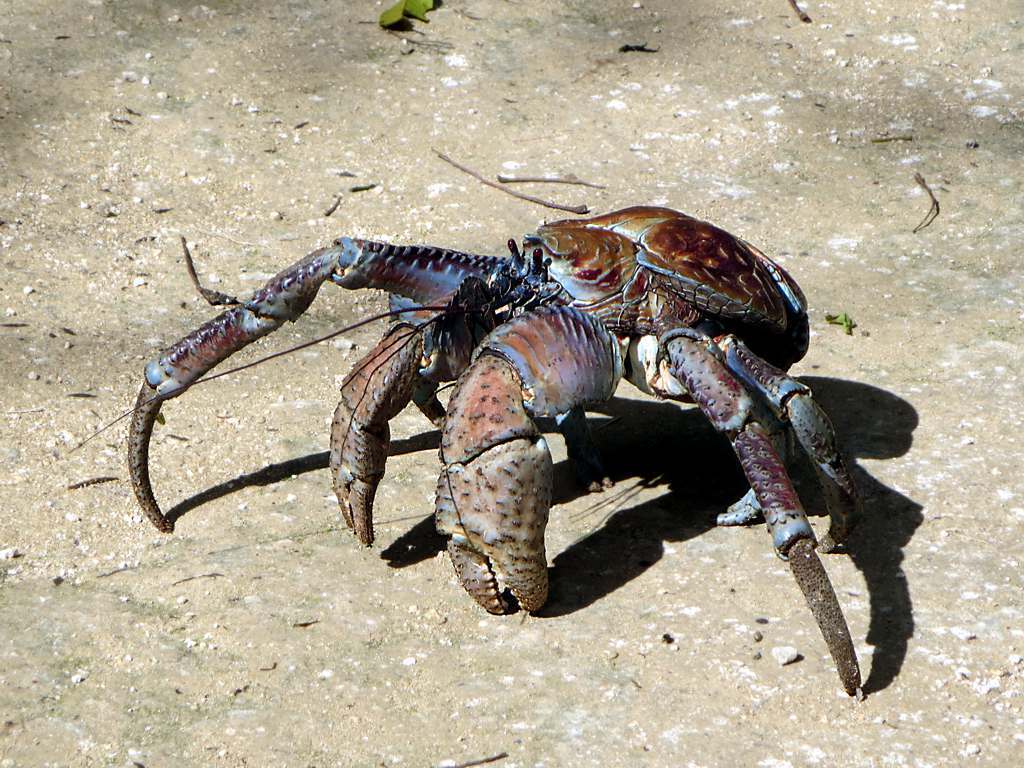
The largest land-living arthropod, a giant hermit crab that abandons its borrowed shell and can weigh 4 kg with legs spanning about a metre. Its claws pinch with a force rivalling the bite of a lion, enough to crack open coconuts.
The coconut crab is a terrestrial species of giant hermit crab, and is also known as the robber crab or palm thief. It is the largest living terrestrial arthropod, with a weight up to 4.1 kg. The distance from the tip of one leg to the tip of another can be as wide as 90 centimeters. It is found on islands across the Indian and Pacific Oceans, as far east as the Gambier Islands, Pitcairn Islands, and Caroline Island, and as far west as Zanzibar. While its range broadly shadows the distribution of the coconut palm, the coconut crab has been extirpated from most areas with a significant human population such as mainland Australia and Madagascar. Wikipedia
What it can do
- iPinching force measured at over 3,300 newtons, among the strongest of any crustacean
- iiOpens coconuts by stripping the husk and hammering the shell
- iiiBreathes air with modified gills ('branchiostegal lungs') and drowns if kept underwater
- ivClimbs trees and can live 60 years or more
In the field
Field marks
- aEnormous land crab with a hard, curled-under abdomen and no shell
- bColour varies from violet-blue to orange-red
- cVery large front claws, the left usually bigger
- dLong, sturdy antennae
- Not to be confused with
- Land hermit crabs (Coenobita) are much smaller and keep living in snail shells as adults. Juvenile coconut crabs also use shells and are told apart by their heavier claws and colour.
- Where to see it
- Christmas Island (Indian Ocean), Aldabra, the Chagos atolls, Vanuatu and Niue, mostly at night.
- When
- Year-round; most active at night
Life & habits
- Diet
- Coconuts, fruit, nuts, carrion, other crabs, and occasionally birds and rats
- Habitat
- Coastal forest and rocky areas on islands, sheltering in burrows and crevices by day
- Size
- Up to about 4 kg and a leg span of about 1 m
- Lifespan
- 60 years or more
Females release eggs into the sea at high tide; larvae drift for weeks, then young crabs come ashore using snail shells before outgrowing them.
Where it lives
Recorded sightings
—
geo-referenced records in GBIF, from museums, herbaria and field observers.
Native range
Islands of the Indian and Pacific Oceans, from Zanzibar, Aldabra and the Chagos through Christmas Island and Indonesia to Micronesia and Polynesia
Drag the globe to turn it. Dots are where records exist, not a range map; darker means more records.
In the old herbals & bestiaries
Woodcuts and engravings matched from the Source Library’s scanned books by name. Plates marked “relative” show a close kin rather than this exact species. Click a plate to read the page it came from, with translation.

In the stacks
Searching the stacks…
Every page naming Birgus latro in the Biodiversity Heritage Library →
Marginalia
Charles Darwin described coconut crabs on the Keeling Islands in The Voyage of the Beagle, noting how they tear husks fibre by fibre before breaking the shell.
Curiosity
In 2016 a coconut crab on the Chagos Islands was observed killing and eating a red-footed booby, confirming it can prey on birds.
Kinship





Photographs: iNaturalist contributors under the licences shown. Records: GBIF.org. Historical plates: Source Library (CC BY-SA 4.0; originals public domain). Summary text: Nature Library editors and Wikipedia (CC BY-SA). Medicinal and edibility notes are historical and educational, not advice. iNaturalist taxon 51727.