- Animals
- ›Arthropods
- ›Hexapods
- ›Insects
- ›Winged and Once-winged Insects
- ›Ants, Bees, Wasps, and Sawflies
- ›Narrow-waisted Wasps, Ants, and Bees
- ›Ants, Bees, and Stinging Wasps
- ›Bees and Apoid Wasps
- ›Bees
- ›Honey Bees, Bumble Bees, and Allies
- ›Apine Bees
- ›Honey Bees
- ›Apis
- ›Apis
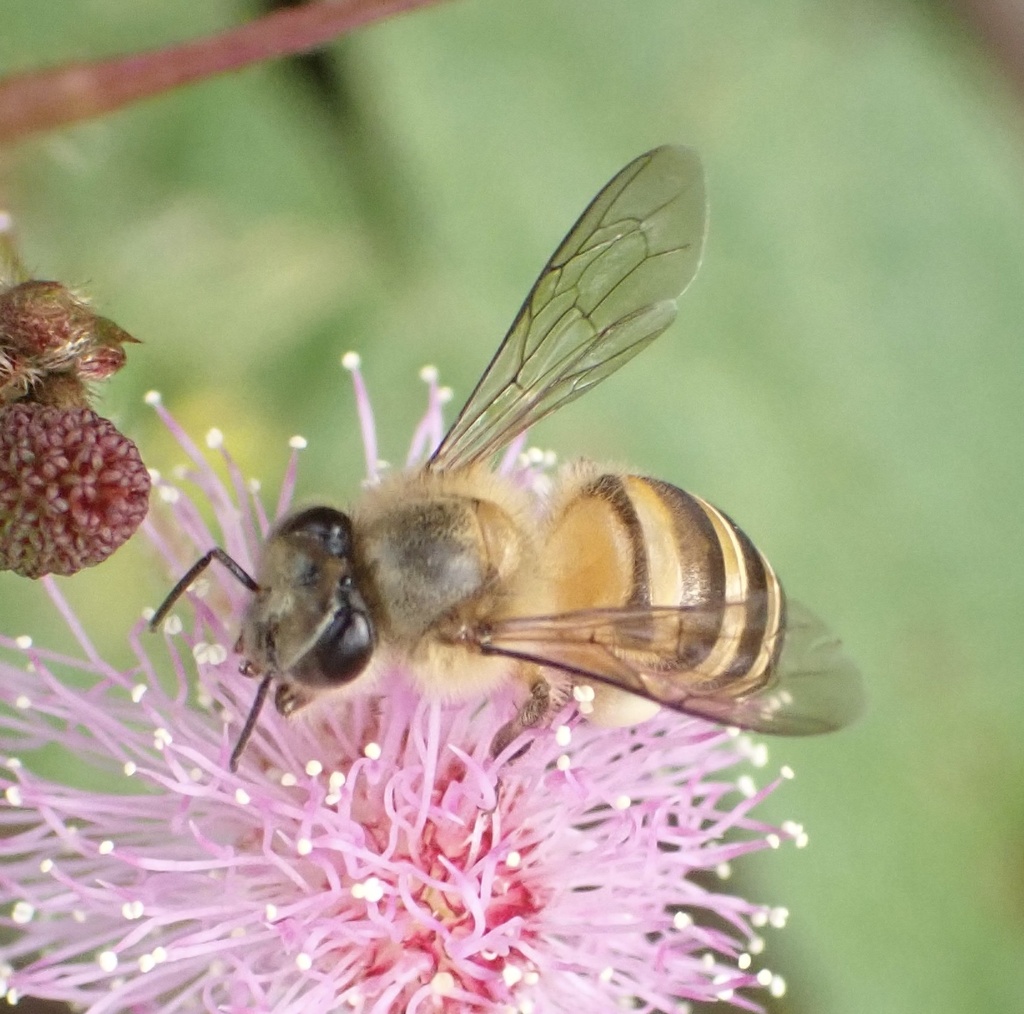
Black-banded Honey Bee
Apis nigrocincta
Apis nigrocincta is a species of honey bee that inhabits the Philippine island of Mindanao as well as the Indonesian islands of Sangihe and Sulawesi. The species is known to have queens with the highest mating frequencies of any species of the tribe Apini.
It is a middle-sized species of the tribe Apini, compared to the larger A. dorsata or smaller A. florea.
From the article Apis nigrocincta on Wikipedia (CC BY-SA), quoted section by section
Description
The bees have a hind wing length ranging anywhere from 5.5 mm to 5.9 mm, and a hind wing width within the range of 1.35 mm to 1.5 mm. The bees have rust-colored scapes, legs, and cylpeuses, with reddish-tan hair color that covers most of the body. Apis nigrocincta has a proboscis characteristic to those of the genus Apis. The proboscis is characterized by a tube around the glossa formed by the flat galae and basal segments of the labial palpi. Liquids are brought to the mouth through the tube by a back and forth movement of the glossa, capillary action, and suction through the mouth. The proboscis is stored in a large groove on the underside of the head, known as the proboscidial fossa, when not in use. Pollen is carried by scopal hairs on the underside of the abdomen or on the hind legs. Teeth and carinae are not present in the mandibles of workers. In females, the claws are cleft and areola are present. The hind tibia and flabellum are similar to the genus Bombus.
Reproductive structure and function. In queens, the ovariole count can range from 150 to 180 per ovary, and that number is much smaller in workers, although variable. In males, the genitalia are greatly reduced compared to other Hymenoptera, but replaced by ornate endophalluses. Within the species of Apis, there is very little differentiation in male genitalia of Apis. …
Wikipedia: “Description and appearance”
Range & habitat
There is little known about the biogeography of the species, only that it is found in parts of Indonesia and the Philippines. A. nigrocincta is suggested to have been derived from China, as it shares similar morphologies with A. cerana from the mainland than with A. cerana from the southwest. It is also stipulated that a proto-nigrocincta may have come from Borneo during the Quaternary glaciation. On the southern part of the Indonesian island of Sulawesi, most colonies are found above 400 m elevation, unlike its cousin A. cerana, of which most colonies are found below 400 m elevation. However, in areas without A. cerana, A. nigrocincta can be found in low elevation as well. In addition, A. nigrocincta inhabit areas that are more forested or mixed-culture areas, in either natural or man-made cavities near streams. In central Sulawesi, A. nigrocincta is only found at elevation levels of 550 m or higher. The areas with a higher density of A. nigrocincta have shorter, less defined dry periods but more pronounced wet periods. Finally, where A. cerana and A. nigrocincta coexist, competition will influence the location of either species.
Nest structure. A. nigrocincta is a medium-sized cavity-nesting species. Colonies are “permanent” and new colonies are formed by fission. …
Wikipedia: “Distribution and habitat”
Listen
Looking for field recordings…
Where it lives
Recorded sightings
—
geo-referenced records in GBIF, from museums, herbaria and field observers.
Drag the globe to turn it. Dots are where records exist, not a range map; darker means more records.
In the stacks
Searching the stacks…
Every page naming Apis nigrocincta in the Biodiversity Heritage Library →
This page is assembled live from iNaturalist, GBIF, Wikipedia, the Source Library and the Internet Archive. It is not yet part of the hand-edited codex. iNaturalist taxon 517613.