- Animals
- ›Arthropods
- ›Hexapods
- ›Insects
- ›Winged and Once-winged Insects
- ›Ants, Bees, Wasps, and Sawflies
- ›Narrow-waisted Wasps, Ants, and Bees
- ›Ants, Bees, and Stinging Wasps
- ›Bees and Apoid Wasps
- ›Bees
- ›Honey Bees, Bumble Bees, and Allies
- ›Apine Bees
- ›Stingless Bees
- ›New World Meliponini
- ›Trigona
- ›Trigona
Spiny-legged Stingless bee
Trigona spinipes
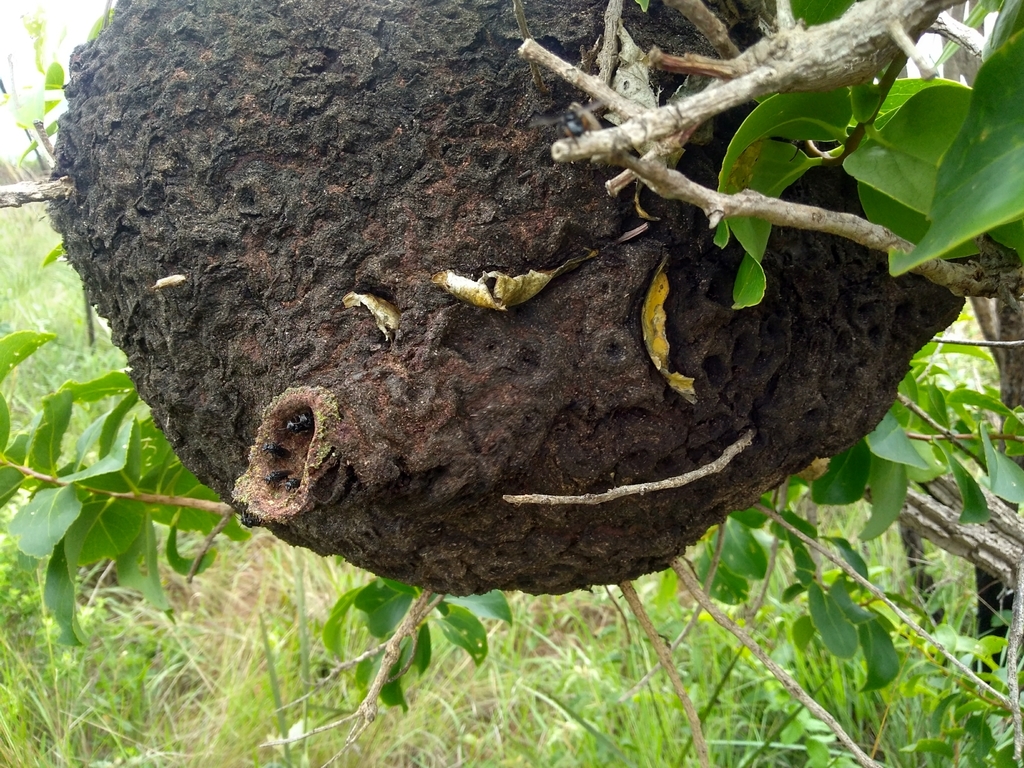
Trigona spinipes is a species of stingless bee. It occurs in Brazil, where it is called arapuá, aripuá, irapuá, japurá or abelha-cachorro ("dog-bee"). The species name means "spiny feet" in Latin. Trigona spinipes builds its nest on trees (or on buildings and other human structures), out of mud, resin, wax, and assorted debris, including dung. Therefore, its honey is not fit for consumption, even though it is reputed to be of good quality by itself, and is used in folk medicine. Colonies may have from 5,000 to over 100,000 workers.
T. spinipes will attack in swarms when they feel the nest is threatened. They cannot sting, and their bite is not very effective. Their main weapon against predatory animals, including human beings, is to entangle themselves in the victim's hair and buzz loudly. They will also aggressively penetrate human bodily openings such as nasal and auditory orifices when in attack mode.
From the article Trigona spinipes on Wikipedia (CC BY-SA), quoted section by section
Description
Trigona spinipes constructs large external nests in trees. Compared to other Trigona species such as T. hyalinata, T. spinipes nests are built quite high above the ground. They are usually built on forks between tree branches 4–7 meters from the ground and can be as large as 50–60 cm long and 50–60 cm wide. The nest material consists of mud, wax, plant fragments, and resins. The honeycombs within the nest contain the brood of eggs, larvae and pupae along within stores of honey and pollen. Early studies of T. spinipes nests noted the presence of a dense internal structure referred to as the “scutellum” which was often used to paralyze fish because of its high content of acetylcholine. This dense structure consists of nest waste such as adult bee excrements and its primary role is suggested to be an internal support upon which honeycombs are built. As for diet, Trigona spinipes has been known to collect pollen from a variety of plants, especially Eucalyptus spp., Aloe sp., and Archontophonix sp.
Wikipedia: “Description and identification”
Range & habitat
Trigona spinipes is quite common in large areas of Brazil as well as Paraguay, Argentina, and other parts of South America. It inhabits a variety of habitats including the cerrado (neotropical savannah), and tropical forests. Studies concerning Trigona spinipes have largely been conducted in Eastern and Southeastern Brazilian states such as São Paulo, Alagoas and Minas Gerais.
Wikipedia: “Distribution and habitat”
What it does
Because Trigona spinipes queens only mate once in their lifetimes, there is tremendous competition between males to copulate with virgin queens. Usually 30–50 but sometimes even hundreds of males can be counted near virgin queen colonies in lek-like groups. The males come from great distances and from a variety of nests. There is a very low probability that a male will ever mate. They stay inside the colony until the age of 2–3 weeks and then leave the nest and live the life of a solitary male bee, which might be 4–6 weeks. While living alone, they will forage with conspecific workers and may follow these workers back to their nests to learn the locations of conspecific nests.
Wikipedia: “Male mating behavior”
Listen
Looking for field recordings…
Where it lives
Recorded sightings
—
geo-referenced records in GBIF, from museums, herbaria and field observers.
Drag the globe to turn it. Dots are where records exist, not a range map; darker means more records.
In the stacks
Searching the stacks…
Every page naming Trigona spinipes in the Biodiversity Heritage Library →
This page is assembled live from iNaturalist, GBIF, Wikipedia, the Source Library and the Internet Archive. It is not yet part of the hand-edited codex. iNaturalist taxon 518869.