- Animals
- ›Arthropods
- ›Hexapods
- ›Insects
- ›Winged and Once-winged Insects
- ›Butterflies and Moths
- ›Ermine Moths and Allies
- ›Praydidae
- ›Prays
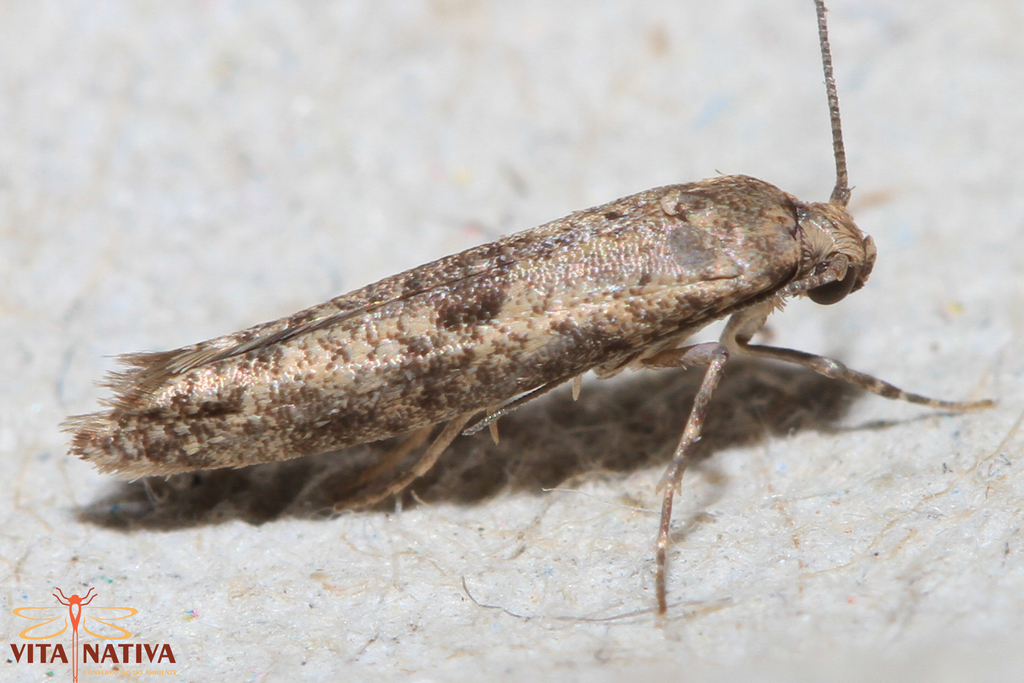
Citrus Flower Moth
Prays citri
Prays citri, also known by the common name citrus flower moth, is a Lepidoptera belonging to the family Yponomeutidae and is a pest of Citrus. Adult P. citri have light grey forewings with dark grey/black spots and greyish brown hindwings and body. They have hair-like structures (fringe) on the perimeter of their wings and a wingspan of 11.5–14.6 mm. Females tend to be lighter in colour than males. But an examination of genital structures is necessary to correctly identify P. citri from other species of the Prays genus.
From the article Prays citri on Wikipedia (CC BY-SA), quoted section by section
Range & habitat
P. citri can be found in several African, Asian, and European countries. As well as in Australia, Fiji, New Zealand, and Samoa. An up to date listing of P. citri distribution can be found on CABI Compendium. These pests can be spread by the movement of plants and fruits. They can also be transported on things like clothing, mail, and vehicles.
Wikipedia: “Distribution”
What it does
Adult female P. citri release a pheromone, identified as (Z)-7-tetradecenal, to attract male moths. Once the moths have copulated, the female lays fertilized eggs after 2–5 hours. She lays between 60 and 156 eggs on the flower of a citrus tree. The eggs will hatch after 3–4 days, and larvae will emerge, lasting for around 12 days. After this, the larvae pupate and form a cocoon on the Citrus tree, and after about 6 days, a moth will emerge. The P. citri life cycle is anywhere from 17 to 25 days. The exact number of days of each developmental stage and the number of eggs laid are highly dependent on temperature. P. citri can have between 3 and 16 generations per year. The idea temperature range for this species is between 25 °C and 30 °C, and if temperatures drop to 10 °C or below larvae cannot develop. Experiments by Sternlicht (1974a) show that female P. citri prefer to oviposit based on the scent of certain Citrus, the shape of a surface, and show a preference to specific colours and light intensities. Generally, they prefer a convex surface with higher light intensity (300–350 lux), and blue, yellow, or white surfaces. The colour preference is likely do to the fact that these are the colour of lemon flowers. Other research by Sternlicht (1974b) shows that males (2–6 days old) show the greatest attraction to females 1–16 hours hold. …
Wikipedia: “Reproduction, oviposition, and life cycle”
Listen
Looking for field recordings…
Where it lives
Recorded sightings
—
geo-referenced records in GBIF, from museums, herbaria and field observers.
Drag the globe to turn it. Dots are where records exist, not a range map; darker means more records.
In the stacks
Searching the stacks…
Every page naming Prays citri in the Biodiversity Heritage Library →
This page is assembled live from iNaturalist, GBIF, Wikipedia, the Source Library and the Internet Archive. It is not yet part of the hand-edited codex. iNaturalist taxon 522765.