- Plants
- ›Vascular Plants
- ›flowering plants
- ›Dicots
- ›Sunflowers, Bellflowers, Fanflowers, and Allies
- ›Sunflowers, Daisies, Asters, and Allies
- ›Thistles and Allies
- ›Cardueae
- ›Thistles and Burdocks

Silybum
Silybum (milk thistle) is a genus of two species of thistles in the family Asteraceae. The plants are native to the Mediterranean regions of Europe, North Africa, and the Middle East. One species has been introduced elsewhere, including in North America. The name "milk thistle" derives from a feature of the leaves, which are prominently banded with splashes of white. Historically, these milky bands were said to be Mother Mary's milk, and this is the origin of another common name, St. Mary's thistle. The most widespread species is Silybum marianum.
Claims have been made since ancient times that the active flavanoid-lignan (flavanolignan) group of constituents, called silymarin, contained only in the seed shell has liver-protective and regenerative properties, as well as antioxidant effects. Chemical, pharmacological, and safety research started in Germany in the 1950s.
2 branches of this genus, most-observed first
See this branch on the Wheel of Life →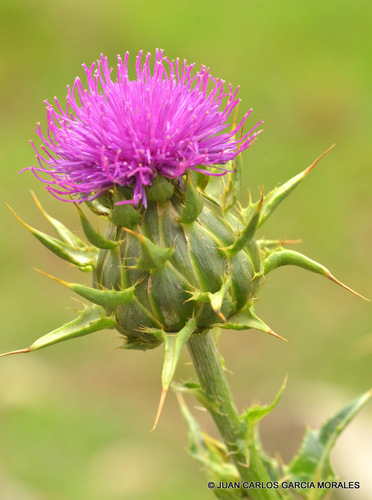

Where it lives
Recorded sightings
—
geo-referenced records in GBIF, from museums, herbaria and field observers.
Drag the globe to turn it. Dots are where records exist, not a range map; darker means more records.
In the old herbals & bestiaries

In the stacks
Searching the stacks…
Every page naming Silybum in the Biodiversity Heritage Library →
This page is assembled live from iNaturalist, GBIF, Wikipedia, the Source Library and the Internet Archive. It is not yet part of the hand-edited codex. iNaturalist taxon 52587.