 NL·0033
Herbarium of the Nature Library
- Name
- Silybum marianum
- Family
- Asteraceae
- Native to
- Mediterranean, North Africa and South-West Asia; invasive in California, Australia and South America
- Habitat
- Mediterranean shrubland, Disturbed ground, Pasture
Milk thistle
Silybum marianum
Also calledMariendistel (German) · Cardo mariano (Spanish) · Chardon-Marie (French) · Shuǐ fēi jì 水飞蓟 (Chinese) · Khār-e Maryam (Persian)
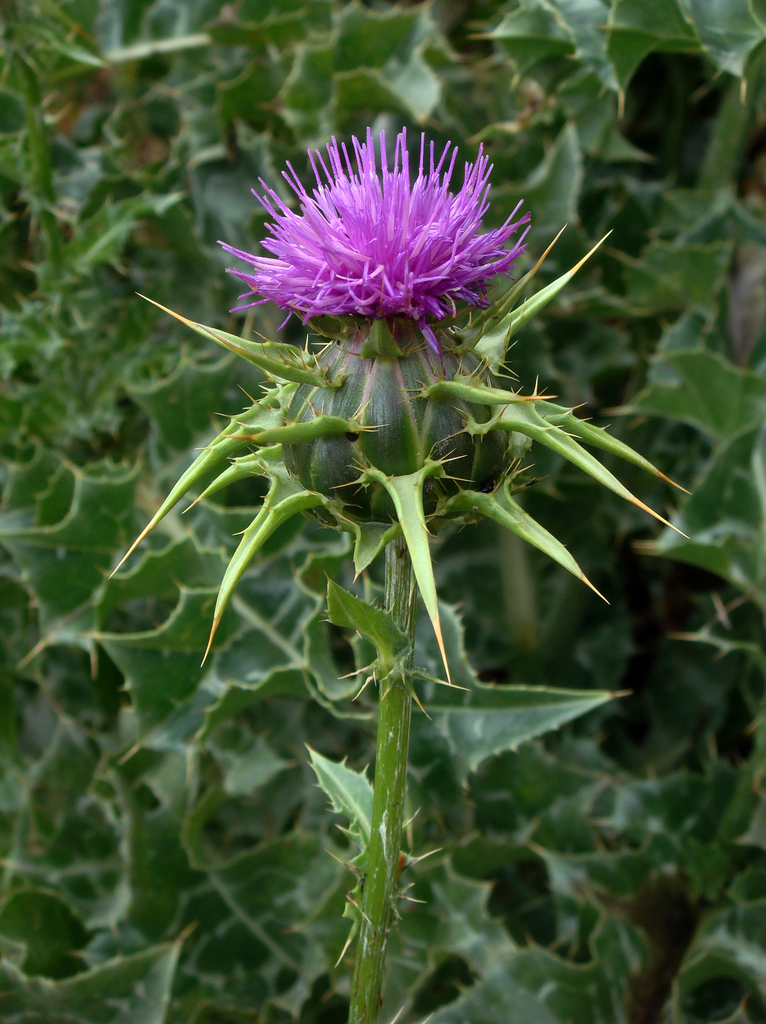
A handsome, fiercely spiny thistle whose glossy leaves are marbled with white veins, said in legend to be drops of the Virgin Mary's milk. Its seeds yield silymarin, which is used as an antidote for death-cap mushroom poisoning.
Silybum marianum is a species of thistle. It has various common names including milk thistle, blessed milkthistle, Marian thistle, Mary thistle, Saint Mary's thistle, Mediterranean milk thistle, variegated thistle and Scotch thistle. This species is an annual or biennial plant of the family Asteraceae. This fairly typical thistle has red to purple flowers and shiny pale green leaves with white veins. Once native from Southern Europe through Asia, it has spread throughout the world. Wikipedia
What it can do
- iSeeds contain silymarin, a flavonolignan complex that protects liver cells in lab studies
- iiIntravenous silibinin can block uptake of death-cap toxins (amatoxins) by the liver
- iiiGrows quickly into dense, spiny thickets that grazing animals avoid
- ivCan accumulate nitrates to levels toxic to cattle and sheep
At the table
Eatenyoung leaves (de-spined) · peeled stems · flower-head receptacle · roots · seeds
Young parts are eaten like artichoke or cardoon once the spines are removed. Plants on heavily fertilised ground can hold nitrates harmful to livestock.
In the medicine cabinet
| Tradition | Use |
|---|---|
| European folk medicine | Seeds for liver and gallbladder complaints, jaundice and to increase breast milk |
| Persian/Unani medicine | Seeds used for liver disorders and as a diuretic |
| Modern medicine | Intravenous silibinin (Legalon SIL) used in Europe for Amanita mushroom poisoning; oral silymarin trialled for alcoholic and fatty liver disease |
Weight of evidence
Moderate. Some clinical trials with promising but limited or mixed results.
Active compounds
silybin A & B (silibinin), isosilybin, silychristin, silydianin, taxifolin
Fruit & seed
Fruit
Cypsela with pappus
Ripens: Summer
Shiny, mottled black-brown achene with a deciduous white pappus.


Seed
~6–7 mm
Glossy, mottled, oval seeds
- Dispersal
- Wind (pappus), animals, hay and machinery
- Germination
- Easy; 10–20 days at 15–20 °C
Photographs from Wikimedia Commons under open licences; hover for the photographer, click for the file.
How to grow it
Hardiness (USDA zones)
Annual/biennial; USDA 5–9. Survives winters down to about -29 °C.
- Light
- Full sun
- Water
- Low
- Soil
- Any well-drained soil
- Propagation
- Seed
- To harvest
- Seeds about 4 months after spring sowing
- Climates
- Mediterranean, Temperate
- 1Check whether it is a listed weed locally before planting
- 2Sow 1 cm deep in spring, 60 cm apart
- 3Bag flower heads with paper as they dry so the seeds are not lost
- 4Wear thick gloves to harvest and clean the seed
Can it grow where you are?
Where it lives
Recorded sightings
—
geo-referenced records in GBIF, from museums, herbaria and field observers.
Native range
Mediterranean, North Africa and South-West Asia; invasive in California, Australia and South America
Drag the globe to turn it. Dots are where records exist, not a range map; darker means more records.
In the old herbals & bestiaries
Woodcuts and engravings matched from the Source Library’s scanned books by name. Plates marked “relative” show a close kin rather than this exact species. Click a plate to read the page it came from, with translation.

Living Images of Plants
Otto Brunfels · 1532 · p.410

De medicinali materia libri sex
Dioscorides · 1552 · p.373

Commentaries on the Six Books of Dioscorides
Pietro Andrea Mattioli · 1560 · p.476

Medical and Philosophical Garden
Joachim Camerarius · 1588 · p.354

Ortus sanitatis
1491 · p.66

The Book of Health: The Art of Distillation
Brunschwig, Hieronymus · 1505 · p.135

Garden of Health
1507 · p.54

Notable Commentaries on the History of Plants
Leonhart Fuchs · 1542 · p.89

Notable Commentaries on the History of Plants
Leonhart Fuchs · 1542 · p.90

Book of Herbs
Hieronymus Bock (Tragus) · 1546 · p.675
In the stacks
Searching the stacks…
Every page naming Silybum marianum in the Biodiversity Heritage Library →
Marginalia
Dioscorides recommended thistle seeds for snakebite, and medieval Europeans dedicated the plant to the Virgin Mary, giving it the name Carduus Mariae. Culpeper wrote that it was good against 'the jaundice' and liver obstructions.
Curiosity
Silymarin is not one compound but a mixture of at least seven flavonolignans plus the flavonoid taxifolin. Silibinin, the main one, is the form given by drip for mushroom poisoning.
Kinship

Photographs: iNaturalist contributors under the licences shown. Records: GBIF.org. Historical plates: Source Library (CC BY-SA 4.0; originals public domain). Summary text: Nature Library editors and Wikipedia (CC BY-SA). Medicinal and edibility notes are historical and educational, not advice. iNaturalist taxon 52586.