- Animals
- ›Arthropods
- ›Hexapods
- ›Insects
- ›Winged and Once-winged Insects
- ›Butterflies and Moths
- ›Butterflies
- ›Brush-footed Butterflies
- ›Satyrs, Morphos, and Allies
- ›Alpines, Arctics, Nymphs and Satyrs
- ›Lethina
- ›Pararge
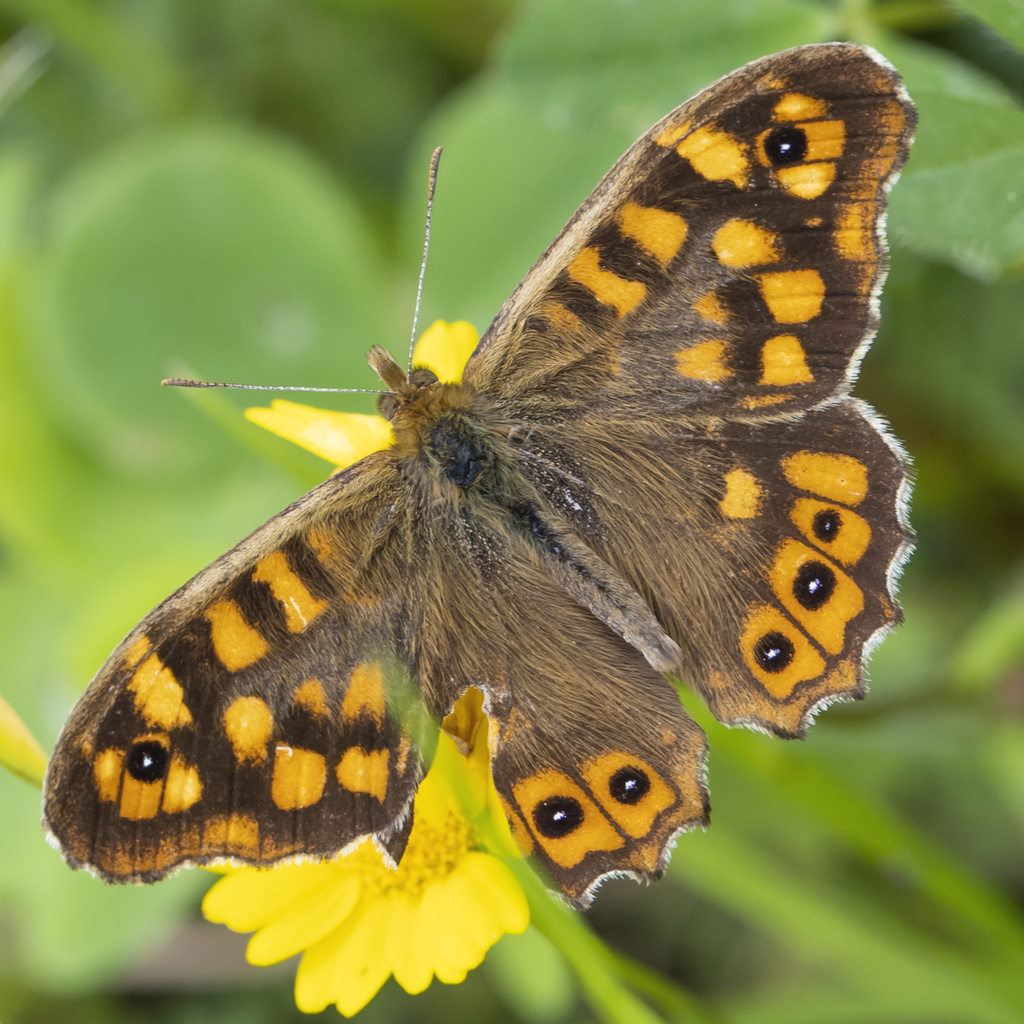
Speckled Wood
Pararge aegeria
The speckled wood (Pararge aegeria) is a butterfly found in and on the borders of woodland areas throughout much of the Palearctic realm. The species is subdivided into multiple subspecies, including Pararge aegeria aegeria, Pararge aegeria tircis, Pararge aegeria oblita, and Pararge aegeria insula. The color of this butterfly varies between subspecies. The existence of these subspecies is due to variation in morphology down a gradient corresponding to a geographic cline. The background of the wings ranges from brown to orange, and the spots are either pale yellow, white, cream, or a tawny orange. The speckled wood feeds on a variety of grass species. The males of this species exhibit two types of mate locating behaviors: territorial defense and patrolling. The proportion of males exhibiting these two strategies changes based on ecological conditions. The monandrous female must choose which type of male can help her reproduce successfully. Her decision is heavily influenced by environmental conditions.
From the article Speckled wood (butterfly) on Wikipedia (CC BY-SA), quoted section by section
Description
The average wingspan of both males and females is 5.1 cm (2 in), although males tend to be slightly smaller than females. Furthermore, males possess a row of grayish-brown scent scales on their forewings that is absent in the females. Females have brighter and more distinct markings than males. The subspecies P. a. tircis is brown with pale yellow or cream spots and darker upperwing eyespots. The subspecies P. a. aegeria has a more orange background and the hindwing underside eyespots are reddish brown rather than black or dark gray. The two forms gradually intergrade into each other. Subspecies P. a. oblita is a darker brown, often approaching black with white rather than cream spots. The underside of its hindwings has a marginal pale purple band and a row of conspicuous white spots. The spots of subspecies P. a. insula are a tawny orange rather than a cream color. The underside of the forewings has patches of pale orange, and the underside of the hindwing has a purple-tinged band. Although there is considerable variation with each subspecies, identification of the different subspecies is manageable.
The morphology of this butterfly varies as a gradient down its geographic cline from north to south. The northern butterflies in this species have a bigger size, adult body mass, and wing area. …
Range & habitat
The speckled wood occupies a diversity of grassy, flowery habitats in forest, meadow steppe, woods, and glades. It can also be found in urban areas alongside hedges, in wooded urban parks, and occasionally in gardens. Within its range the speckled wood typically prefers damp areas. It is generally found in woodland areas throughout much of the Palearctic realm. P. a. tircis is found in northern and central Europe, Asia Minor, Syria, Russia, and central Asia, and the P. a. aegeria is found in southwestern Europe and North Africa. Two additional subspecies are found within the British Isles: the Scottish speckled wood (P. a. oblita) is restricted to Scotland and its surrounding isles, and the Isles of Scilly speckled wood (P. a. insula) is found only on the Isles of Scilly. P. a. tircis and P. a. aegeria gradually intergrade into each other.
Wikipedia: “Habitat and range”
What it does
In the speckled wood butterfly females are monandrous; they typically only mate once within their lifetime. On the other hand, males are polygynous and typically mate multiple times. In order to locate females, males employ one of two strategies: territorial defense and patrolling. During territorial defense, the male defends a sunny spot in the forest, waiting for females to stop by. Another strategy is patrolling, during which males fly through the forest actively searching for females. Then, the female must make a choice between mating with a patrolling male or a territorial male. By mating with a territorial male, a female can be sure that she has chosen a high quality male, as the ability to defend a territory reflects the genetic quality of a male. Therefore, by choosing a territorial male, the female is being more picky about which male she chooses to mate with. The choice is most likely dependent on the search costs associated with finding a mate. When actively searching for a male, a female must spend her precious time and energy, which results in search costs, especially when she has a limited life span. As search costs increase, female choosiness for a mate decreases. For example, if a female's life span is shorter, she has a higher cost associated with searching for the ideal mate. …
Wikipedia: “Mating behavior”
At the table
Larval food plants include a variety of grass species such as Agropyron (Lebanon), Brachypodium (Palaearctic), Brachypodium sylvaticum (British Isles), Bromus (Malta), Cynodon dactylon (Spain), Dactylis glomerata (British Isles, Europe), Elymus repens (Lebanon), Elytrigia repens (Spain), Holcus lanatus (British Isles), Hordeum (Malta), Melica nutans (Finland), Melica uniflora (Europe), Oryzopsis miliacea (Spain), Poa annua (Lebanon), Poa nemoralis (Czechia/Slovakia), Poa trivialis (Czechia/Slovakia), but the preferred species of grass is the couch grass (Elytrigia repens). The adult is nectar feeding.
Wikipedia: “Food sources”
In human culture
The eggs are laid on a variety of grass host plants. The caterpillar is green with a short, forked tail, and the chrysalis (pupa) is green or dark brown. The species is able to overwinter in two totally separated developmental stages, as pupae or as half-grown larvae. This leads to a complicated pattern of several adult flights per year.
Food sources. Larval food plants include a variety of grass species such as Agropyron (Lebanon), Brachypodium (Palaearctic), Brachypodium sylvaticum (British Isles), Bromus (Malta), Cynodon dactylon (Spain), Dactylis glomerata (British Isles, Europe), Elymus repens (Lebanon), Elytrigia repens (Spain), Holcus lanatus (British Isles), Hordeum (Malta), Melica nutans (Finland), Melica uniflora (Europe), Oryzopsis miliacea (Spain), Poa annua (Lebanon), Poa nemoralis (Czechia/Slovakia), Poa trivialis (Czechia/Slovakia), but the preferred species of grass is the couch grass (Elytrigia repens). The adult is nectar feeding.
Growth and development. The growth and development of the speckled wood butterfly is dependent on the larval density and the sex of the individual. High larval densities result in decreased survivorship as well as a longer development and smaller adults. However, females are much more adversely affected by this phenomenon. …
Wikipedia: “Life history”
Listen
Looking for field recordings…
Where it lives
Recorded sightings
—
geo-referenced records in GBIF, from museums, herbaria and field observers.
Drag the globe to turn it. Dots are where records exist, not a range map; darker means more records.
In the stacks
Searching the stacks…
Every page naming Pararge aegeria in the Biodiversity Heritage Library →
This page is assembled live from iNaturalist, GBIF, Wikipedia, the Source Library and the Internet Archive. It is not yet part of the hand-edited codex. iNaturalist taxon 52592.