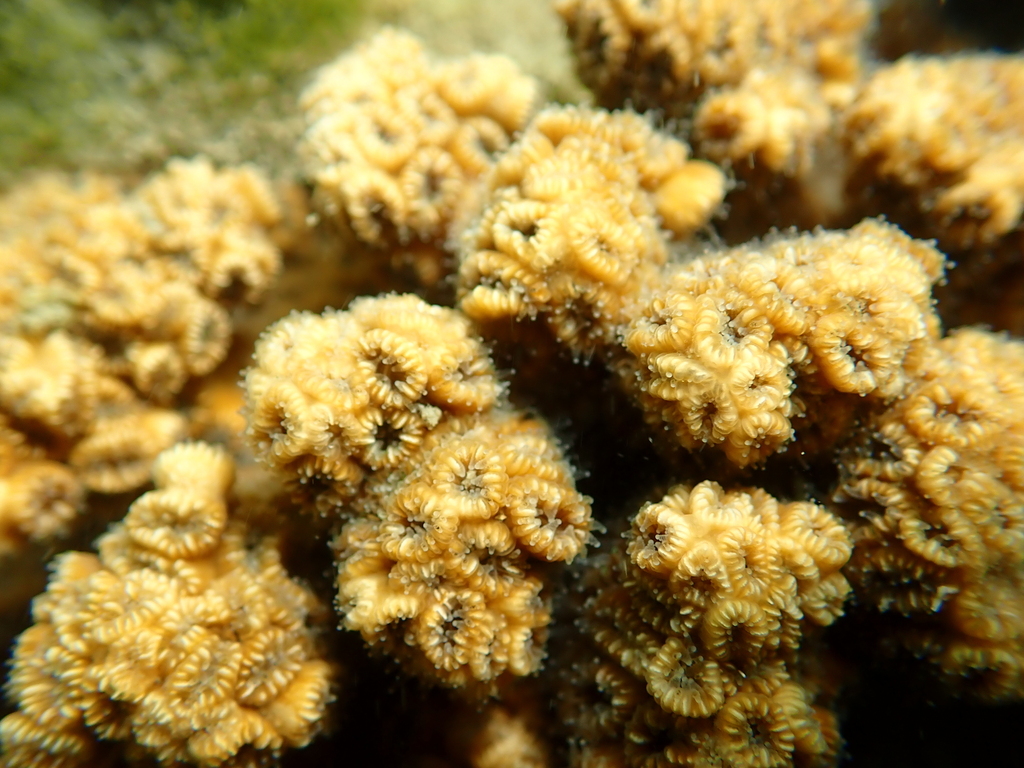
Compact Ivory Bush Coral
Oculina arbuscula
Oculina arbuscula is a branching temperate coral found along the east coast of the United States from Florida to North Carolina. It has a facultative symbiosis with microalgae of the family Symbiodiniaceae. Unlike tropical corals, O. arbuscula can survive without its algal endosymbionts by switching to a predominantly heterotrophic feeding strategy. Symbiotic colonies are typically found in shallower waters due to light availability, whereas aposymbiotic (without symbionts) or mixed colonies are found as deep as 200m. The ability of O. arbuscula to exist in different symbiotic states makes it a good model system for studying the cnidarian-dinoflagellate symbiosis.
From the article Oculina arbuscula on Wikipedia (CC BY-SA), quoted section by section
Description
O. arbuscula forms colonies up to 0.5 meters in diameter with relatively short, stubby branches. Symbiotic colonies, depending on symbiont density, range from light to dark brown in color, whereas aposymbiotic colonies are white. Colonies with mixed symbiotic states are often seen, with some branches or parts of branches appearing brown and others white.
Wikipedia: “Morphology”
What it does
In low light environments, O. arbuscula relies on filter feeding particles from the seawater as its primary trophic strategy, likely because maintaining algal symbionts is not energetically favorable in those environments. Symbiotic colonies will also filter feed; however, their primary source of nutrition is from photosynthates derived from their endosymbionts. O. arbuscula is generally a very hardy coral and can survive even when deprived of food and light for six weeks.
Wikipedia: “Feeding strategy”
Where it lives
Recorded sightings
—
geo-referenced records in GBIF, from museums, herbaria and field observers.
Drag the globe to turn it. Dots are where records exist, not a range map; darker means more records.
In the stacks
Searching the stacks…
Every page naming Oculina arbuscula in the Biodiversity Heritage Library →
This page is assembled live from iNaturalist, GBIF, Wikipedia, the Source Library and the Internet Archive. It is not yet part of the hand-edited codex. iNaturalist taxon 525922.