- Animals
- ›Arthropods
- ›Hexapods
- ›Insects
- ›Winged and Once-winged Insects
- ›Stick Insects
- ›Verophasmatodea
- ›Areolatae
- ›Bacilloidea
- ›Heteropterygidae
- ›Dataminae
- ›Datamini
- ›Dares
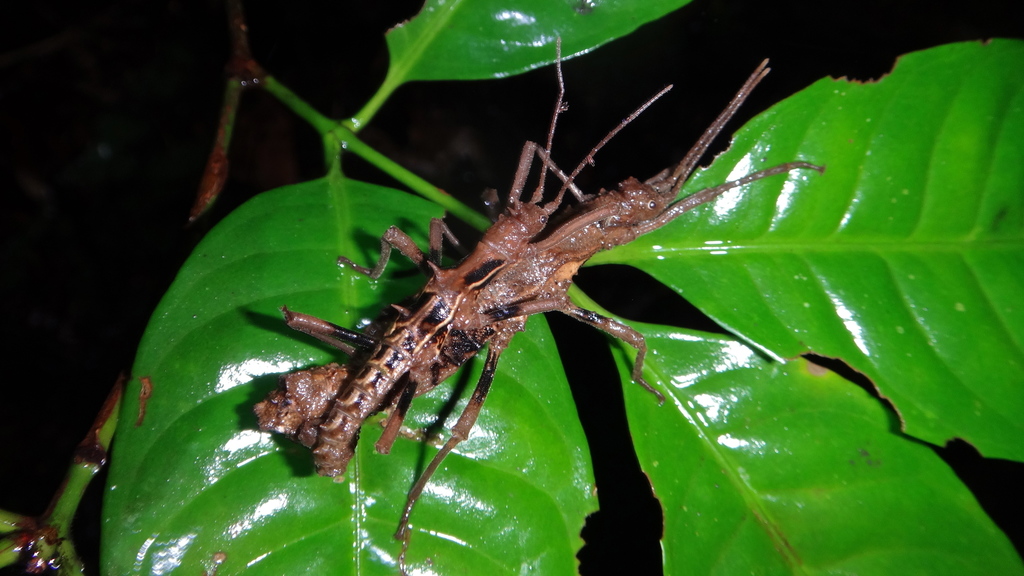
Dares verrucosus
Dares verrucosus is a species of stick insects. Like most other members of the genus Dares, the species is native to Borneo, more precisely in the north of the island.
From the article Dares verrucosus on Wikipedia (CC BY-SA), quoted section by section
Description
Both sexes have the typical habitus for the genus. For the 41 to 46 millimetres (1.6 to 1.8 in) long females this means that they have no spines and that the body surface is occupied by many tubercles. The coloring is mostly dominated by a rather light brown, more rarely by a darker shade of brown. Lighter and darker, blurred spots complement the coloring. The underside is colored light brown to beige. The antennae consist of 25 segments. Their basal segment (scapus) is flat and has one or two teeth on the outside. The abdomen is widest in the middle and increases in height in adult, egg-laying females, which makes the animals look very plump, especially from the side. The males remain smaller than the females at 32 to 38 millimetres (1.3 to 1.5 in) in length. They are usually light brown, more rarely medium brown. On the upper side of the thorax, more precisely on the meso- and metanotum, there are usually two almost black longitudinal stripes interrupted by spines and segment boundaries to form spots, which also extend to the first segments of the abdomen are sufficient. They are flanked by particularly light, almost beige areas on the edge of the meso- and metanotum and in their center. In the case of darker specimens, the light area in the middle may be missing. Half of the middle and hind femura are colored black. The males have four spines on their heads. …
Wikipedia: “Characteristics”
Range & habitat
Dares verrucosus is native to the Malay state of Sabah in the north of the island of Borneo. Most of the secured origins are in the east of Sabah. The nocturnal way of life and the defense behavior corresponds to that of the other Dares species. In this species, too, the defense strategy consists of an almost perfect phytomimesis, which is possible due to its color and body shape. When touched, the animals drop to the ground. They stay there for a while and playing dead. The females lay one to three eggs a week on the ground. These are almost spherical, 3.5 to 3.8 millimetres (0.14 to 0.15 in) in size and speckled from dark gray to dark brown. There are 0.3 mm long, creamy white, curved hairs on the surface. The lid (operculum) has a diameter of 2.3 to 2.4 millimetres (0.091 to 0.094 in). The micropylar plate has three arms, one of which points towards the lid (operculum). The other two run circularly around the egg. After three to five months the nymphs hatch. Often in older nymphs there are a few light, almost white spots at the base of the abdomen, as is typical for many other Dares nymphs. It takes a good year for them to grow into imagos. Adult animals can live to be several years old. Kim D'Hulster reports of a female who lived five years after hatching.
Wikipedia: “Distribution area and way of life”
Listen
Looking for field recordings…
Where it lives
Recorded sightings
—
geo-referenced records in GBIF, from museums, herbaria and field observers.
Drag the globe to turn it. Dots are where records exist, not a range map; darker means more records.
In the stacks
Searching the stacks…
Every page naming Dares verrucosus in the Biodiversity Heritage Library →
This page is assembled live from iNaturalist, GBIF, Wikipedia, the Source Library and the Internet Archive. It is not yet part of the hand-edited codex. iNaturalist taxon 532716.