- Fungi Including Lichens
- ›Ascomycete Fungi
- ›Sac Fungi and Lichens
- ›Common Lichens
- ›Shield Lichens, Sunburst Lichens, Rosette Lichens, and Allies
- ›shield lichens, rim lichens, and allies
- ›shield lichens and allies
- ›typical shield lichens
- ›Sulcaria
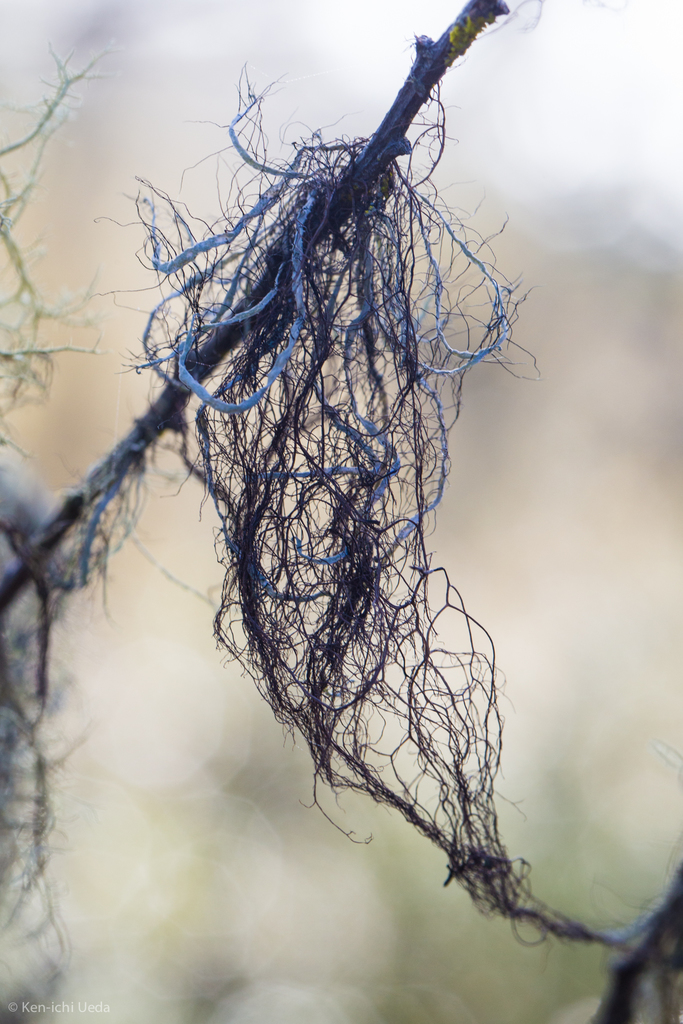
Sulcaria spiralifera
Sulcaria spiralifera is a species of fruticose lichen in the family Parmeliaceae. First described in 1977 as a species of Bryoria, it was transferred to the genus Sulcaria in 2014 based on DNA analysis. The species comprises two chemical variants now recognized as varieties: the typical variety and var. pseudocapillaris, which differ in their chemical composition and spot test reactions. It is found in the northwestern United States, where it grows as an epiphyte, hanging from a variety of tree species in open or shaded maritime forests. The lichen is characterized by its pendulous brown thallus with spiral-arranged white pores (pseudocyphellae) on its surface, extending 4–12 cm (1+9⁄16–4+3⁄4 in) in length.
From the article Sulcaria spiralifera on Wikipedia (CC BY-SA), quoted section by section
Description
The thallus of Sulcaria spiralifera usually hangs in a more or less pendent fashion, extending from 4–12 cm (1+9⁄16–4+3⁄4 in) in length. Displaying colors ranging from pale to dark brown, the exterior cortex can either be dull or exhibit a subtle sheen, frequently appearing pruinose, or powdery, in the norstictic acid chemotype. The darkest brown coloration is typically found on thalli growing at the western edges of dune forests, where they are exposed to sand abrasion, salt spray, wind, and high light levels, suggesting this coloration may be an environmental adaptation rather than a genetic trait. It features predominantly irregular branching without any apparent primary branches, and the angles created at these junctions are usually acute. The branches themselves have diameters falling between 0.10 and 0.35 mm, with small, spine-like side branches emerging near the tips. One of the distinguishing characteristics of this lichen is the presence of pseudocyphellae, or small pores on the surface of the thallus. These typically stand out due to their white color and can be straight or wrap around the branches in a spiral fashion. Their size ranges from 1 to 4 mm in length, they sometimes exhibit a furrowed texture, and they may be found either densely packed or sporadically. …
Range & habitat
Found along the west coast of North America, Sulcaria spiralifera is a seldom seen yet occasionally locally abundant species native to regions spanning from northern California to Washington. Its preferred habitats include open or shaded maritime forests, where it is found growing on lodgepole pines (Pinus contorta), Sitka spruces (Picea sitchensis), and an array of shrubs and deciduous trees. The species is most abundant in high exposure sites such as forest edges along sand dunes and large canopy gaps. In lodgepole pine stands, which have relatively open canopies, it occurs abundantly in both the understory and upper canopy. However, in Sitka spruce stands with more closed canopies, it is mostly restricted to the upper tree crowns. The species thrives in a climate characterized by cool rainy winters and mild dry summers, where fog plays a significant role in its moisture requirements. Its distribution closely correlates with the coastal summer fog zone, occurring in areas that experience between 60 and 80 foggy days per year. On a typical foggy day in coastal northern California forests, these lichens can receive moisture equivalent to 0.3 cm of rainfall.
== References ==
Wikipedia: “Habitat and distribution”
Where it lives
Recorded sightings
—
geo-referenced records in GBIF, from museums, herbaria and field observers.
Drag the globe to turn it. Dots are where records exist, not a range map; darker means more records.
In the stacks
Searching the stacks…
Every page naming Sulcaria spiralifera in the Biodiversity Heritage Library →
This page is assembled live from iNaturalist, GBIF, Wikipedia, the Source Library and the Internet Archive. It is not yet part of the hand-edited codex. iNaturalist taxon 533049.