- Animals
- ›Arthropods
- ›Hexapods
- ›Insects
- ›Winged and Once-winged Insects
- ›Ants, Bees, Wasps, and Sawflies
- ›Narrow-waisted Wasps, Ants, and Bees
- ›Ants, Bees, and Stinging Wasps
- ›Formicoidea
- ›Ants
- ›Formicine Ants
- ›Formicini
- ›Formica
- ›Formica rufa
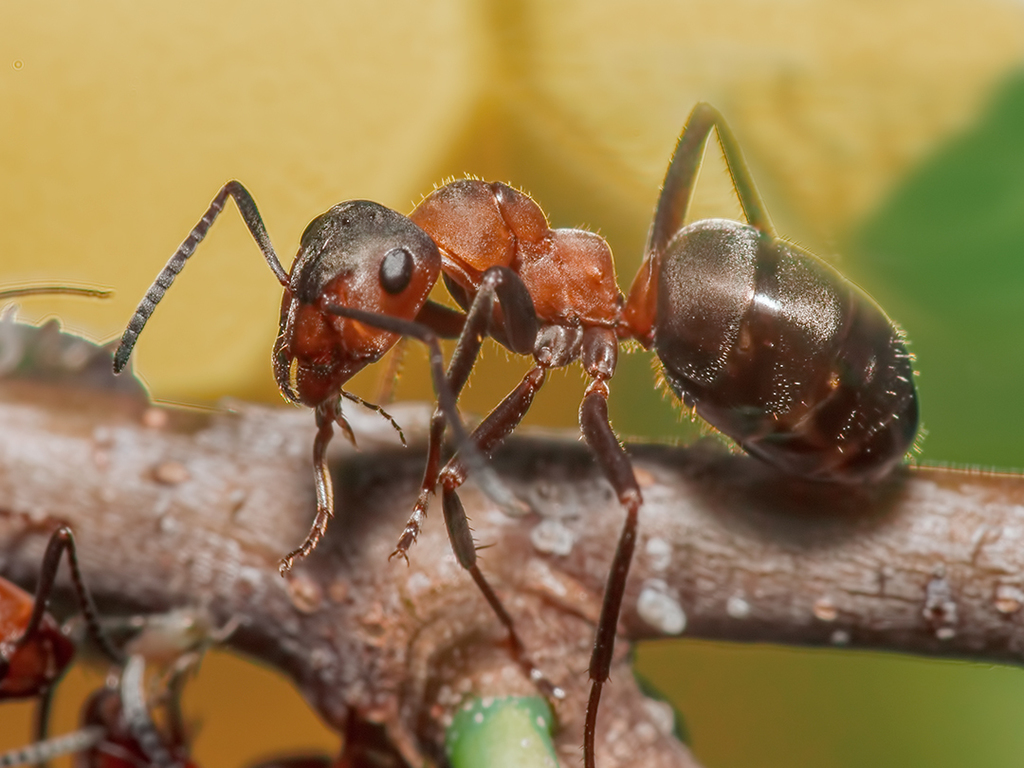
Southern Wood Ant
Formica rufa
Formica rufa, also known as the red wood ant, southern wood ant, or horse ant, is a boreal member of the Formica rufa group of ants, and is the type species for that group, being described by Linnaeus. It is native to Eurasia, with a recorded distribution stretching from the middle of Scandinavia to northern Iberia and Anatolia, and from Great Britain to Lake Baikal, with unconfirmed reports of it in the Russian Far East. There are claims that it can be found in North America, but this is not confirmed in specialised literature: no recent publication where North American wood ants are listed mentions it as present and records from North America are listed as dubious or unconfirmed in a record compilation. The workers' heads and thoraces are colored red and the abdomen brownish-black, usually with dark patches on the head and promesonotum, although some individuals may be more uniformly reddish and even have some red on the part of the gaster facing the body. In order to separate them from closely related species, specimens needs to be inspected under magnification, where difference in hairiness is among the telling characteristics, with Formica rufa being hairier than, for example, Formica polyctena but less hairy than Formica lugubris. Workers are polymorphic, measuring 4.5–9 mm in length. They have large mandibles and, like many other ant species, are able to spray formic acid from their abdomens as a defence. Formic acid was first extracted in 1671 by the English naturalist John Ray, by distilling a large number of crushed ants of this species.
From the article Formica rufa on Wikipedia (CC BY-SA), quoted section by section
Description
Nests of these ants are large, conspicuous, dome-shaped mounds of grass, twigs, or conifer needles, often built against a rotting stump and usually situated in woodland clearings where the sun's rays can reach them. Large colonies may have 100,000 to 400,000 workers and 100 queens. F. rufa is highly polygynous and often readopts postnuptial queens from its own mother colony, leading to old, multichamber nests that may contain well over 100 egg-producing females. These colonies can be several metres in height and diameter. F. rufa is aggressively territorial, and often attacks and removes other ant species from the area. Nuptial flights take place during the springtime and are often marked by savage battles between neighbouring colonies as territorial boundaries are re-established. New nests are established by budding from existing nests in the spring, or by temporary social parasitism, the hosts being species of the F. fusca group, notably F. fusca and F. lemani, although incipient F. rufa colonies have also been recorded from nests of F. glebaria and F. cunicularia. An F. rufa queen ousts the nest's existing queen and lays eggs of her own, and the existing workers care for her offspring until those offspring take over the nest.
What it does
These ants' primary diet is aphid honeydew, but they also prey on invertebrates such as insects and arachnids; they are voracious scavengers. Foraging trails may extend 100 m (330 ft). Larger workers have been observed to forage farther away from the nest. F. rufa is commonly used in forestry and is introduced into an area as a form of pest management.
Wikipedia: “Diet”
Listen
Looking for field recordings…
Where it lives
Recorded sightings
—
geo-referenced records in GBIF, from museums, herbaria and field observers.
Drag the globe to turn it. Dots are where records exist, not a range map; darker means more records.
In the stacks
Searching the stacks…
Every page naming Formica rufa in the Biodiversity Heritage Library →
This page is assembled live from iNaturalist, GBIF, Wikipedia, the Source Library and the Internet Archive. It is not yet part of the hand-edited codex. iNaturalist taxon 53853.