- Animals
- ›Arthropods
- ›Chelicerates
- ›Arachnids
- ›Spiders
- ›Typical Spiders
- ›Entelegyne Spiders
- ›Orbweavers and Allies
- ›Orbweavers
- ›Typical Orbweavers
- ›Larinioides
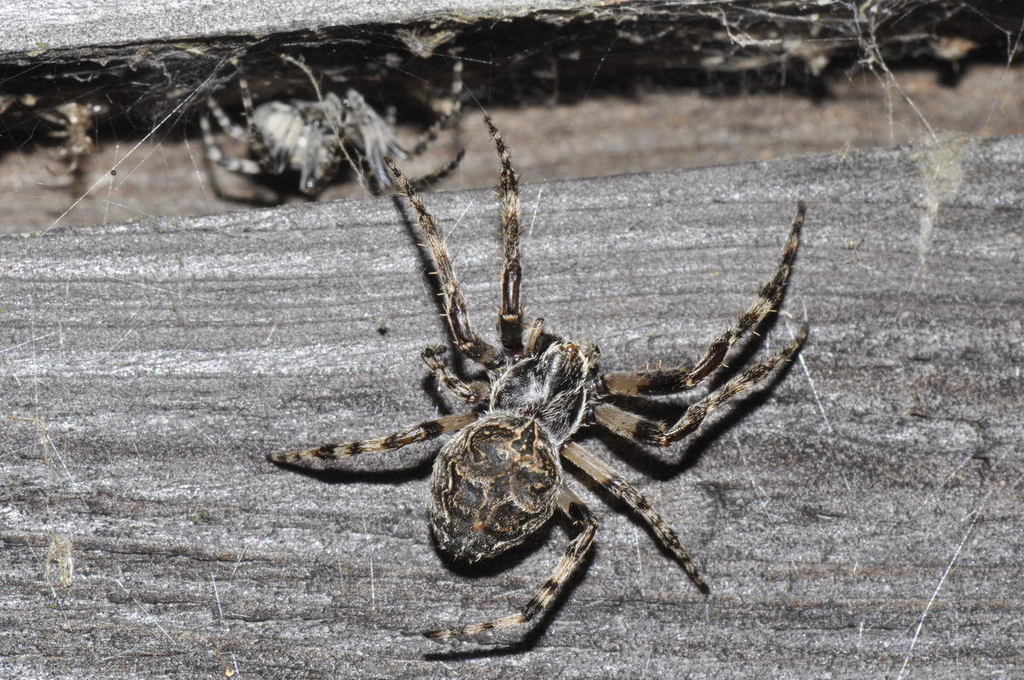
Grey Cross Spider
Larinioides sclopetarius
Larinioides sclopetarius, commonly called bridge-spider or gray cross-spider, is a relatively large orb-weaver spider with Holarctic distribution. These spiders originated in Europe, have been observed as south as the Mediterranean Coast and as north as Finland, and have been introduced to North America. They are often found on bridges, especially near light and over water. The species tends to live on steel objects and is seldom seen on vegetation. Females reach a body length of 10–14 mm, and males 8–9 mm. Their orb webs can have diameters of up to 70 cm.
L. sclopetarius is attracted to light. Spiders found near light sources may be in better condition and have greater reproductive success than spiders living in unlit areas. Most of these lighted areas are found in cities or other metropolitan areas. As a result, many urban areas have become saturated with these spiders. As many as 100 of these spiders can be found in a square meter in optimal feeding locations.
From the article Larinioides sclopetarius on Wikipedia (CC BY-SA), quoted section by section
Description
L. sclopetarius exhibit a slight sexual dimorphism, where females are heavier than males. Females typically weigh around 60 mg, whereas males weigh around 38 mg. However, males may be slightly larger than females. Females can range from 4.5- 6.25 mm in length. Males vary from 4.25 mm -7 mm in length. L. sclopetarius differs from its close relatives, L. patagiatus and L. cornutus, with a few defining characteristics. Unlike the latter two species, L. sclopetarius has white hairs that provide a silhouette for their heads and dark markings on its abdomen.
Range & habitat
In North America L. sclopetarius is most common in the Great Lakes states, but can be found throughout the country. It is mostly found near buildings. L. sclopetarius is also found in Central Europe, often near water. They are also most commonly found near artificial sources of light near water bodies such as bridges and boats. They often aggregate in high densities near light sources. The lights tend to attract more insects which increases the spider's prey capture. Their light-seeking behaviors may have some genetic basis. In these feeding-locations, adult females tend to occupy the best foraging areas. Juveniles and immature spiders are relegated to worse feeding areas when competition is high. These behaviors may be observed because juveniles are unable to compete for better territories. However, when these spiders mature, they often search for more illuminated areas to create their webs and lay their eggs.
Wikipedia: “Habitat and distribution”
What it does
These spiders are primarily nocturnal foragers. Their prey capture fluctuates with the seasons. Their prey capture is highest in the summer months, declining in the spring and fall. Chironomids consist of a significant portion of their diet. These small flies may comprise up to 94% of the spiders' diets. Their prey's average size ranges from 1.2 to 6.8 mm.
Wikipedia: “Diet”
Where it lives
Recorded sightings
—
geo-referenced records in GBIF, from museums, herbaria and field observers.
Drag the globe to turn it. Dots are where records exist, not a range map; darker means more records.
In the stacks
Searching the stacks…
Every page naming Larinioides sclopetarius in the Biodiversity Heritage Library →
This page is assembled live from iNaturalist, GBIF, Wikipedia, the Source Library and the Internet Archive. It is not yet part of the hand-edited codex. iNaturalist taxon 538959.