- Animals
- ›Arthropods
- ›Hexapods
- ›Insects
- ›Winged and Once-winged Insects
- ›Stick Insects
- ›Verophasmatodea
- ›Areolatae
- ›Bacilloidea
- ›Heteropterygidae
- ›Heteropteryginae
- ›Heteropterygini
- ›Haaniella
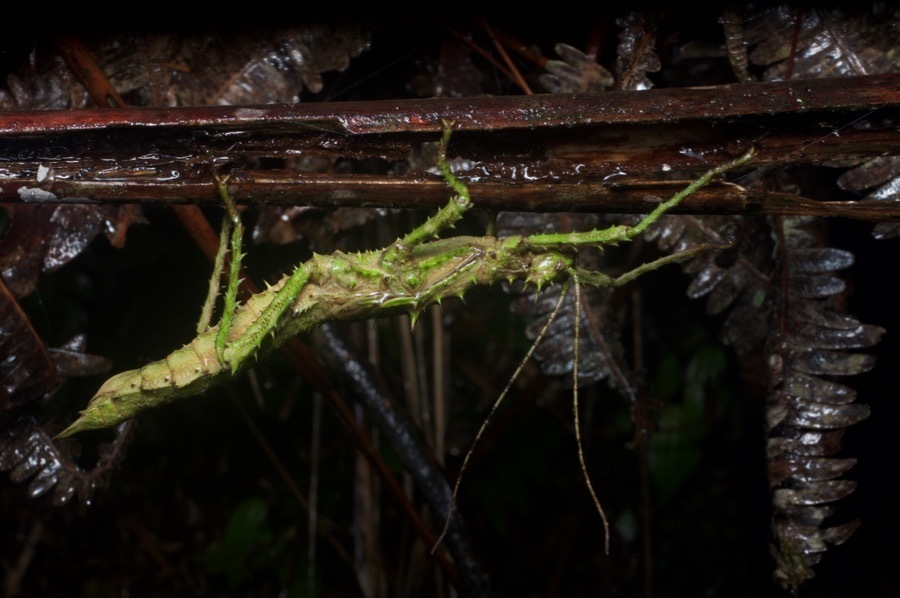
Haaniella erringtoniae
Haaniella erringtoniae is a stick insect species. It is a typical representative of the subfamily Heteropteryginae. The occasionally used common name Errington's Haaniella refers to the species name.
From the article Haaniella erringtoniae on Wikipedia (CC BY-SA), quoted section by section
Description
Both sexes are armed with many spines on the body and legs. Fore and hind wings are greatly shortened. The sexual dimorphism typical of stick insects is also very pronounced in this species. The slimmer, little patterned to monochrome males are gray-brown to greenish in color and are about 65 to 80 millimetres (2.6 to 3.1 in) long. The bright green front edges of the thickened, only 10 millimetres (0.39 in) long front wings, which are here developed as tegmina, are striking. The bigger females reach a length of 85 to 110 millimetres (3.3 to 4.3 in). They are reddish-brown and beige, or occasionally a light pink piebald. Typical are the light-colored bandages on the femurs and two rows of white dots on the ventral abdomen. The for Heteropterygini species typical secondary ovipositor is beak-shaped.
Range & habitat
The species is native to Malesia more precisely on the Malay Peninsula. The animals found in the west of the island Sumatra are Haaniella muelleri. During the day the insects hide in the leafy layer of the forest floor, where they are very well camouflaged due to their color and body shape. Do not climb until dusk they hit trees and bushes to eat the leaves. In the event of danger, both sexes are able to produce rustling noises with their wings (stridulation). In addition, the animals then threaten the attacker with the abdomen raised and the hind legs splayed upwards. When approaching further, the tibae of the hind legs are quickly struck against the femurs, making the spines on them very effective weapons of defense.
Wikipedia: “Distribution and way of life”
What it does
The females lay their eggs a few centimeters deep in the ground with the laying stinger. With a length of about 6.5 millimetres (0.26 in) and a width of 5.5 millimetres (0.22 in), these are not even particularly large compared to the eggs of other representatives of this genus. In contrast to most of other Haaniella species, they are not rough and bristled, but smooth and hairless, like the lemon-shaped eggs of Haaniella saussurei. The cruciform micropylar plate with the clearly visible micropyle in the lower corner of the cross is striking. The life cycle of Haaniella erringtoniae is shorter in each phase than that of most of other Haaniella species, like those known from Borneo. After only six months, the first nymphs hatch from the eggs, which are often already adult after a further six months.
Wikipedia: “Reproduction”
Listen
Looking for field recordings…
Where it lives
Recorded sightings
—
geo-referenced records in GBIF, from museums, herbaria and field observers.
Drag the globe to turn it. Dots are where records exist, not a range map; darker means more records.
In the stacks
Searching the stacks…
Every page naming Haaniella erringtoniae in the Biodiversity Heritage Library →
This page is assembled live from iNaturalist, GBIF, Wikipedia, the Source Library and the Internet Archive. It is not yet part of the hand-edited codex. iNaturalist taxon 541036.