- Animals
- ›Arthropods
- ›Hexapods
- ›Insects
- ›Winged and Once-winged Insects
- ›Butterflies and Moths
- ›Ghost Moths and Swift Moths
- ›Swift Moths
- ›Phymatopus
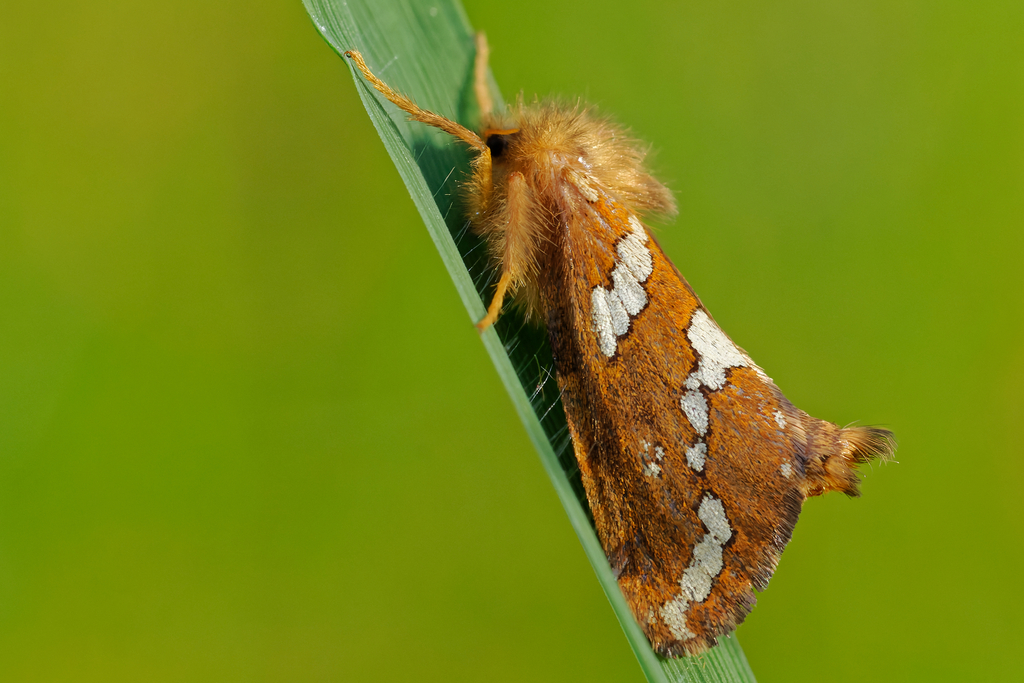
Gold Swift
Phymatopus hecta
The gold swift (Phymatopus hecta) is a moth belonging to the family Hepialidae. Until recently it was placed in the genus Hepialus. The species was first described by Carl Linnaeus in his 1758 10th edition of Systema Naturae. Moths of the Hepialidae are considered to be primitive moths; they do not have a proboscis and are unable to feed. The gold swift is a widespread species found in Europe and Asia, including Japan.
From the article Gold swift on Wikipedia (CC BY-SA), quoted section by section
In human culture
This is a rather small moth for the family, with a wingspan of 26–32 mm. The male is distinctive, the brown forewings marked with two parallel bands of white markings. The larger female is less striking with muted grey-and-brown markings. The adult is on the wing in June and July (this refers to the British Isles; other parts of the range may differ) and both sexes are moderately attracted to light. To attract females, the male emits a scent rather similar to pineapple.
The adult moths spend most of the 24 hours resting, in a wide variety of places from the tree canopy to the base of the ground vegetation. They are active only for two brief periods: for an hour or two around sunset, when they mate and previously mated females lay eggs; and then very briefly for about 15 minutes at sunrise, when mating pairs separate, and males that have remained overnight in exposed positions move to less visible places. Very occasionally, and usually in mountainous areas, there is a period of activity in the mid-afternoon.
Courtship and mating. The mating system is spectacular, but rarely observed because it takes place in the late evening, on either side of sunset. …
Wikipedia: “Life history”
Listen
Looking for field recordings…
Where it lives
Recorded sightings
—
geo-referenced records in GBIF, from museums, herbaria and field observers.
Drag the globe to turn it. Dots are where records exist, not a range map; darker means more records.
In the stacks
Searching the stacks…
Every page naming Phymatopus hecta in the Biodiversity Heritage Library →
This page is assembled live from iNaturalist, GBIF, Wikipedia, the Source Library and the Internet Archive. It is not yet part of the hand-edited codex. iNaturalist taxon 541634.