- Animals
- ›Arthropods
- ›Chelicerates
- ›Arachnids
- ›Spiders
- ›Typical Spiders
- ›Entelegyne Spiders
- ›Orbweavers and Allies
- ›Orbweavers
- ›Typical Orbweavers
- ›Cyclosa
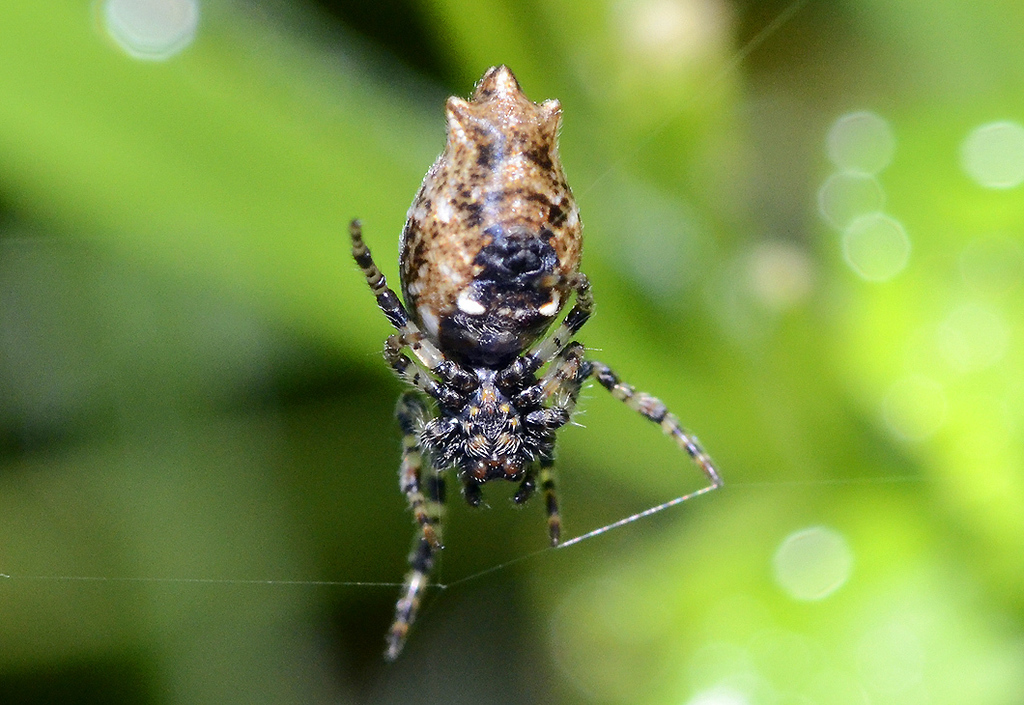
Oculate Garbage-line Web Spider
Cyclosa oculata
Cyclosa oculata is a species of orb-weaver spider in the genus Cyclosa. Originally described from Europe, it has a wide distribution across the Palearctic region and has been introduced to South Africa and Hawaii.
From the article Cyclosa oculata on Wikipedia (CC BY-SA), quoted section by section
Description
Adult males have a cephalothorax length of 2 mm and abdomen length of 2-2.25 mm.Adult females have a cephalothorax length of 2-2.25 mm and abdomen length of 3.5 mm. The dark brown to black sternum shows three lighter, reddish-brown round spots on each side and a similar spot at the rear tip that appears to be formed from two fused spots. The legs show distinct darker and lighter banding.
Range & habitat
C. oculata is widely distributed across Europe, extending eastward through Russia to the Far East, and south through the Caucasus, Kazakhstan, and Central Asia to China. It has been introduced to South Africa and Hawaii. In Europe, the species has been recorded from Belgium, France (including Corsica), Spain, Austria, Hungary, the Balkans, Romania, and southern Russia. It was also found in the Antilles and Venezuela. Simon suggested that the species is likely of tropical origin and was introduced to the European fauna long ago.
Wikipedia: “Distribution”
What it does
Cyclosa oculata prefers sunny wasteland areas that are little or not at all affected by cultivation, meaning areas that are neither mowed nor grazed. It is particularly found on sparse sandy soils with late-growing plants, and sometimes occurs in large numbers on such sites. However, it is absent from scrubland areas when these lie completely fallow. Warm locations are preferred. In mountainous areas, the species does not appear to ascend above 600 meters elevation. The web is built 20–25 cm above ground level on free-standing heath plants or broom and similar vegetation. It is a typical Cyclosa web, but differs from the closely related Cyclosa conica in having fewer radial threads, making the mesh size slightly larger. The sticky catching area has a more radial extension compared to other species. In harmony with the reduced number of radial threads, fewer attachment points are present. In older animals, the web shows a greater number of catching threads. The web often shows that the upper frame threads have been frequently strengthened through repeated use. The sticky threads in adult female webs are spaced 3–4 mm apart, becoming closer toward the outer and inner edges. The catching area measures 90–100 mm. …
Wikipedia: “Habitat and ecology”
Where it lives
Recorded sightings
—
geo-referenced records in GBIF, from museums, herbaria and field observers.
Drag the globe to turn it. Dots are where records exist, not a range map; darker means more records.
In the stacks
Searching the stacks…
Every page naming Cyclosa oculata in the Biodiversity Heritage Library →
This page is assembled live from iNaturalist, GBIF, Wikipedia, the Source Library and the Internet Archive. It is not yet part of the hand-edited codex. iNaturalist taxon 543264.