- Animals
- ›Arthropods
- ›Hexapods
- ›Insects
- ›Winged and Once-winged Insects
- ›Butterflies and Moths
- ›Butterflies
- ›Brush-footed Butterflies
- ›Checkerspots, Anglewings, Peacocks, and Allies
- ›Ladies, Anglewings, and Allies
- ›Aglais
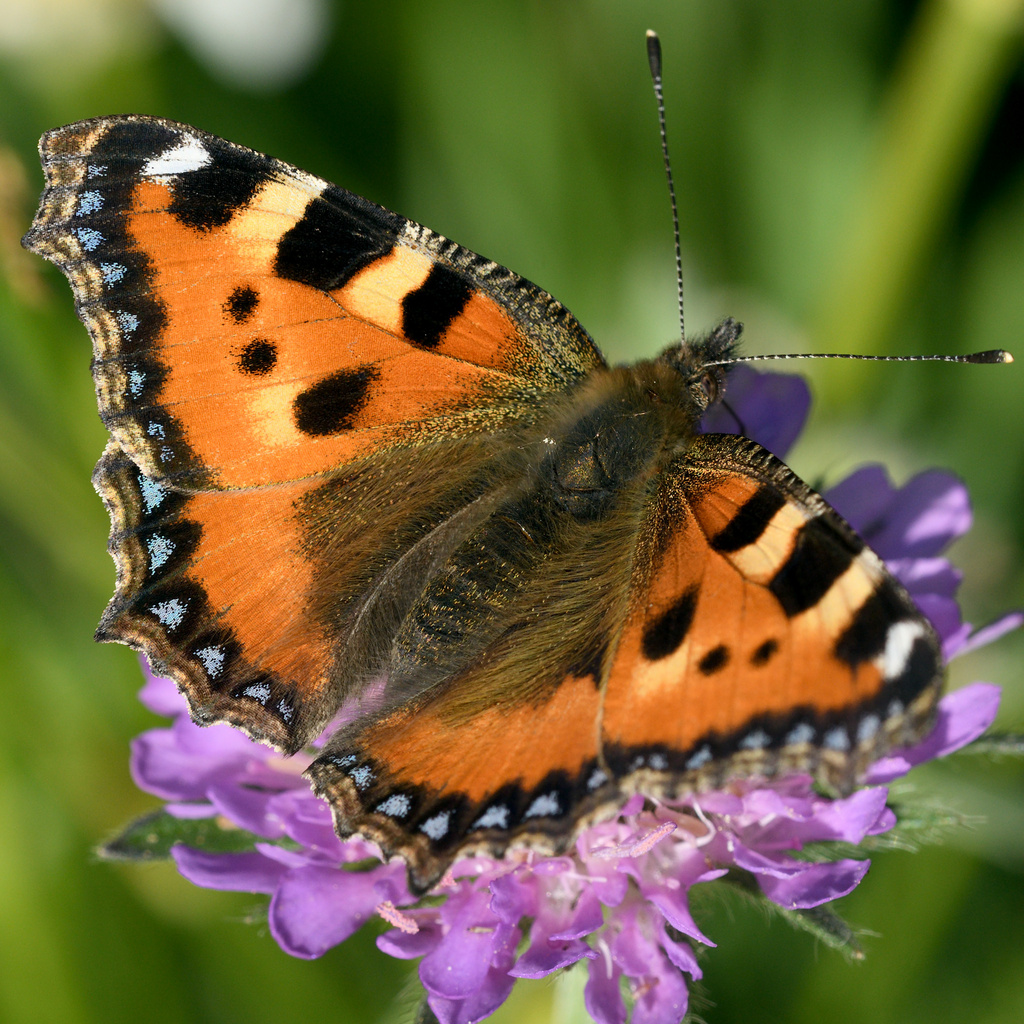
Small Tortoiseshell
Aglais urticae
The small tortoiseshell (Aglais urticae) is a colourful Eurasian butterfly in the family Nymphalidae. Adults feed on nectar and may hibernate over winter; in warmer climates they may have two broods in a season. While the dorsal surface of the wings is vividly marked, the ventral surface is drab, providing camouflage. Eggs are laid on the common nettle, on which the larvae feed.
From the article Small tortoiseshell on Wikipedia (CC BY-SA), quoted section by section
Description
It is a medium-sized butterfly that is mainly reddish orange, with black and yellow markings on the forewings as well as a ring of blue spots around the edge of the wings. It has a wingspan ranging from 4.5 to 6.2 cm.
Range & habitat
It is found throughout temperate Europe, Asia Minor, Central Asia, Siberia, China, Nepal, Sikkim Himalayas in India, Mongolia, Korea and Japan, wherever common nettle, which their larvae feed on, is found. There are a few records from New York City which, however, are believed to be of introduced insects.
Wikipedia: “Range”
What it does
As with several nymphalid butterflies, the caterpillars feed on stinging nettles (Urtica dioica) and small nettle (Urtica urens). Humulus lupulus has also been recorded as larval food plant. Adults feed on nectar. The species has one of the longest seasons of any Eurasian butterfly, extending from early spring to late autumn. Adults overwinter in hibernation, emerging on the first warm sunny days of the year to mate and breed. In southern parts of the range there may be two broods each year, but northern insects are inhibited by long length of summer days from breeding a second time.
Hatching. Tortoiseshell butterflies usually begin to emerge from their pupa from mid-June into August. They begin hibernation sometime in October and immediately show territorial behaviour after hibernation. The tortoiseshell butterflies that are found in the north usually have one brood a season, whereas further south these butterflies can have two broods. The ability to go through three generations of butterflies in a year is due to the tortoiseshell butterflies' decreased thermal requirement. The larvae of this butterfly are social. These larvae can be found on Urtica dioica, which have a high nitrogen content and much water in the leaves.
Hibernation. The small tortoiseshell butterfly tends to enter hibernation by mid to late September. …
Wikipedia: “Life cycle”
Listen
Looking for field recordings…
Where it lives
Recorded sightings
—
geo-referenced records in GBIF, from museums, herbaria and field observers.
Drag the globe to turn it. Dots are where records exist, not a range map; darker means more records.
In the old herbals & bestiaries

In the stacks
Searching the stacks…
Every page naming Aglais urticae in the Biodiversity Heritage Library →
This page is assembled live from iNaturalist, GBIF, Wikipedia, the Source Library and the Internet Archive. It is not yet part of the hand-edited codex. iNaturalist taxon 54468.