- Animals
- ›Molluscs
- ›Cephalopods
- ›Octopuses, Squids, and Cuttlefishes
- ›Octopuses and Vampire Squids
- ›Octopuses
- ›Incirrate Octopuses
- ›Typical Octopuses, Giant Octopuses, and Allies
- ›Typical Octopuses
- ›Octopus
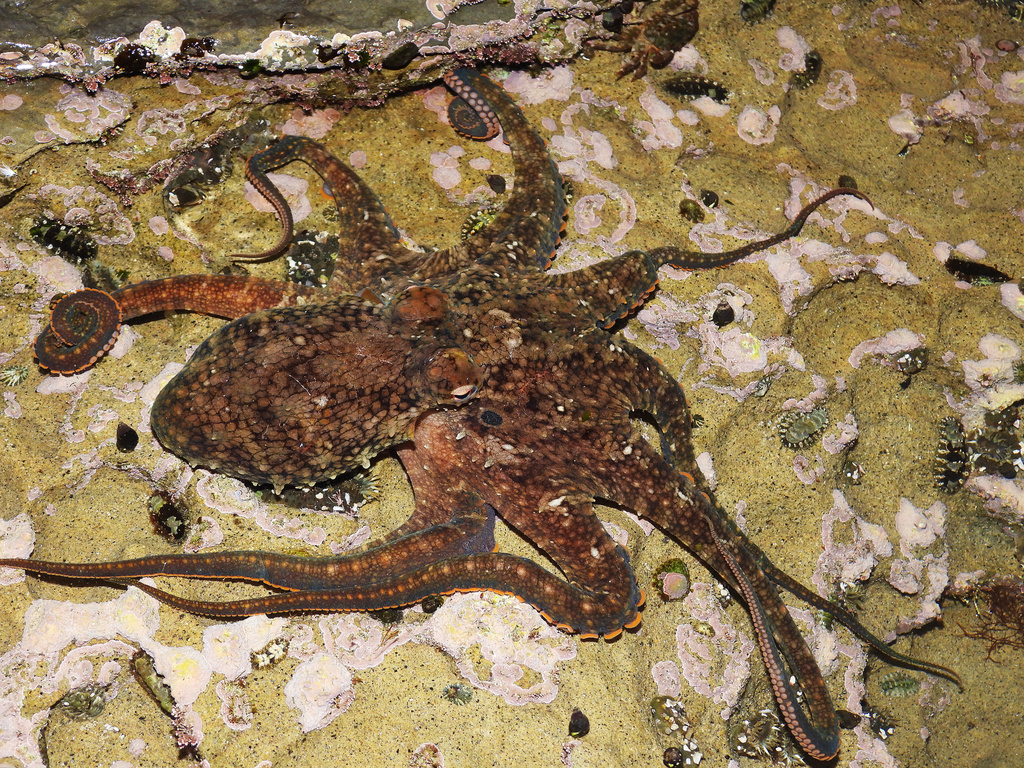
Lesser Two-spot Octopus
Octopus bimaculoides
The California two-spot octopus (Octopus bimaculoides), often simply called a "bimac", is an octopus species native to many parts of the Pacific Ocean including the coast of California. One can identify the species by the circular blue eyespots on each side of its head. Bimacs usually live to be about two years old. They are closely related to Verrill's two-spot octopus (Octopus bimaculatus). In 2015, O. bimaculoides became the first octopus to have a fully sequenced genome.
From the article California two-spot octopus on Wikipedia (CC BY-SA), quoted section by section
Description
Octopus bimaculoides reaches a mantle size of 17.5 cm (6.9 in) with arms to 58 cm (23 in). Not usually heavily textured, it has several common colors, such as grey with yellow splotches, and uses highly developed crypsis, which is camouflage or color-changing to match the environment. Octopuses achieve color change in part by chromatophores, iridophores, and leucophores. All are structures of the skin in increasing depth. Chromatophores are elastic pigment sacs with muscle fibers attached by which they can expand and contract. The leucophores are important because they allow for the reflection of white light, and allow the skin to reflect wavelengths of light which are prevalent in their habitat, and produce disruptive patterns. The other aspect to cephalopod camouflage is the brain, which contains nerves coated in chromatophore fibers, controlling coloration patterning. This octopus is named for the false eye spot (ocellus) under each real eye. These ocelli are an iridescent blue, chain-link circle, set in a circle of black. On its arms, the octopus possesses many "suckers" that it uses to taste. They have three hearts, two gills, blue blood, and a donut-shaped brain.
Range & habitat
O. bimaculoides are found in coastal waters, in the eastern Pacific along mid- and southern-California and the western side of the Baja California Peninsula in Mexico. They live at depths from the intertidal, down to at least 20 m (66 ft). It prefers rocky reefs or debris for hiding, and tolerates a wide temperature range 15–26 °C (59–79 °F), though prefers 18–22 °C (64–72 °F).
Wikipedia: “Distribution and habitat”
What it does
Since these octopuses do not live for long, they mature rapidly and can hunt for food to feed themselves right after hatching. Hatchlings feed on amphipods or mysid shrimp. As they grow, the list of what they eat grows with them. California two-spot octopuses eat anything they can find, like fish and crustaceans. They are nocturnal, and hunt at night. Their camouflage abilities give them an advantage while hunting.
Wikipedia: “Diet”
Where it lives
Recorded sightings
—
geo-referenced records in GBIF, from museums, herbaria and field observers.
Drag the globe to turn it. Dots are where records exist, not a range map; darker means more records.
In the stacks
Searching the stacks…
Every page naming Octopus bimaculoides in the Biodiversity Heritage Library →
This page is assembled live from iNaturalist, GBIF, Wikipedia, the Source Library and the Internet Archive. It is not yet part of the hand-edited codex. iNaturalist taxon 54509.