- Animals
- ›Arthropods
- ›Hexapods
- ›Insects
- ›Winged and Once-winged Insects
- ›Butterflies and Moths
- ›Owlet Moths and Allies
- ›Cutworm Moths and Allies
- ›Cutworms and Dart Moths
- ›Poliini
- ›Polia
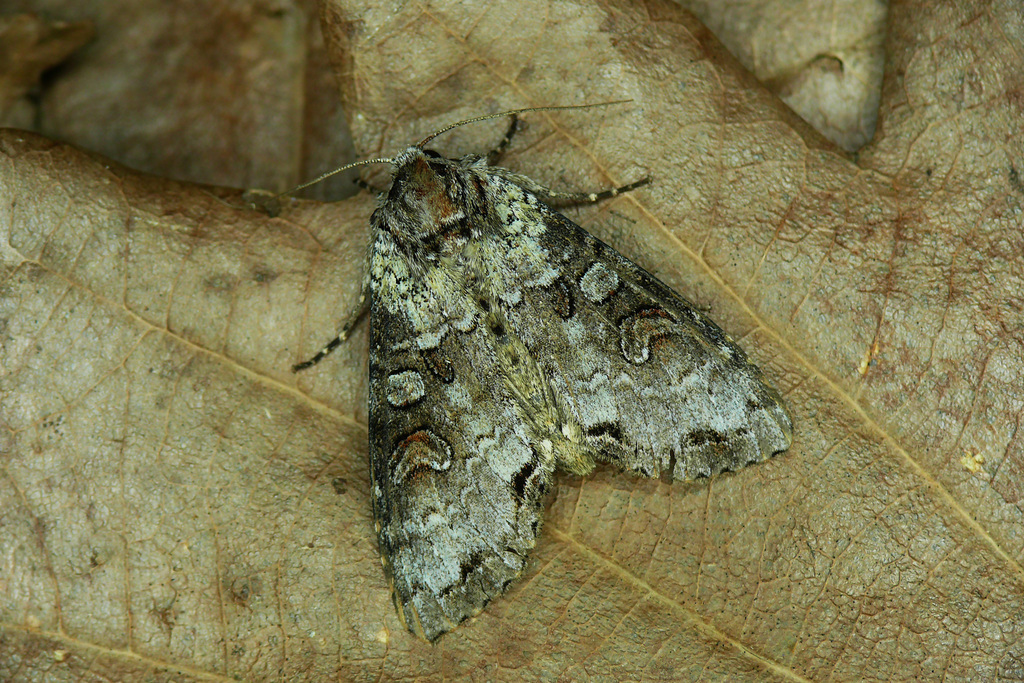
Silvery Arches
Polia hepatica
Polia hepatica, the silvery arches, is a moth of the family Noctuidae. The species was first described by Carl Alexander Clerck in 1759. It is found in temperate Europe and east across the Palearctic to Siberia and Korea. It is not present in northernmost Fennoscandia and the southern parts of the Iberian Peninsula, Italy and Greece. It is also absent from Japan.
The wingspan is 39–47 mm. Forewing paler than in advena, more bluish grey, sometimes blue green, without dark suffusion except in median area; stigmata as in advena, the orbicular pale and conspicuous; submarginal line preceded by black brown scales on both folds not forming wedge-shaped marks, and not indented on the submedian fold; hindwing fuscous with dark discal lunule and pale postmedian line. — the form obscurata Stgr. from Amurland is smaller and darker; hepatica Hbn. represents the form with blue green coloration and brown suffusion; in suffusa Tutt the median area is more concisely brown than the rest of the wing. — Larva reddish brown, with fine dark and light mottling; dorsal line slender, white, edged with black; lateral line broader; head pale brown.
Listen
Looking for field recordings…
Where it lives
Recorded sightings
—
geo-referenced records in GBIF, from museums, herbaria and field observers.
Drag the globe to turn it. Dots are where records exist, not a range map; darker means more records.
In the stacks
Searching the stacks…
Every page naming Polia hepatica in the Biodiversity Heritage Library →
This page is assembled live from iNaturalist, GBIF, Wikipedia, the Source Library and the Internet Archive. It is not yet part of the hand-edited codex. iNaturalist taxon 547257.