- Plants
- ›Vascular Plants
- ›flowering plants
- ›monocots
- ›Agaves, Orchids, Irises, and Allies
- ›Orchids
- ›Lower Epidendroid Orchids
- ›Epidendreae
- ›Cattleya Alliance Orchids
- ›Epidendrum
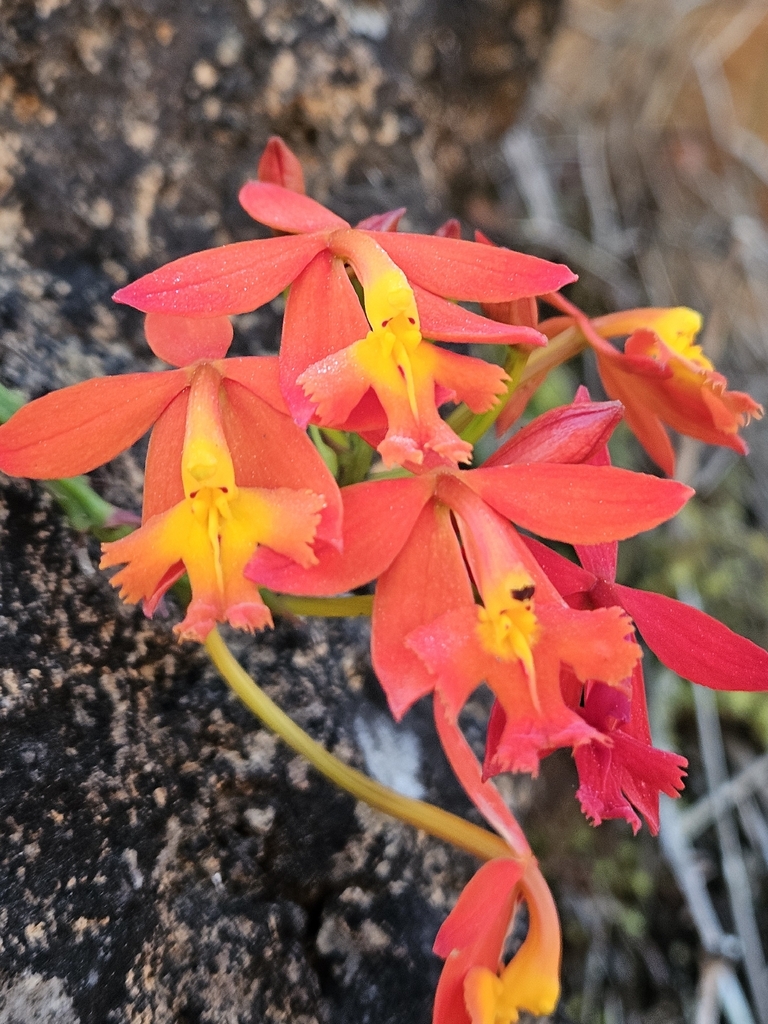
Fire-star orchid
Epidendrum radicans
Epidendrum radicans is a species of orchid. Common names include ground-rooting epidendrum, fire-star orchid, rainbow orchid, and reed-stem epidendrum. It is a common roadside weed at middle elevations in Central America. It is a crucifix orchid, often confused with many other members of the section Schistochila, including E. calanthe, E. cinnabarinum, E. denticulatum, E. erectum, E. fulgens, E. ibaguense, E. imatophyllum, E. incisum, E. schomburgkii, E. secundum, and E. xanthinum, among others. The diagnostic characteristic of E. radicans is its tendency to sprout roots all along the...
From the article Epidendrum radicans on Wikipedia (CC BY-SA), quoted section by section
Description
It is a herbaceous plant with a terrestrial habit (it grows on the ground, not on trees), generally on rocks, being very variable, with long and fleshy aerial roots that come out of the stems. It reaches a size of up to 1.5 m long. It has a cylindrical, reed-like, straight stem, 19 to 125 cm long and 3.5 to 8 mm in diameter, the main ones lying on the surface, somewhat branched, the branches more or less erect, climbing or also lying down. The leaves are alternate, the blades ovate-elliptic, shortly mucronate at the apex (tip of leaf), 2 to 9 cm long and 1.2 to 2.5 cm long, thick, with a leathery consistency, with the base embracing the stem, sometimes somewhat purple. Like other members of subgenus Amphiglottium, it is a sympodial orchid which grows stems which do not swell into pseudobulbs and are covered with imbricating sheaths, produces a terminal inflorescence covered at its base by close imbricating sheaths, and produces a lip adnate to the column to its apex. The lip of E. radicans is trilobate, as with the other members of section Schistochila, with the lacerate lobes which are typical of the subsections Carinata and Tuberculata. E. radicans differs from the other lacerate Schistochila by producing roots from most of the stem.
Inflorescences. …
What it does
It is distributed throughout Mexico, Costa Rica, El Salvador, Guatemala, Honduras, Nicaragua, Panama, Venezuela and Colombia where it is common on rocks in full sun, in the cloud forest of the mountains at altitudes of 900-2500 metres above sea level, oak forest, semi-evergreen forest, riparian vegetation and evergreen scrub. E. radicans is part of a complex of several orange-flowered, weedy species (including Asclepias spp.) that are unrelated but ecologically similar. Species within this group share pollinators as well as habitat, and are believed to exhibit what is known as convergent evolution, where unrelated species "converge" upon similar physical characteristics as a result of similar evolutionary pressures. Paulette Bierzychudek studied pollinator behavior in the apparent complex consisting of E. radicans, Asclepias curassavica, and Lantana camara, but could not find clear evidence that floral mimicry was affecting pollination rates for any of the three species.
Wikipedia: “Ecology”
How it is grown
The plant is easily propagated from tip cuttings and pups (keikis) produced on the stems. It thrives in temperatures between 10° and 27°C (50° and 80°F) and in USDA hardiness zone 10–12, under full sun or partial shade in loamy, sandy, well-drained soil. In summers, two hours of direct sunlight may scorch and dehydrate the plant, though the soil must not remain soggy or hold water. It can tolerate low nutrient areas and it does not require extensive maintenance. It can be potted in garden beds and should be potted in large containers (infrequent repotting will restrict its growth and potential blooms). Support may be necessary for a compact, upright growth, though the stems still grow and bloom even if they droop or ramble. A slow-release fertilizer may be necessary for vitality, in addition to mulch (to reduce competition from weeds and to maintain moisture). Pests include mealybugs, spider mites, scale, thrips, whitefly and root mealybugs. Diseases in cultivation include root rot, leaf spot disease, rust, mosaic virus, black rot, botrytis petal blight, powdery mildew and southern blight. Though generally, the plant is rarely bothered by pests or diseases, as it can adapt to a wide range of conditions compared to other orchid species.
Wikipedia: “Cultivation”
Where it lives
Recorded sightings
—
geo-referenced records in GBIF, from museums, herbaria and field observers.
Drag the globe to turn it. Dots are where records exist, not a range map; darker means more records.
In the stacks
Searching the stacks…
Every page naming Epidendrum radicans in the Biodiversity Heritage Library →
This page is assembled live from iNaturalist, GBIF, Wikipedia, the Source Library and the Internet Archive. It is not yet part of the hand-edited codex. iNaturalist taxon 54890.