- Animals
- ›Arthropods
- ›Hexapods
- ›Insects
- ›Winged and Once-winged Insects
- ›Butterflies and Moths
- ›Owlet Moths and Allies
- ›Cutworm Moths and Allies
- ›Cutworms and Dart Moths
- ›Physetica
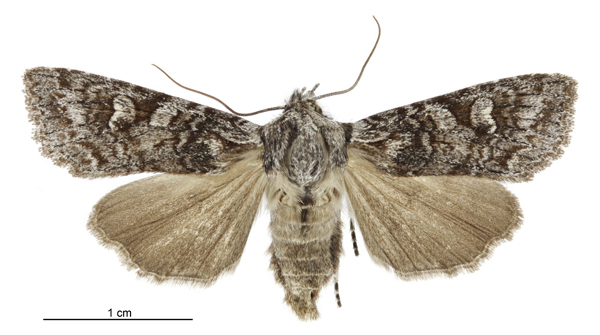
Physetica longstaffi
Physetica longstaffi is a species of moth of the family Noctuidae. It is endemic to New Zealand and found in the North and South Islands. This species lives in open habitats and shrublands, at altitudes ranging from the low alpine zone down to sea-level. As at 2017 the biology of this species is in need of further investigation as there is no published description of the larvae of this species nor have larval specimens been preserved in collections. There is also confusion over the possible larval host plants for this species. This species is on the wing from February to May. There is also a record from the North Cape in December. The adults of this species is attracted to light. P. longstaffi might possibly be confused with P. sequens or P. phricias. However unlike both P. sequens and P. phricias, P. longstaffi has a large oval mark near the centre of the forewing. Other distinguishing features include further differences in the colouration of the forewings of P. longstaffi as well as differences in the third labial palp segment of the male and differences in the shape of the male genitalia.
From the article Physetica longstaffi on Wikipedia (CC BY-SA), quoted section by section
Description
Howes originally described the species as follows:
Expanse. 28 to 30 lines. Antennae ferruginous-grey, filiform. Legs, palpi, head, and thorax grey irrorated with ferruginous. A dark mark across front of thoracic crest. Crests strong. Abdomen greyish-ochreous, lighter in colour towards anal tuft, which is light ochreous-grey. Forewings grey, markings ferruginous. Reniform and orbicular grey out-lined with ferruginous. Base of wing light grey, followed by a dark jagged transverse line. A double jagged transverse line at 1⁄4 across wing. A suffused patch around reniform, continuing as a well-defined jagged line with a faint line on each side to dorsum. A rather indistinct suffused line near termen. Cilia grey. Hindwings uniform dark-grey. Cilia silvery-grey with a dark-grey line at base.The male adult of this species has a wingspan of between 30 and 36 mm and the female has a wingspan of between 33 and 37 mm. P. longstaffi might possibly be confused with P. sequens or P. phricias. However unlike both P. sequens and P. phricias, P. longstaffi has a large oval mark near the centre of the forewing. There are other distinguishing features such as the differences in the colouration of the forewings of P. longstaffi as well as differences in the third labial palp segment of the male and differences in the shape of the male genitalia.
Range & habitat
This species is endemic to New Zealand and is found throughout the North and South Islands.
Wikipedia: “Distribution”
What it does
This species is on the wing from February to May. There is also a record from the North Cape in December. This species is attracted to light.
Wikipedia: “Behaviour”
Listen
Looking for field recordings…
Where it lives
Recorded sightings
—
geo-referenced records in GBIF, from museums, herbaria and field observers.
Drag the globe to turn it. Dots are where records exist, not a range map; darker means more records.
In the stacks
Searching the stacks…
Every page naming Physetica longstaffi in the Biodiversity Heritage Library →
This page is assembled live from iNaturalist, GBIF, Wikipedia, the Source Library and the Internet Archive. It is not yet part of the hand-edited codex. iNaturalist taxon 551069.