- Animals
- ›Arthropods
- ›Chelicerates
- ›Arachnids
- ›Spiders
- ›Mygalomorphs
- ›Avicularioidea
- ›Tarantulas
- ›Psalmopoeine Tarantulas
- ›Ephebopus
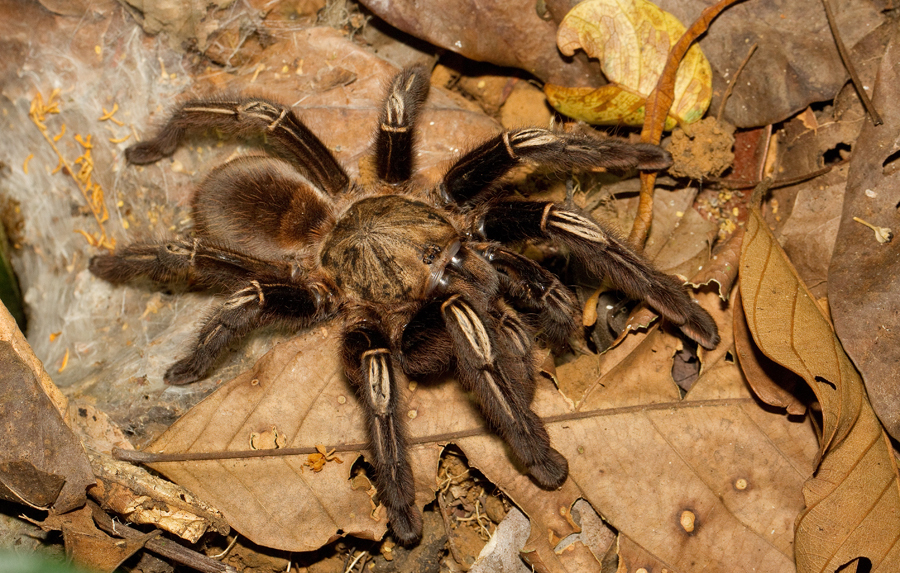
Yellow-kneed Skeleton Tarantula
Ephebopus murinus
The skeleton tarantula, Ephebopus murinus, is a species of spider belonging to the family Theraphosidae (tarantulas), sub-family Aviculariinae. A New World species, it is native to several South American countries. Its common name is derived from the skeleton-like markings on its legs.
From the article Skeleton tarantula on Wikipedia (CC BY-SA), quoted section by section
Description
The adult E. murinus usually grows to a leg span of about 11–12 cm (4.5 inches), though females can grow as large as 15 cm (6 inches). The legs are black, the abdomen is small and brown, and the carapace is coffee colored or golden. The leg striping is similar to that of Aphonopelma seemani, but more yellowish in colour.
Range & habitat
E. murinus is a terrestrial, semi-fossorial, lowland forest-dwelling species native to northern Brazil, French Guiana, and Suriname.
Wikipedia: “Habitat and distribution”
What it does
Unlike most members of the subfamily Aviculariinae, which are arboreal, E. murinus lives mainly on or near the forest floor, where it will build a heavily webbed burrow beneath the topsoil or amongst branches, rocks, and other forest floor debris. As a defense against potential predators, and in common with many other New World tarantulas, the species of the genus Ephebopus will brush urticating hairs from their bodies. Uniquely, rather than being located on the abdomen, Ephebopus urticating hairs are located on the spider's palps - on the medial side of the palpal femora; the spider sheds these hairs by rubbing the palp against the chelicerae. E. murinus is also a fast and aggressive species, and will readily rise up and present its fangs to a potential predator.
Wikipedia: “Behavior”
Where it lives
Recorded sightings
—
geo-referenced records in GBIF, from museums, herbaria and field observers.
Drag the globe to turn it. Dots are where records exist, not a range map; darker means more records.
In the stacks
Searching the stacks…
Every page naming Ephebopus murinus in the Biodiversity Heritage Library →
This page is assembled live from iNaturalist, GBIF, Wikipedia, the Source Library and the Internet Archive. It is not yet part of the hand-edited codex. iNaturalist taxon 552400.