- Plants
- ›Vascular Plants
- ›flowering plants
- ›Dicots
- ›nightshades, bindweeds, gooseweeds, and allies
- ›nightshade family
- ›nightshades and allies
- ›nightshades and jaltomatas
- ›Solanum
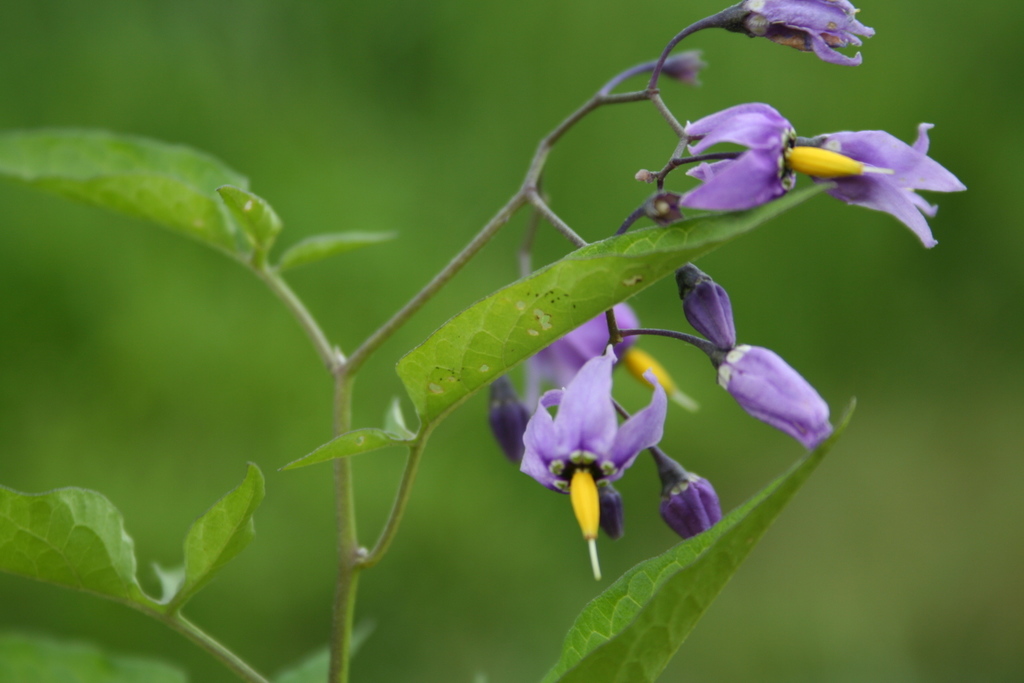
bittersweet nightshade
Solanum dulcamara
Solanum dulcamara is a species of vine in the genus Solanum (which also includes the potato and the tomato) of the family Solanaceae. Common names include bittersweet, bittersweet nightshade, bitter nightshade, blue bindweed, Amara Dulcis, climbing nightshade, felonwort, fellenwort, felonwood, poisonberry, poisonflower, scarlet berry, snakeberry, trailing bittersweet, trailing nightshade, violet bloom, and woody nightshade.
It is native to the Old World and widely naturalised elsewhere, including North America, with a preference for wetlands.
From the article Solanum dulcamara on Wikipedia (CC BY-SA), quoted section by section
Description
Solanum dulcamara is a semi-woody herbaceous perennial vine, which scrambles over other plants, capable of reaching a height of 4 metres (13 feet) where suitable support is available, but more often 1–2 m (3+1⁄2–6+1⁄2 ft) high. The leaves are 4–12 centimetres (1+1⁄2–4+1⁄2 inches) long, roughly arrowhead-shaped, and often lobed at the base. It has a long flowering season lasting from May through November. The flowers are in loose clusters of 3–20, 1–1.5 cm (3⁄8–5⁄8 in) across, star-shaped, with five purple petals and yellow stamens and style pointing forward. The fruit is an ovoid red berry about 1 cm long, soft and juicy, with the aspect and odour of a tiny tomato. The fruit persists for an average of 19.5 days, and bears an average of 17.9 seeds per fruit. The fruits average 84.1% water.
Range & habitat
It is native to Europe, eastern Asia, and northern Africa, but has spread throughout the world. It is a nonnative species in the United States. It grows in all types of terrain with a preference for wetlands and the understory of riparian forests. It can occur in woodlands, scrubland, hedges and marshes.
Wikipedia: “Distribution and habitat”
What it does
The plant is relatively important in the diet of some species of birds such as European thrushes, which feed on its fruits, being immune to its poisons, and scatter the seeds abroad. Along with other climbers, it creates a dark and impenetrable shelter for various animals.
Wikipedia: “Ecology”
At the table
Solanum dulcamara has a variety of documented medicinal uses, all of which are advised to be approached with proper caution as the entirety of the plant is considered to be poisonous. Always seek advice from a professional before using a plant medicinally. There have only been records of medicinal use for adults (not children) and it is possible to be allergic to S. dulcamara; medicinal use is not advised in these cases. The alkaloids, solanine (from unripe fruits), solasodine (from flowers) and beta-solamarine (from roots) have been found to inhibit the growth of E. coli and S. aureus. Solanine and solasodine extracted from S. dulcamara showed antidermatophytic activity against Chrysosporium indicum, Trichophyton mentagrophytes and T. simil, thus it may cure ringworm. Indigenous people of North America used the roots for relief of fever and nausea. The stem is believed to be considerably less poisonous than the rest of the plant, and it has mostly been used in treatment for conditions of the skin. There are records of it being used to treat mild recurrent eczema, psoriasis, scabies, and dermatomycosis. It is approved by the German Commission E for external use as supportive therapy in chronic eczema. …
Wikipedia: “Medicinal uses”
Toxicity
The berry is poisonous to humans and livestock, and the berry's attractive and familiar look makes it dangerous for children. The poison in this species is believed to be solanine. This plant is one of the less poisonous members of the Solanaceae. Instances of poisoning in humans are very rare on account of the fruit's intensely bitter taste. The fruit has been reported to have a sweet aftertaste, hence the vernacular name bittersweet.
How it is grown
The plant grows well in dark areas in places where it can receive the light of morning or afternoon. An area receiving bright light for many hours reduces its development. It grows more easily in rich wet soils with plenty of nitrogen. When grown for medicinal purposes, it is best grown in a dry, exposed environment.
Wikipedia: “Cultivation”
In human culture
Solanum dulcamara has been used as a symbol of fidelity. This is in reference to its curious property of combining extreme bitterness with surprising sweetness – hence its common name "bittersweet". This symbolism is seen in Christian art from the Middle Ages as well as in bridal wreaths.
Wikipedia: “Symbolism”
Where it lives
Recorded sightings
—
geo-referenced records in GBIF, from museums, herbaria and field observers.
Drag the globe to turn it. Dots are where records exist, not a range map; darker means more records.
In the old herbals & bestiaries

Book of Herbs
Hieronymus Bock (Tragus) · 1546 · p.651

On the Names of Plants
Hieronymus Bock (Tragus) · 1552 · p.888

Six Groups of the History of Plants
Rembert Dodoens · 1583 · p.419

Hortus Eystettensis
Basilius Besler · 1640 · p.198

Hortus Eystettensis
Basilius Besler · 1640 · p.198

Maria Sibylla Merian — Der rupsen begin, voedzel en wonderbaare verandering (1712)
Maria Sibylla Merian · 1717 · p.309

Herbarium Portatile, Oder Behendes Kräuter- und Gewächs-Buch: Darinn nicht allein 1363. so wol Einheimische als Außländndische Kräuter mit Lateinisch und Deutscher Benennung abgebildet, sondern auch die meisten, so in der Medicin gebräuchlich, kürtzlich erkläret werden
Panckow, Thomas · 1656 · p.162
In the stacks
Searching the stacks…
Every page naming Solanum dulcamara in the Biodiversity Heritage Library →
This page is assembled live from iNaturalist, GBIF, Wikipedia, the Source Library and the Internet Archive. It is not yet part of the hand-edited codex. iNaturalist taxon 55620.