- Plants
- ›Vascular Plants
- ›flowering plants
- ›monocots
- ›Agaves, Orchids, Irises, and Allies
- ›Orchids
- ›Slipper Orchids
- ›Cypripedium
- ›Cypripedium
- ›Cypripedium
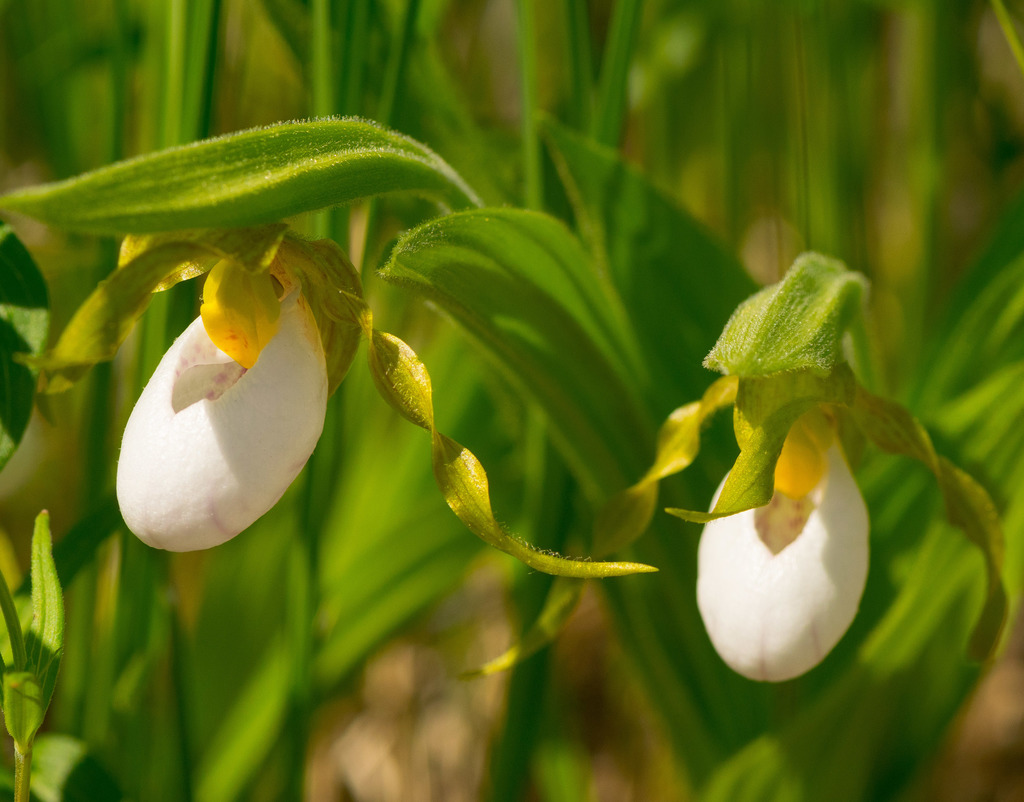
small white lady's-slipper
Cypripedium candidum
Cypripedium candidum, known as the small white lady's slipper or white lady's slipper, is a small herbaceous plant in the orchid family, Orchidaceae. It is native to eastern North America, with its range centered in the Upper Midwest and a majority of plants occurring in Minnesota. Disjunct populations occur as far south as Arkansas and Alabama.
A slow-growing perennial, C. candidum typically grows in full sun in alkaline wetlands and fens, especially on calcareous soils. It requires high-quality habitats with diverse native prairie flora and has declined in many areas because of habitat loss caused by agricultural conversion, woody encroachment, and invasive species. The plant is considered vulnerable across all of its range and is listed as an endangered species in several jurisdictions.
From the article Cypripedium candidum on Wikipedia (CC BY-SA), quoted section by section
Description
Cypripedium candidum grows from a branching rhizome with slender roots up to 30 cm (12 in) long. A single plant may produce a clump of up to sixty stems, arising from different points along the rhizome. The stems are erect and 11–40 cm (4.3–16 in) tall, making it one of the smallest North American species of Cypripedium. Near the middle of the stem, there are three to five leaves arranged alternately, each 7–20 cm (3–8 in) long, 0.9–5.3 cm (0.4–2 in) wide, and covered in small hairs. The stem base has an additional two to four scale-like, bladeless leaf sheaths. Plants bloom from mid-May to mid-June, often while the shoots are still emerging from the soil. The flowering stems bear one or rarely two flowers, subtended by a leaflike bract 3.3–11 cm (1.3–4.3 in) long. Like other slipper orchids, the flowers are bilaterally symmetric, with three sepals and three petals, and the pedicel is twisted by 180° so that the median petal sits at the bottom of the flower. The median petal, also called the lip or labellum, has a modified shape resembling a pouch, 17–27 mm (0.67–1.1 in) long. It is glossy white with purple markings on its interior. Above the labellum, the dorsal sepal points upward; it is ovate, often with a pointed tip, 15–35 mm (0.59–1.4 in) long and 7–13 mm (0.3–0.5 in) wide. …
Range & habitat
Cypripedium candidum has a large native range, extending across approximately 2.3 million km2 (890,000 sq mi) of eastern North America, centered around the Upper Midwest. It ranges from southern Manitoba and Saskatchewan southward through Minnesota and the eastern Dakotas to Nebraska and Missouri and eastward through the Great Lakes region to New York and Virginia, with disjunct populations in Alabama. Minnesota hosts the largest number of plants, with over 10,000 individuals estimated in 1983, largely concentrated in the state's northwestern prairies. Despite a 98% loss in suitable habitat in the state, there are likely more plants in Minnesota than the combined total in all other states and provinces. Since the alteration of much of its habitat for agricultural uses, there has been an estimated 90% decline in populations globally, and the species is now considered extirpated from Pennsylvania and Saskatchewan. Because the plants do not grow at sites that have been grazed by livestock or tilled for agriculture, suitable habitat is typically fragmented. A few disjunct populations are scattered across the southeastern United States. In 1988, a population was discovered in western Maryland, marking the first time the species had been documented east of Ohio and south of Pennsylvania. …
Wikipedia: “Distribution”
What it does
Cypripedium candidum requires pollination to produce fruit and is self-compatible but also outcrosses. Pollinating insects enter the lip of the orchid and spend several minutes attempting to escape before squeezing through the exit holes, where pollen is deposited on their thorax. Pollination occurs when the insect re-enters the same flower, another flower on the same plant, or a flower on another plant and brings the pollen in contact with that flower's stigma, again while attempting to exit the lip. Several species of bees and true bugs pollinate the flowers, all of which are 2–3 mm tall, similar to the dimensions of the flower's exit holes. Documented pollinators include sweat bees (Halictus, Lasioglossum, and Augochlorella), small carpenter bees (Ceratina), and stink bugs (Cosmopepla lintneriana). The lack of a specialized pollinator may contribute to high rates of hybridization with the closely-related species Cypripedium parviflorum.
Surveys have found a high variability in the proportion of plants that are pollinated and that set fruit, varying across populations and years. One possible explanation is that variation in the onset of spring may affect whether the peak bloom of C. candidum coincides with that of other prairie plants whose pollinators it relies on. …
Wikipedia: “Pollination and reproduction”
At the table
The global population of Cypripedium candidum has declined by as much as 90% from historic levels, and the current population trend may still be decreasing. In Minnesota, where the majority of plants are found, the statewide population is less than 5% of its historic level and continues to decline. As a result, the species is considered globally vulnerable by NatureServe and the IUCN Red List as of August, 2026. Moreover, NatureServe lists it as vulnerable, imperiled, or critically imperiled species in every state and province across its range, although these listings do not confer enhanced legal protections in any jurisdictions. Despite global population trends, C. candidum has not been assessed or listed federally in the United States and does not receive protections under the Endangered Species Act of 1973. It is listed as an endangered species and protected by law in Kentucky, Maryland, New Jersey, and New York and has various other state-level designations elsewhere, summarized in the table below.
C. candidum is rare in Canada, which contains less than 10% of the plant's native range. Canada listed the species as endangered in 1981 but changed its designation to threatened in 2014 following the discovery of new populations in Manitoba, enhanced habitat protections, and ongoing management practices. …
Wikipedia: “Population statuses and trends”
In human culture
All orchids require a fungal partner in order to germinate, and plants may continue to obtain nutrients from mycorrhizal fungi even after maturing, especially during periods of dormancy. Documented fungal partners of Cypripedium candidum include Rhizoctonia subtilis and members of the families Tulasnellaceae and Thelephoraceae and the genus Phialophora. Like many slipper orchids, Cypripedium candidum is slow-growing, reaching maturity after about 12 years. The lifespan is unknown but is likely more than 50 years. As a plant grows, its rhizome branches dichotomously, resulting in large clumps with many flowering stems. Plants sometimes enter periods of dormancy for up to six years, possibly as a response to cold or dry spring conditions. Larger plants are less likely to go dormant and more likely to survive dormancy. In late summer, plants produce the underground buds from which the following year's flowering stems emerge. Unfavorable conditions after these buds form, including mowing or late-spring fires can result in a failure of the plant to flower. The flowers typically begin blooming in May, before the leaves are fully developed, and remain open for up to ten days. Across its range, the flowering period varies from April to July.
Wikipedia: “Life history”
Where it lives
Recorded sightings
—
geo-referenced records in GBIF, from museums, herbaria and field observers.
Drag the globe to turn it. Dots are where records exist, not a range map; darker means more records.
In the stacks
Searching the stacks…
Every page naming Cypripedium candidum in the Biodiversity Heritage Library →
This page is assembled live from iNaturalist, GBIF, Wikipedia, the Source Library and the Internet Archive. It is not yet part of the hand-edited codex. iNaturalist taxon 55628.