- Animals
- ›Arthropods
- ›Chelicerates
- ›Arachnids
- ›Mites and Ticks
- ›Acariformes
- ›Sarcoptiformes
- ›Endeostigmatan Mites
- ›Eriophyoidea
- ›Gall and Rust Mites
- ›Eriophyinae
- ›Aceriini
- ›Aceria
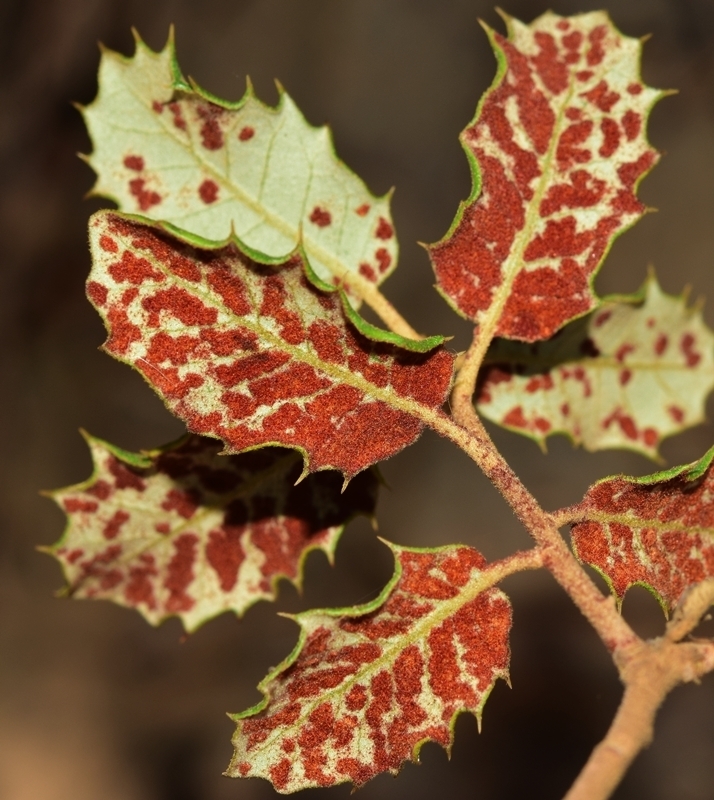
Holm Oak Felt Gall Mite
Aceria ilicis
Aceria ilicis is a species of mite that causes growths, known as galls, on the leaves of holm oak (Quercus ilex). It was first described by the Italian naturalist and biologist, Giovanni Canestrini in 1890. It is found in Europe and Turkey.
From the article Aceria ilicis on Wikipedia (CC BY-SA), quoted section by section
Description
Aceria ilicis causes felt-like galls (erinea), which are a patch of glandular hairs, caused by gall mites of the family Eriophyoidea. The bulge is 2–3 mm high on the upperside of the leaf of holm oak (also known as evergreen oak) and the depression below is several mm wide; there are usually several on a leaf. Mites live within the dense mass of tangled hairs. Occasionally the bulge is on the lower side and depression on the upperside.
Inquilines. It is uncertain, but Aceria trichophila could be an inquiline of Aceria ilicis.
Wikipedia: “Description of the gall”
Range & habitat
Found in the following countries in Europe; Belgium, Croatia, France, Germany, Greece, Italy, the Netherlands, Portugal, Slovenia, Spain, Switzerland and the United Kingdom (England) Also found in Turkey (Asia).
Wikipedia: “Distribution”
Where it lives
Recorded sightings
—
geo-referenced records in GBIF, from museums, herbaria and field observers.
Drag the globe to turn it. Dots are where records exist, not a range map; darker means more records.
In the stacks
Searching the stacks…
Every page naming Aceria ilicis in the Biodiversity Heritage Library →
This page is assembled live from iNaturalist, GBIF, Wikipedia, the Source Library and the Internet Archive. It is not yet part of the hand-edited codex. iNaturalist taxon 556479.