- Plants
- ›Vascular Plants
- ›flowering plants
- ›Dicots
- ›Nances, Willows, and Allies
- ›Violet Family
- ›Viola
- ›Viola
- ›Melanium
- ›Bracteolatae
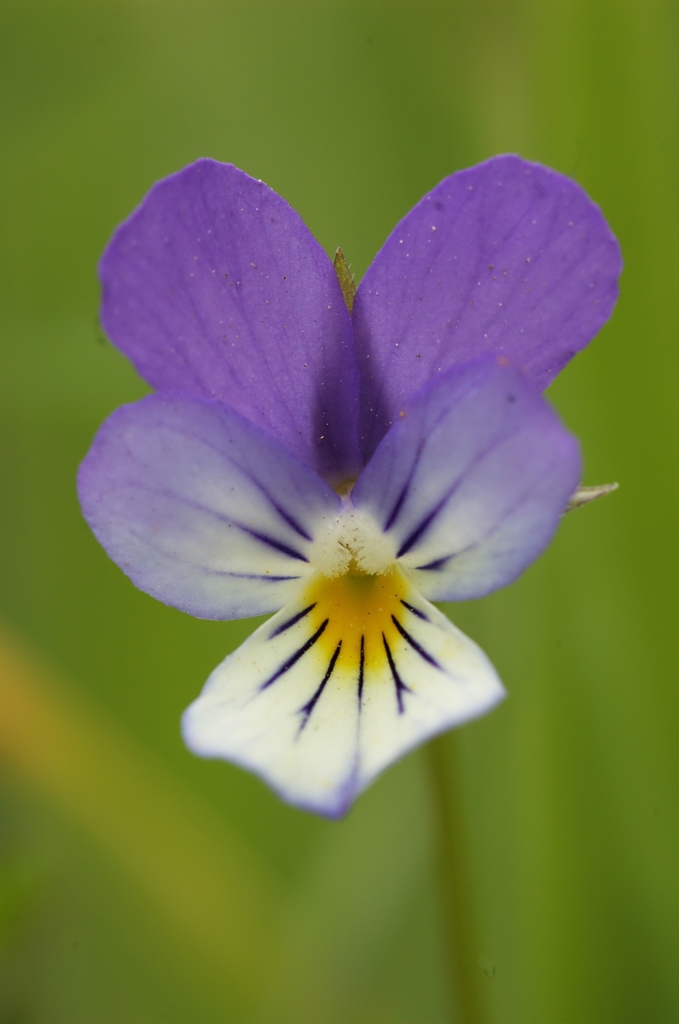
Wild Pansy
Viola tricolor
Viola tricolor is a common European wild flower, growing as an annual or short-lived perennial. The species is also known as wild pansy, Johnny Jump up (though this name is also applied to similar species such as the yellow pansy), heartsease, heart's ease, heart's delight, tickle-my-fancy, Jack-jump-up-and-kiss-me, come-and-cuddle-me, three faces in a hood, love-in-idleness, and pink of my john.
It has been introduced into North America, where it has spread. It is the progenitor of the cultivated pansy, and is therefore sometimes called wild pansy; before the cultivated pansies were developed, "pansy" was an alternative name for the wild form. It can produce up to 50 seeds at a time. The flowers can be purple, blue, yellow or white.
From the article Viola tricolor on Wikipedia (CC BY-SA), quoted section by section
Description
Viola tricolor is a small plant of creeping and ramping habit, reaching at most 15 centimetres (6 in) in height, with flowers about 1.5 cm (1⁄2 in) in diameter. Its root is of the rhizome type with fine rootlets. The stem (acoli stem: which remains flush with the soil and from which leave the leaves and the flowering stalk) is hairless, sometimes downy and is branched. The plant has no leaf rosette at the base, unlike some other violets, such as Viola hirta. Leaves are, on the contrary, alternate. They are stalked at limbus oval, oblong or lanceolate and more or less serrated margins. The stipules are often quite developed, at least those of the upper leaves. These stipules are palm-lined or palmatised. The flowers are solitary and lateral, hoisted on long peduncles. They appear on aerial stems with more or less long internodes. The sepals are never larger than the corolla. It is 10 to 25 millimetres (3⁄8 to 1 in) long. This corolla can be purple, blue, yellow or white. It can most often be two-tone, yellow and purple. The tricolor shape, yellow, white and purple, is the most sought after. It flowers from April to September (in the Northern Hemisphere). The plants are hermaphroditic and self-fertile, pollinated by bees.
Range & habitat
It is common almost everywhere on the Eurasian continent, near the sea or inland, at altitudes ranging from 0 to 2,700 metres (8,900 ft). It grows in open grasslands, wastelands, mainly on acidic or neutral soils and usually in partial shade. It is also found on the banks and in the alluviums.
Wikipedia: “Distribution and habitat”
What it does
In Iceland, Viola tricolor is known to be a host for at least two species of plant pathogenic fungi, Pleospora herbarum and Ramularia agrestis.
Wikipedia: “Ecology”
At the table
As an ornamental and medicinal plant, the wild pansy has been cultivated since the Middle Ages and bred in Britain since 1810. As some of its names imply, V. tricolor and other plants in the Viola genus (such as V. odorata, or sweet violet), have a long history of use in herbalism and folk medicine, particularly Iranian, Greco-Arab, Ayurvedic and Unani traditional health systems. Traditionally, it has been used to treat cardiovascular conditions, epilepsy, skin diseases, burns and eczema, and as an expectorant for respiratory problems such as bronchitis, asthma, and cold symptoms, and modern research has begun to corroborate these traditionally held knowledges and uses. Studies have shown V. tricolor extract has antinociceptive, immunosuppressant and anti-inflammatory properties, making it a potential treatment for autoimmune disorders. The extract is known to be antimicrobial, sedative, antiepileptic, and diuretic, as well as potentially antiviral and antiprotozoal. V. tricolor L extract has shown vasorelaxant, cardio-relaxant, hypotensive, and cardio protective effects. Some studies have discovered potential anti-cancer properties, where the extract (primarily the ethyl acetate component) has been attributed to induced apoptosis and inhibited angiogenesis in cancer cells. …
Wikipedia: “Uses”
In human culture
According to Roman mythology, the wild pansy turned into the Love-in-idleness as Cupid shot one of his arrows at the imperial votaress, but missed and instead struck it. As Cupid is the god of desire, affection and erotic love, the flower's juice received the trait, to act as a love potion. Its name relates to the use of the flower, as it is often used for idleness or vileness acts. According to Greek mythology, Zeus fell in love with a young woman named Io and provoked jealousy to his wife Hera. He transformed the girl into a heifer and kept her grazing at his feet. For pity on the diet of herbs to which he submitted the beloved, he caused the earth to produce beautiful flowers that he called Io. Another Greek legend has it that the delicate white flowers were worshiped by Eros. To inhibit this worship, Aphrodite colored them, which resulted in tricolor coloration. No. 1 of 3 Lyrics, H. 161, written for piano in 1921 by British composer Frank Bridge, is called "Heart's Ease".
Literature. Long before cultivated pansies were released into the trade in 1839, V. tricolor was associated with thought in the "language of flowers", often by its alternative name of pansy (from the French pensée, "thought"): hence Ophelia's often quoted line in Shakespeare's Hamlet, "There's pansies, that's for thoughts". (What Shakespeare had in mind was V. …
Wikipedia: “In culture”
Where it lives
Recorded sightings
—
geo-referenced records in GBIF, from museums, herbaria and field observers.
Drag the globe to turn it. Dots are where records exist, not a range map; darker means more records.
In the old herbals & bestiaries

Living Images of Plants
Otto Brunfels · 1532 · p.412

The Book of Health: The Art of Distillation
Brunschwig, Hieronymus · 1505 · p.136

Notable Commentaries on the History of Plants
Leonhart Fuchs · 1542 · p.837

Notable Commentaries on the History of Plants
Leonhart Fuchs · 1549 · p.835

On the Names of Plants
Hieronymus Bock (Tragus) · 1552 · p.636

Commentaries on the Six Books of Dioscorides
Pietro Andrea Mattioli · 1560 · p.747

Commentaries on the Six Books of Pedanius Dioscorides on Medical Matter
Pietro Andrea Mattioli · 1565 · p.1354

Florum et coronariarum historia
Rembert Dodoens · 1568 · p.21

A New Herbal, or History of Plants
Rembert Dodoens (trans. Henry Lyte) · 1578 · p.174

Six Groups of the History of Plants
Rembert Dodoens · 1583 · p.178

Herbarium Portatile, Oder Behendes Kräuter- und Gewächs-Buch: Darinn nicht allein 1363. so wol Einheimische als Außländndische Kräuter mit Lateinisch und Deutscher Benennung abgebildet, sondern auch die meisten, so in der Medicin gebräuchlich, kürtzlich erkläret werden
Panckow, Thomas · 1656 · p.145
In the stacks
Searching the stacks…
Every page naming Viola tricolor in the Biodiversity Heritage Library →
This page is assembled live from iNaturalist, GBIF, Wikipedia, the Source Library and the Internet Archive. It is not yet part of the hand-edited codex. iNaturalist taxon 55739.