- Animals
- ›Arthropods
- ›Hexapods
- ›Insects
- ›Winged and Once-winged Insects
- ›Dragonflies and Damselflies
- ›Damselflies
- ›Coenagrionoid Damselflies
- ›Narrow-winged Damselflies
- ›Argia
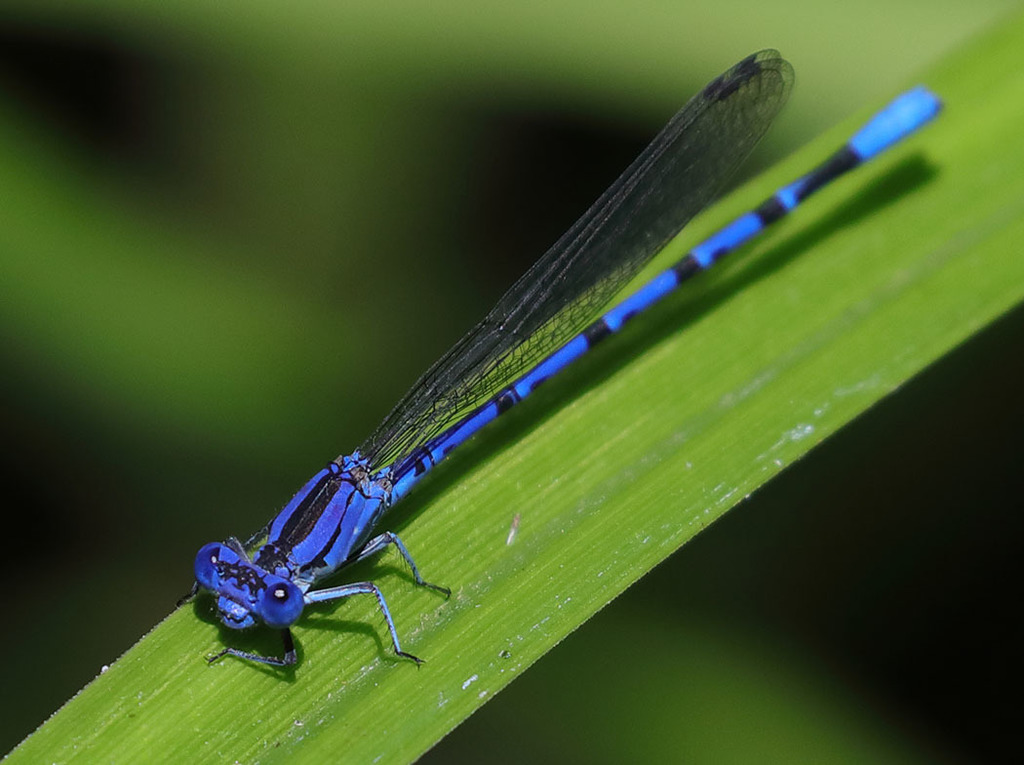
Vivid Dancer
Argia vivida
Argia vivida, the vivid dancer, is a species of narrow-winged damselfly in the family Coenagrionidae. This species is commonly found in springs and forests of Central America and North America. Argia vivida inhabit areas of diverse temperatures due to thermoregulation. The species is also considered the state insect of Nevada.
Argia vivida vary in color, although they are typically associated with the bright blue coloration. Other variations include red, brown, or grey depending on the type of morph and temperature. Mating occurs in mornings and afternoons, and eggs are oviposited just below the surface of the water. Larvae and adults feed on larvae from small invertebrates and small flying insects, respectively.
From the article Argia vivida on Wikipedia (CC BY-SA), quoted section by section
Range & habitat
Argia vivida exhibit thermoregulation by living in habitats that allow for different thermal regimes throughout the day. At night, individuals typically settle in forest trees to maintain their body temperatures and slow the radiant loss of heat. During the day, they move away from the trees into sunspots available in thinned forest for thermal basking. Therefore, an ideal habitat for the species consists of a forest containing dense trees in addition to cleared patches or thinned forest to best suit their thermoregulation requirements. In fuel-modified forests, Argia vivida still roost in trees at night but prefer cleared fuel treatment sections of the forest compared to thinned forest for the purposes of basking and foraging.
Wikipedia: “Thermoregulation and habitat”
What it does
Upon mating, females lay their eggs on sources of vegetation just below the surface of the water. A temperature of at least 11°C is required for egg development, although larvae can overwinter in water temperatures in the range 0–33°C. In thermal springs, the life cycle takes approximately 1 year to complete, but may extend for up to 2 to 3 years in cooler springs. Argia vivida finally emerge as adults anytime between April through October depending on the current temperature.
Wikipedia: “Life cycle”
Listen
Looking for field recordings…
Where it lives
Recorded sightings
—
geo-referenced records in GBIF, from museums, herbaria and field observers.
Drag the globe to turn it. Dots are where records exist, not a range map; darker means more records.
In the stacks
Searching the stacks…
Every page naming Argia vivida in the Biodiversity Heritage Library →
This page is assembled live from iNaturalist, GBIF, Wikipedia, the Source Library and the Internet Archive. It is not yet part of the hand-edited codex. iNaturalist taxon 56240.