- Animals
- ›Arthropods
- ›Hexapods
- ›Insects
- ›Winged and Once-winged Insects
- ›Butterflies and Moths
- ›Butterflies
- ›Brush-footed Butterflies
- ›Checkerspots, Anglewings, Peacocks, and Allies
- ›Ladies, Anglewings, and Allies
- ›Nymphalis
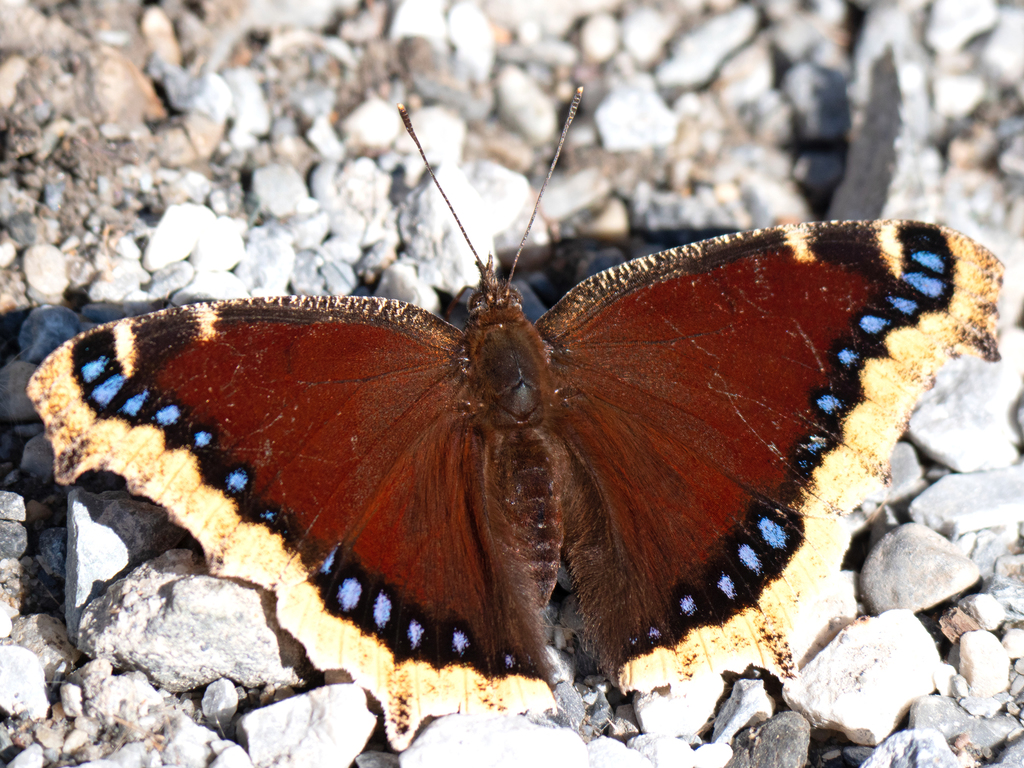
Mourning Cloak
Nymphalis antiopa
Nymphalis antiopa, known as the mourning cloak in North America and the Camberwell beauty in Britain, is a large butterfly native to Eurasia and North America. The immature form of this species is sometimes known as the spiny elm caterpillar. Other older names for this species include grand surprise and white petticoat. A powerful flier, this species is sometimes found in areas far from its usual range during migration.
These butterflies have a lifespan of 11 to 12 months, one of the longest lifespans for any butterfly. It is the state insect of the U.S. state of Montana, adopted in 2001.
From the article Nymphalis antiopa on Wikipedia (CC BY-SA), quoted section by section
Range & habitat
The mourning cloak butterflies are distributed broadly around the northern hemisphere. They are commonly found throughout all of North America and northern Eurasia. Three subspecies of mourning cloak butterflies are found throughout North America: northern Nymphalis antiopa hyperborea Seitz, 1913; eastern N. a. lintnerii Fitch, 1857; southwestern N. a. thomsoni Butler, 1887. They can usually be found in hardwood forests, though they have been found in virtually all habitats. They may also be found as far as the northern part of South America, though they are typically not seen as frequently in southern states such as Florida, Louisiana, or Texas. They are also found in temperate and even arctic Asia. Migrants arrive in Great Britain most years during summer and autumn, but numbers are usually very low. There is no evidence that the species breeds in Britain; it is thought that mild, wet winters prevent them from surviving there for very long. The 'Butterfly Farmer' L. Hugh Newman raised thousands for release at his 'farm' in Bexley, but none were seen the following spring. Specimens stored in his refrigerator for the winter, however, survived. …
Wikipedia: “Distribution”
What it does
Mourning cloaks, like all other butterflies, undergo complete metamorphosis. Egg →Larva (L1 ... L5) → Pupa → Adult. Before the leaves bud-out, Mourning cloaks are known to lay their eggs as ring clusters around the terminal twigs on host plants. The host plant selection is vital because it provides the food source for the young caterpillars. Females are known to have multiple broods, typically up to two to three. The newly hatched caterpillars will group together until they shed their skin—termed an instar for each shedding. This shedding event occurs four times throughout development in a process called ecdysis. The larvae experience a fifth skin shed to produce a fully grown caterpillar. The next stage in the mourning cloak's life cycle is to morph into a pupa and then cocoon in a process that encases the creature in a tan or gray chrysalis, which will hang from the stems of grass. This pupa stage allows for resting and further maturation. This metamorphosis takes approximately fifteen days. Following development as the chrysalis is the emergence of an adult mourning cloak butterfly. Studies show that the mourning cloaks use endocrine mechanisms similar to other lepidopterans to regulate female-specific protein synthesis, oogenesis, and male and female reproductive gland development. …
Wikipedia: “Life cycle”
At the table
Upon hatching, the caterpillars will begin to eat the leaves of the larval food-plant. A large number of food-plant plants was recorded, such as willow (Salix nigra, Salix pentandra, Salix caprea, Salix aurita, Salix cinerea, Salix phylicifolia), American elm, hackberry, hawthorn, wild rose, Betula species (Betula verrucosa, Betula chinensis), Alnus incana and poplar. The caterpillars live gregariously in communal silken nest on the host-plant, until they disperse prior to pupation. Adult mourning cloaks primarily feed on sap, ripe and fallen fruits and sugary exudate from aphids, very rarely seen nectaring on flowers.
Wikipedia: “Larval food-plants”
In human culture
The specific epithet antiopa is thought to be derived from Antiope, a common name in Greek mythology.
North American name "mourning cloak". In several European countries with Germanic languages, other than Britain, the name for this butterfly literally translates to "mourning cloak", such as German "Trauermantel", Dutch "rouwmantel", Swedish "sorgmantel" and Norwegian "sørgekåpe". Finnish "suruvaippa" is also a calque of the Germanic names. This suggests it is a name which came with Scandinavian or German rather than with British settlers, for whom this species would be considerably less familiar. Other common names include: Czech "Černopláštník" . "Babočka osiková". Polish "Rusałka żałobnik". Russian "Траурница" . Japanese "キベリタテハ" . Chinese "黄縁立羽". L. Hugh Newman likened the butterfly's pattern to a girl who, disliking having to be in mourning, defiantly let a few inches of a bright dress show below her mourning dress.
British name "Camberwell beauty". The name originated from the discovery of two individuals at Coldharbour Lane in Camberwell in August 1748. Camberwell is in South London, about three miles south of London Bridge—in reporting this, the author Moses Harris named the species grand surprise or Camberwell beauty (Bretherton & Emmet, 1990). In Britain, the English name is 'Camberwell beauty', but the Welsh name is 'y fantell alar', which means 'mourning cloak'.
Wikipedia: “Etymology”
Listen
Looking for field recordings…
Where it lives
Recorded sightings
—
geo-referenced records in GBIF, from museums, herbaria and field observers.
Drag the globe to turn it. Dots are where records exist, not a range map; darker means more records.
In the stacks
Searching the stacks…
Every page naming Nymphalis antiopa in the Biodiversity Heritage Library →
This page is assembled live from iNaturalist, GBIF, Wikipedia, the Source Library and the Internet Archive. It is not yet part of the hand-edited codex. iNaturalist taxon 56832.