- Animals
- ›Arthropods
- ›Hexapods
- ›Insects
- ›Winged and Once-winged Insects
- ›Ants, Bees, Wasps, and Sawflies
- ›Narrow-waisted Wasps, Ants, and Bees
- ›Ants, Bees, and Stinging Wasps
- ›Formicoidea
- ›Ants
- ›Myrmicine Ants
- ›Crematogastrini
- ›Tetramorium
- ›Tetramorium caespitum
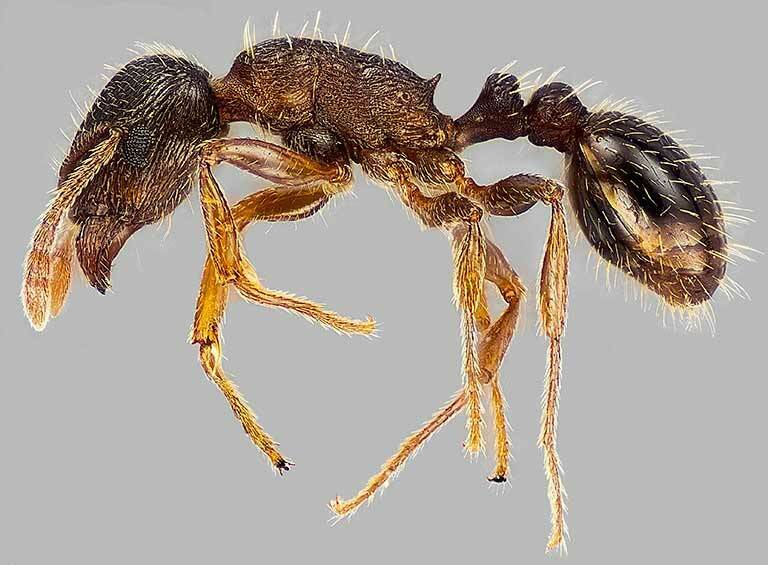
Immigrant Pavement Ant
Tetramorium immigrans
Tetramorium immigrans—also known as the immigrant pavement ant, pavement ant, and the sugar ant in parts of North America—is an ant native to Europe, which also occurs as an introduced pest in North America. Its common name comes from the fact that colonies in North America usually make their nests under pavement. This is one of the most commonly seen ants in North America, being well adapted to urban and suburban habitats. It is distinguished by a single pair of spines on the back, two nodes on the petiole, and grooves on the head and thorax.
Pavement ants have been studied on the International Space Station in 2014.
From the article Tetramorium immigrans on Wikipedia (CC BY-SA), quoted section by section
Description
The pavement ant is dark brown to blackish, and 2.5–4 millimeters (0.10–0.16 in) long. A colony is composed of workers, alates, drones (male ants), and a queen. Workers do have a small stinger, which can cause mild discomfort in humans but is essentially harmless. Alates, or new queen ants and drones, have wings, and are at least twice as large as the workers. Tetramorium nuptial flights occur in spring and summer; queens and drones leave the nest and find a mate. The drone's only job is to mate with the virgin queens. The dealate, or newly fertilized queen, sheds her wings, finds a suitable nesting location and digs a founding chamber called the clausteral chamber or cell. The queen must raise the first generation of young herself until they are old enough to forage for food. During this period she survives by metabolizing the proteins of her flight muscles. As the eggs hatch and the ants develop, they spend that time, about two to three months, tending to the queen of their colony; they will continue helping in the colony until they are a month old. Older workers forage for food and defend the colony. They will eat almost anything, including other insects, seeds, honeydew, honey, bread, meats, nuts, ice cream, and cheese. Although they do not usually nest inside buildings, they may become a minor nuisance to humans as they enter homes, attracted by food left out. …
Range & habitat
Tetramorium immigrans creates nests that are shallow to moderately deep in pavement cracks, compacted soil, and other disturbed urban substrates. Multiple surveys have indicated that the nests occupy a surface area of between 1.2-4.8 m², with workers defending a surrounding area of approximately 43 m², but there is variation observed throughout colonies that are outside of this bracket. T. immigrans nests consist of an internal structure with many different interconnect chambers and galleries. The majority of nest volume can be found 30-50 cm below the surface and tunnels from 6-9 mm in diameter. In certain soils, shafts and isolated chambers may reach up to 60-90 cm in depth. Nests will frequently exhibit multiple entrance points that are characterized by crater-like mounds of excavated soil, which become particularly prominent in the warmer season during periods of increasing foraging.
Colony size and inter-colony interactions. Colonies of T. immigrans are relatively large when compared to the colonies of similar temperate ant species. Field observations have commonly reported colony sizes that range from a few thousand workers to over 10,000 individuals in nests that have been well-established. Rapid growth is possible for nests in the first 1-2 years of a colony being founded. …
Wikipedia: “Habitat and nests”
Listen
Looking for field recordings…
Where it lives
Recorded sightings
—
geo-referenced records in GBIF, from museums, herbaria and field observers.
Drag the globe to turn it. Dots are where records exist, not a range map; darker means more records.
In the stacks
Searching the stacks…
Every page naming Tetramorium immigrans in the Biodiversity Heritage Library →
This page is assembled live from iNaturalist, GBIF, Wikipedia, the Source Library and the Internet Archive. It is not yet part of the hand-edited codex. iNaturalist taxon 569552.