- Plants
- ›Vascular Plants
- ›flowering plants
- ›Dicots
- ›Roses, Elms, Figs, and Allies
- ›rose family
- ›Amygdaloideae
- ›Amygdaleae
- ›Prunus
- ›Padus
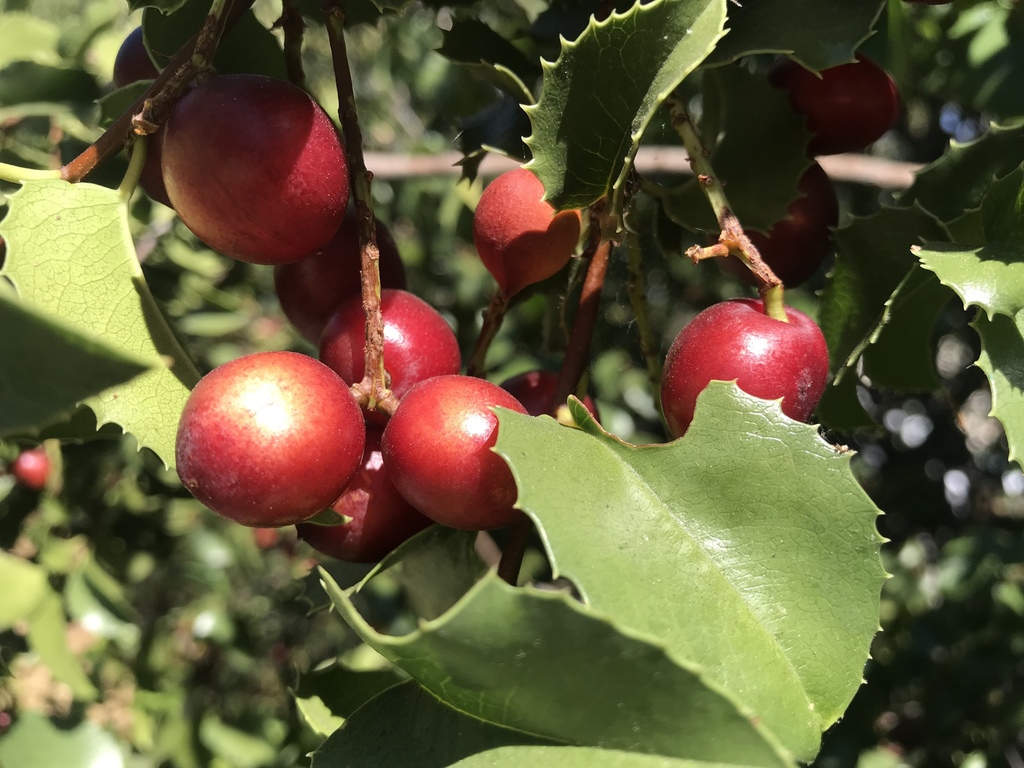
hollyleaf cherry
Prunus ilicifolia
Prunus ilicifolia is a North American species of Prunus with the common names hollyleaf cherry, evergreen cherry, and in native Salinan, islay.
Prunus ilicifolia is an evergreen shrub or tree with shiny and spiny toothed leaves similar in appearance to those of holly. It grows to nearly 15 metres (49 feet) tall, with thick, alternate leaves 1.6–12 centimetres (3⁄4–4+3⁄4 inches) in length. It has small white flowers growing in clusters, similar in appearance to most members of the rose family. The purple to black fruit is a sweet drupe with a very thin pulp around a large single stone.
From the article Prunus ilicifolia on Wikipedia (CC BY-SA), quoted section by section
Description
It is an evergreen shrub or small tree approaching 15 metres (49 feet) in height, with sclerophyllous foliage consisting of dense, hard, alternate leaves. The leaves are 1.6–12 centimetres (3⁄4–4+3⁄4 inches) long with a 4–25 millimetres (1⁄8–1 in) petiole and spiny margins, somewhat resembling those of the holly. The leaves are dark green when mature and generally shiny on top, and have a smell resembling almonds when crushed. The flowers are small (1–5 mm), white, produced on racemes in the spring from March to May. The flowers are terminal on small stalks, with the youngest at the cluster center. The fruit is 12–25 mm (1⁄2–1 in) in diameter, sweet in taste, with little flesh surrounding the smooth seed.
Range & habitat
Prunus ilicifolia is native to California chaparral and foothill woodlands along the Coast Ranges below 1,600 m (5,200 ft). Its distribution extends from coastal California (from Mendocino County to San Diego County as well as desert chaparral areas of the Mojave Desert) to Baja California and areas of northern Baja California Sur. This is the only species of the genus Prunus native to California's Santa Monica Mountains, which divide the Los Angeles Basin from the San Fernando Valley. In chaparral communities, it tends to inhabit north-facing slopes, erosion channels, or other moist, cool sites. It is a persistent member of chaparral communities, being slow-growing but long-lived; common chaparral flora associates are toyon, western poison-oak and coffeeberry. In the absence of fire, P. ilicifolia will outlive or outshade surrounding vegetation, making room for seedlings. Eventually, it will form extensive stands codominated by scrub oak.
Wikipedia: “Distribution and habitat”
What it does
Although it will resprout from the stump after fires, the seeds are not fire-adapted like those of many other chaparral plants. Instead, it relies on the natural death of surrounding vegetation during long periods of fire-free conditions to make room for its seedlings. Though the seeds are often reported to require sunlight to germinate, germination rates of nearly 100% have been achieved with wild-collected seed buried completely in pots with a peatlite mix. The caterpillars of the pale swallowtail (Papilio eurymedon) feed on this and other members of the riparian woodland plant community. It is also a larval host to the California hairstreak, Lorquin's admiral, Nevada buckmoth, and western tiger swallowtail. Bees are attracted to it.
Wikipedia: “Ecology”
At the table
P. ilicifolia, according to Janice Timbrook, "was [consumed] by every group in whose territory it occurs", and is an important part of the ethnobotany of many California indigenous people in that range.
Fruit pulp. The pulp of the cherry is edible, and the toxic pit kernels can be processed for consumption. The cherries and their seeds form a part of the traditional cuisine of multiple indigenous groups who inhabit the native range of P. ilicifolia. Despite containing a small amount relative to the size of the pit, the cherry pulp is consumed both raw and processed. Prunus fruits in California were sometimes dried and stored for later use; the Payómkawichum are reported to have let the fruit sit for a few days to improve the taste, and the people of Santa Catalina Island are also reported to have dried the fruit. Chumash people would mash and spread the pulp on a flat rock to sun-dry, this dried mash would be rolled up and eaten like fruit leather. The fruit can also be made into a jam; as reported by Donald C. Peattie. The fruit is also pressed into a juice, and some groups fermented the fruit into an intoxicating drink. In 1982, researcher Rita Weyrauch wrote that modern Chumash people remember the fruit being fermented to make a drink called teeswin. According to mission historian Maynard Geiger and UCLA anthropologist Clement W. …
Wikipedia: “Uses”
In medicine
The cherries were picked in late summer by Chumash people. The tree was not beaten with sticks or climbed, as they said it was very delicate; instead, cherries were picked individually from the tree along with those fallen to the ground. Green cherries would also be picked, but stored separately. To gather the cherries, Chumash people used net bags which were similarly employed to gather acorns and manzanita berries. The bags were hung over the chest by a woven strap which hung behind the neck or over the shoulder. Once filled, the bag was carried on the back with a tumpline. Gathered cherries would be emptied from their bags into larger, closely woven sacks with drawstrings which would be used to transport them further; often, the cherries would often be cleaned of their pulp near the gathering site, leaving the kernels to be transported alone for further processing. The net bags were made using cordage which would be woven into meshes just fine enough to prevent the cherries from falling through and the resulting net bag's mouth would be kept open by a hoop made of willow or sumac wood. The nets were often made using a popular cordage called tok, made from dogbane. Where dogbane was scarce, cordage could be made from milkweed (Asclepias eriocarpa or A. …
Wikipedia: “Traditional harvest method”
Toxicity
The pits are toxic to humans. The leaves are poisonous to eat, but not to handle.
How it is grown
Prunus ilicifolia is used in California native plants and wildlife gardens, and drought-tolerant sustainable landscaping. The plant thrives in full sun and loose open soil (porous), and needs regular watering when young.
Traditional harvest method. The cherries were picked in late summer by Chumash people. The tree was not beaten with sticks or climbed, as they said it was very delicate; instead, cherries were picked individually from the tree along with those fallen to the ground. Green cherries would also be picked, but stored separately. To gather the cherries, Chumash people used net bags which were similarly employed to gather acorns and manzanita berries. The bags were hung over the chest by a woven strap which hung behind the neck or over the shoulder. Once filled, the bag was carried on the back with a tumpline. Gathered cherries would be emptied from their bags into larger, closely woven sacks with drawstrings which would be used to transport them further; often, the cherries would often be cleaned of their pulp near the gathering site, leaving the kernels to be transported alone for further processing. The net bags were made using cordage which would be woven into meshes just fine enough to prevent the cherries from falling through and the resulting net bag's mouth would be kept open by a hoop made of willow or sumac wood. …
Wikipedia: “Cultivation”
In human culture
The similarity of the leaves to those of holly is the source of both the common name "holly-leaved cherry" and the scientific epithet ilicifolia (Ilex [holly]-leaved).
Wikipedia: “Etymology”
Where it lives
Recorded sightings
—
geo-referenced records in GBIF, from museums, herbaria and field observers.
Drag the globe to turn it. Dots are where records exist, not a range map; darker means more records.
In the stacks
Searching the stacks…
Every page naming Prunus ilicifolia in the Biodiversity Heritage Library →
This page is assembled live from iNaturalist, GBIF, Wikipedia, the Source Library and the Internet Archive. It is not yet part of the hand-edited codex. iNaturalist taxon 57250.