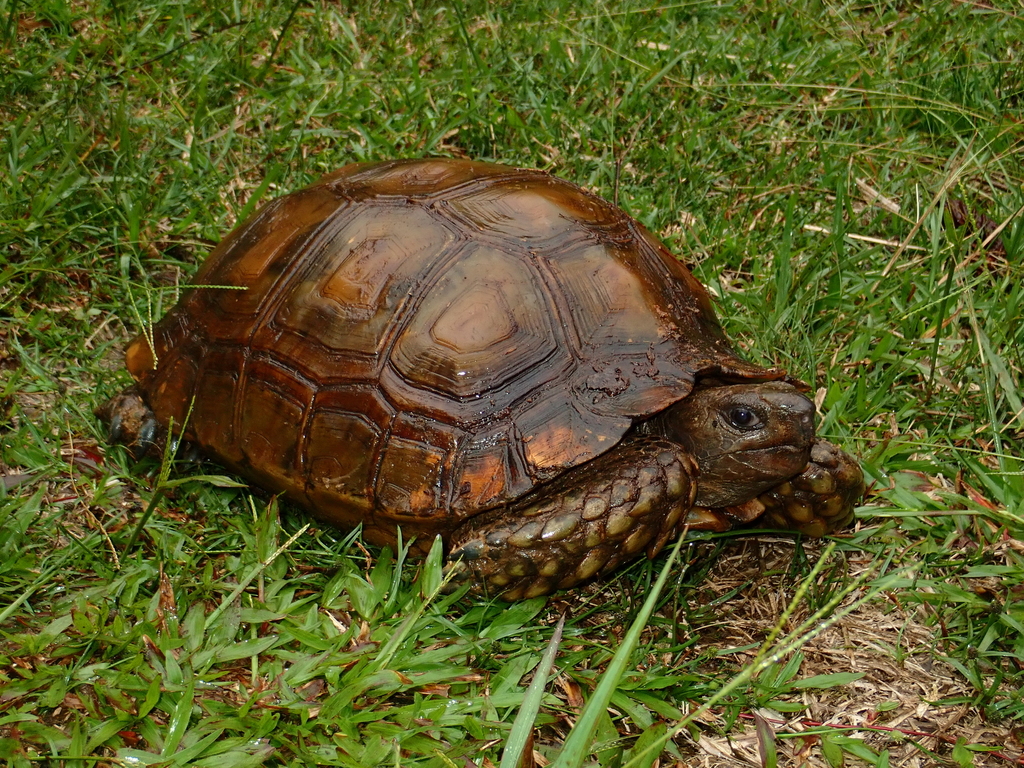
Asian Forest Tortoise
Manouria emys
The Asian forest tortoise (Manouria emys) is a species of tortoise in the family Testudinidae. The species is endemic to Southeast Asia. It is believed to be among the most primitive of living tortoises, based on molecular and morphological studies.
From the article Asian forest tortoise on Wikipedia (CC BY-SA), quoted section by section
Description
M. emys is the largest tortoise in mainland Asia. The largest adults of the northern subspecies (M. e. phayrei) can reach 25 kg (55 lb) in the wild and much more in captivity. It has a broad, flattened upper shell and a large lower shell, with distinctive features on its head, limbs, and skin that set it apart from other tortoises.
The carapace is considerably depressed (flattened), its depth less than half its length. Anterior and posterior margins are reverted (upturned) and strongly serrated (toothed). A nuchal (neck) shield is present, along with two supracaudal (above the tail) shields. Dorsal shields show concentric striations (grooves) and are often concave. Vertebral shields are much broader than long and at least as broad as costals (side plates). The lower shell (plastron) is large, with the gular region (throat area) produced (slightly extended) and typically notched (indented). The hind lobe (rear section) is deeply notched (indented). Pectoral shields may be widely separated or joined by a short median suture (seam). The axillary (armpit) shield is very small, while the inguinal (groin) shield is large. The head is moderate in size, featuring two large prefrontal shields and a large frontal shield. The beak is not hooked. Jaws are feebly denticulated (weakly toothed), with a strong median ridge (raised line) on the upper jaw's alveolar surface (inner surface). …
Range & habitat
M. emys occurs in countries across Asia, which includes Bangladesh, Cambodia, India, Indonesia, Malaysia, Myanmar, Thailand, and Vietnam.
Wikipedia: “Distribution”
What it does
This species has been observed in the wild to consume whole fungi, shoots of koster's curse (Miconia crenata), leaves and petioles of elephant ears (Alocasia sarawakensis and Alocasia scabriuscula), shoots of Begonia sp., shoots of Phrynium sp., shoots of vegetable fern (Diplazium esculentum), and flowers of wild ginger (Etlingera coccinea). Most commonly eaten were plants of the genus Alocasia, with individuals observed standing nearly vertical to reach leaves. In captivity, individuals have accepted a wide variety of food, predominantly being herbivorous but occasionally consuming frogs, snails, or carrion when presented.
Wikipedia: “Diet”
Where it lives
Recorded sightings
—
geo-referenced records in GBIF, from museums, herbaria and field observers.
Drag the globe to turn it. Dots are where records exist, not a range map; darker means more records.
In the stacks
Searching the stacks…
Every page naming Manouria emys in the Biodiversity Heritage Library →
This page is assembled live from iNaturalist, GBIF, Wikipedia, the Source Library and the Internet Archive. It is not yet part of the hand-edited codex. iNaturalist taxon 57389.