- Animals
- ›Arthropods
- ›Hexapods
- ›Insects
- ›Winged and Once-winged Insects
- ›Butterflies and Moths
- ›Butterflies
- ›Swallowtails and Parnassians
- ›Parnassians
- ›True Parnassians
- ›Parnassius
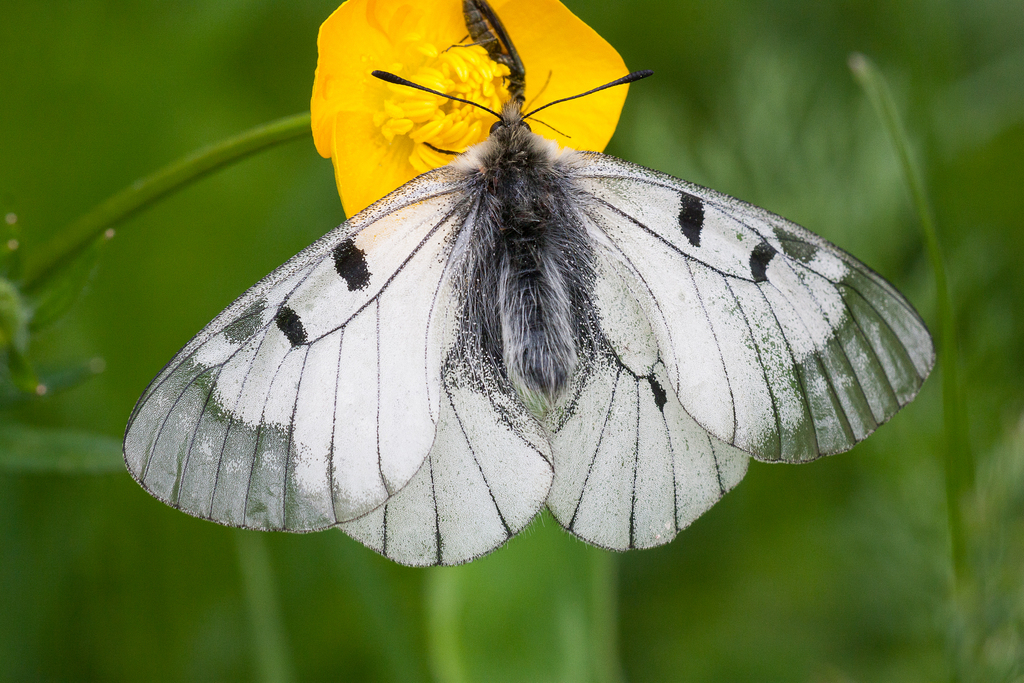
Clouded Apollo
Parnassius mnemosyne
The clouded Apollo (Parnassius mnemosyne) is a butterfly species of the family of swallowtail butterflies (Papilionidae) found in the Palearctic realm. It is a large butterfly which inhabits meadows and deciduous woodland clearings with plenty of flowering plants, but cannot survive in denser forest. It is found both in the lowlands and in the mountains but not usually found at altitudes above 1,500 m (4,900 ft) except in the Central Asian mountains where it is also known from higher altitudes.
From the article Clouded Apollo on Wikipedia (CC BY-SA), quoted section by section
Description
Wings: White; the veins thinly black, fringes blackish; forewing with 2 black cell-spots, distal margin in male from the apex to about middle, in female further down and also more broadly, transparent-grey; hindwing dusted with black from the abdominal margin to the cell and at the apex of the cell, more densely in female than in male. Antenna and legs: Black, likewise the abdomen, the last being covered with whitish hairs in the male, while in the female it is nearly naked, glossy, bearing a whitish bladder-like pouch which occupies nearly two -thirds of the underside. Varies generally little. A rare aberration in which the cell-spots of the forewing are connected by a black streak has received the name ab. halteres Mosch., and as ab. melaina Honr.a form has been introduced which is darkened by dense black dusting (occurring especially often in the female and which is found everywhere among the ordinary form, being particularly often met with in Carinthia, Carniola, in the neighborhood of Vienna, in Wallis (Valais), Transylvania, and Austrian Silesia. In Carinthia, the environs of Friesach, at an elevation of from 630 to 750 m, there occurs a conspicuously small local form, minor Reb. & Rog., in which the black spots of the forewing are reduced, the expanse being only 52 mm. …
Range & habitat
Its range of distribution extends from the Pyrenees, across the Central Massif, the Alps, and the Carpathians as far as central Asia. It inhabits all European countries including Norway, where it appears rarely and only in certain places. A subspecies lived in Denmark, but is now extinct. A great number of geographical races and individual forms are distinguished in this extensive region. The most striking specimens include the dark race from the eastern Bavarian Alps (subspecies hartmanni); form melania has the most pronounced dark colouring. The paper of Dr. I.N. Bolotov and colleagues (2013) summarizes data on the northern localities of Parnassius mnemosyne, which are mostly situated in the Russian Federation and gives a thorough description of the species' northern range location. It is shown that the northernmost populations in the exist within the karst landscapes in the north of White Sea-Kuloi Plateau (between 65°35' and 66°03' N) in the downstream of the Soyana and Kuloi rivers and in the north of Timan Highland (66°10' N) along the shore of Kosminskoe Lake (the Pechora River basin). Northern limits of the clouded Apollo's range appear to be strongly determined by the distribution of its larval host plants (primarily Corydalis solida and the role of climate and relief seem to be of minor importance. …
Wikipedia: “Distribution”
In human culture
The species was named in the classical tradition for Mnemosyne, the mother of the nine Muses.
Wikipedia: “Etymology”
Listen
Looking for field recordings…
Where it lives
Recorded sightings
—
geo-referenced records in GBIF, from museums, herbaria and field observers.
Drag the globe to turn it. Dots are where records exist, not a range map; darker means more records.
In the stacks
Searching the stacks…
Every page naming Parnassius mnemosyne in the Biodiversity Heritage Library →
This page is assembled live from iNaturalist, GBIF, Wikipedia, the Source Library and the Internet Archive. It is not yet part of the hand-edited codex. iNaturalist taxon 57485.