- Animals
- ›Arthropods
- ›Chelicerates
- ›Arachnids
- ›Scorpions
- ›Neoscorpionina
- ›Orthosterni
- ›Buthida
- ›Flat-tailed and Bark Scorpions
- ›Arrowbreasted Scorpions
- ›Heteroctenus
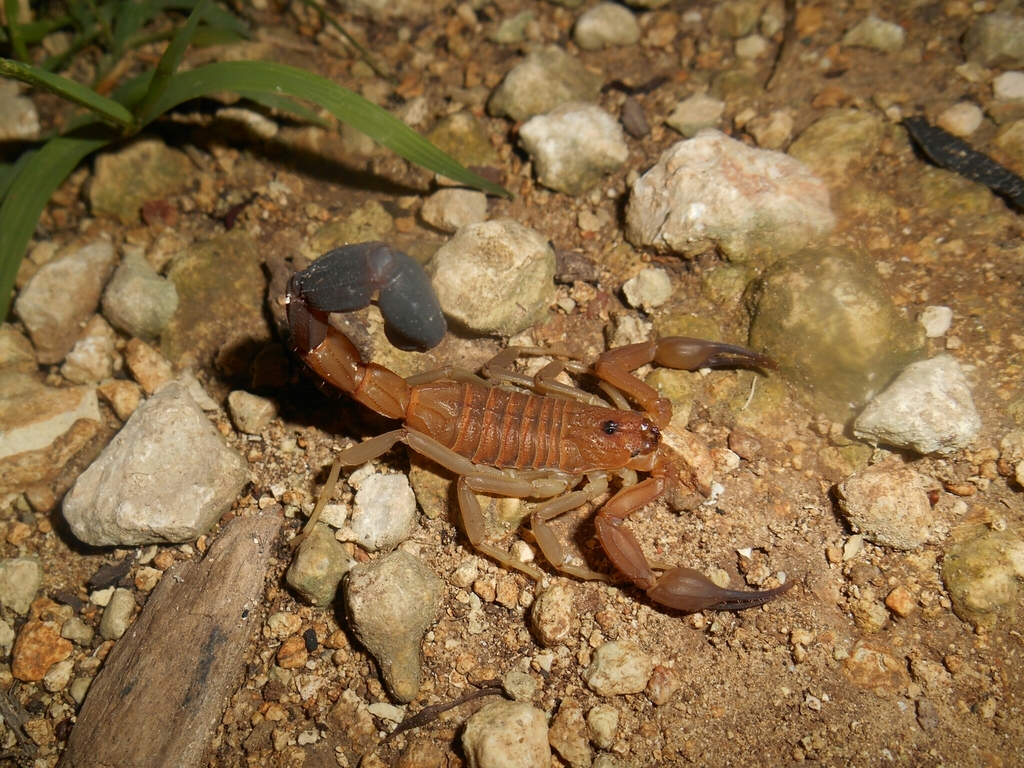
Heteroctenus junceus
Heteroctenus junceus, the red scorpion or blue scorpion, is an endemic species, one of 36 different types of scorpion found in Cuba and the Dominican Republic, as well as parts of Central America. It is called "blue scorpion" due to the peculiar blue tone on its tail and stinger; it is also known as "red scorpion" because it has a reddish dark body.
From the article Heteroctenus junceus on Wikipedia (CC BY-SA), quoted section by section
Description
Full-grown adults reach 55–100 millimetres (2.2–3.9 in) in length. The body is yellowish brown, pink, orange, with a red or purple tail, a single stinger and the eight limbs darker, burgundy, purple or blackish, with a black triangle intercular. H. junceus has a life expectancy of three to five years, although lack of food results in only 15% reaching adulthood. Every year, hundreds of persons are stung by this scorpion in Cuba, but these stings are not dangerous because the venom has an LD50 of 8.0 mg/kg, which is far more venom than is carried in the stinger.
Range & habitat
Heteroctenus junceus can inhabit ecosystems ranging from savanna forests to semi-desert areas. They are commonly found under rocks or fallen trees and throughout the epiphytic vegetation within the Bromeliads.
Wikipedia: “Habitat”
Where it lives
Recorded sightings
—
geo-referenced records in GBIF, from museums, herbaria and field observers.
Drag the globe to turn it. Dots are where records exist, not a range map; darker means more records.
In the stacks
Searching the stacks…
Every page naming Heteroctenus junceus in the Biodiversity Heritage Library →
This page is assembled live from iNaturalist, GBIF, Wikipedia, the Source Library and the Internet Archive. It is not yet part of the hand-edited codex. iNaturalist taxon 601769.