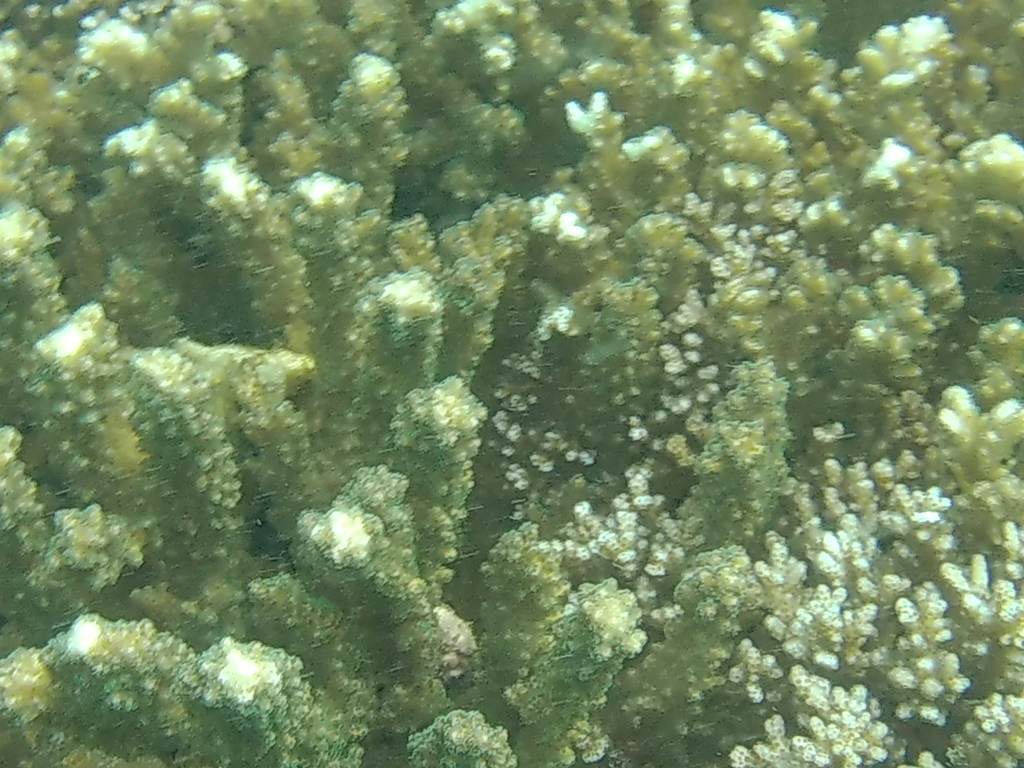
Cauliflower coral
Pocillopora capitata
Pocillopora capitata, commonly known as the Cauliflower coral, is a principal hermatypic (or reef-building) coral found in the Eastern Tropical Pacific. P. capitata is a colonial species of stony coral of the class Anthozoa, the order Scleractinia, and the family Pocilloporidae. This species was first documented and described by Addison Emery Verrill in 1864. P. capitata is threatened by many of the effects of climate change, including — but not limited to — increased temperatures that cause bleaching and hypoxic conditions.
From the article Pocillopora capitata on Wikipedia (CC BY-SA), quoted section by section
Description
The first known appearance of Pocillopora capitata in the fossil record occurred in the upper Pleistocene, approximately 0.126 million years ago. As with all hermatypic corals, P. capitata is a benthic, substrate-attached, sessile marine species. The species also exhibits bilateral symmetry, has an imperforate skeleton, and usually has brown tissue coloration. Colonies of P. capitata may take on the shape of either an irregular mound or an openly branched system, in which branches are tall and cylindrical in appearance before flattening out towards the tips. Polyps of corals belonging to the family Pocilloporidae are all known to have a corallite structure with twelve poorly developed septa. Individual polyps possess twelve small tentacles arranged in a ring around the mouth that may outstretch during the day for feeding purposes. Retraction of the tentacles will result in the appearance of a fine, dark ring around the edge of the corallite calice. The arrangement of the calices themselves is typically crowded, often so much so that adjacent calices will touch; this crowding tends to happen particularly at the tips of coral branches. The verrucae — which are bumps of the sponge-like coenosteum that contain several corallites — of P. …
Wikipedia: “Description and Morphology”
Range & habitat
The Pocillopora genus of corals generally dominates the coral reef ecosystems of the far Eastern Tropical Pacific, a region heavily impacted by the flow of the warm, eastward Equatorial Counter Current. P. capitata is found in the shallow foreshore zones of coral reefs of the subtropical Pacific, almost exclusively in the far east of the Pacific oceanic basin. Coordinate-wise, P. capitata ranges from 26°N to 5°S and from 115°E to 77°W. P. capitata has been found to inhabit Panamà, Colombia — including the Gorgona islands — the Gulf of California, and Ecuador, including the offshore Galapagos archipelago (with the exceptions of Fernandina Island and Isabela Island). In the Mexican Central Pacific, P. capitata can be found dwelling amongst the La Boquita, Carrizales, and Tenacatita coral reefs. P. capitata can typically be found at depths between 0 and 40 meters below sea level; however, in the Galapagos Islands, P. capitata typically inhabits depths ranging between 3 and 12 meters below the sea's surface. Due to their preferred depth range and typical distribution within the foreshore region of coral reefs, P. capitata tends to experience high levels of wave exposure. As with most Scleractinian corals — which are defined by their obligatory symbiotic relationships with photosynthetic endosymbiont dinoflagellates of the order Symbiodiniaceae — P. …
Wikipedia: “Habitat and Geographic Distribution”
What it does
As with many other members of the class Anthozoa, P. capitata may be either gonochoric or hermaphroditic. Like other Scleractinian corals, P. capitata uses both asexual and sexual reproductive strategies, and has been known to generationally alternate between the two. When reproducing, polyps will release mature gametes into the water column through the mouth from the coelenteron — the central body cavity of cnidarians.
Wikipedia: “Reproduction”
In human culture
After fertilization has occurred and the zygote phase has been reached, individuals initiate their life cycles as planktonic planula larva, meaning that the larvae are free-swimming and possess multiple cilia that aid with such locomotion. Metamorphosis of P. capitata includes development of morphological features such as the septa, tentacles, and pharynx, after which point the larva will settle aboral side down on the substrate of a coral reef and begin to develop into its adult form.
Wikipedia: “Development and Early Life History”
Where it lives
Recorded sightings
—
geo-referenced records in GBIF, from museums, herbaria and field observers.
Drag the globe to turn it. Dots are where records exist, not a range map; darker means more records.
In the stacks
Searching the stacks…
Every page naming Pocillopora capitata in the Biodiversity Heritage Library →
This page is assembled live from iNaturalist, GBIF, Wikipedia, the Source Library and the Internet Archive. It is not yet part of the hand-edited codex. iNaturalist taxon 60545.