- Animals
- ›Arthropods
- ›Hexapods
- ›Insects
- ›Winged and Once-winged Insects
- ›Butterflies and Moths
- ›Butterflies
- ›Brush-footed Butterflies
- ›Satyrs, Morphos, and Allies
- ›Alpines, Arctics, Nymphs and Satyrs
- ›Erebiina
- ›Erebia
- ›Erebia
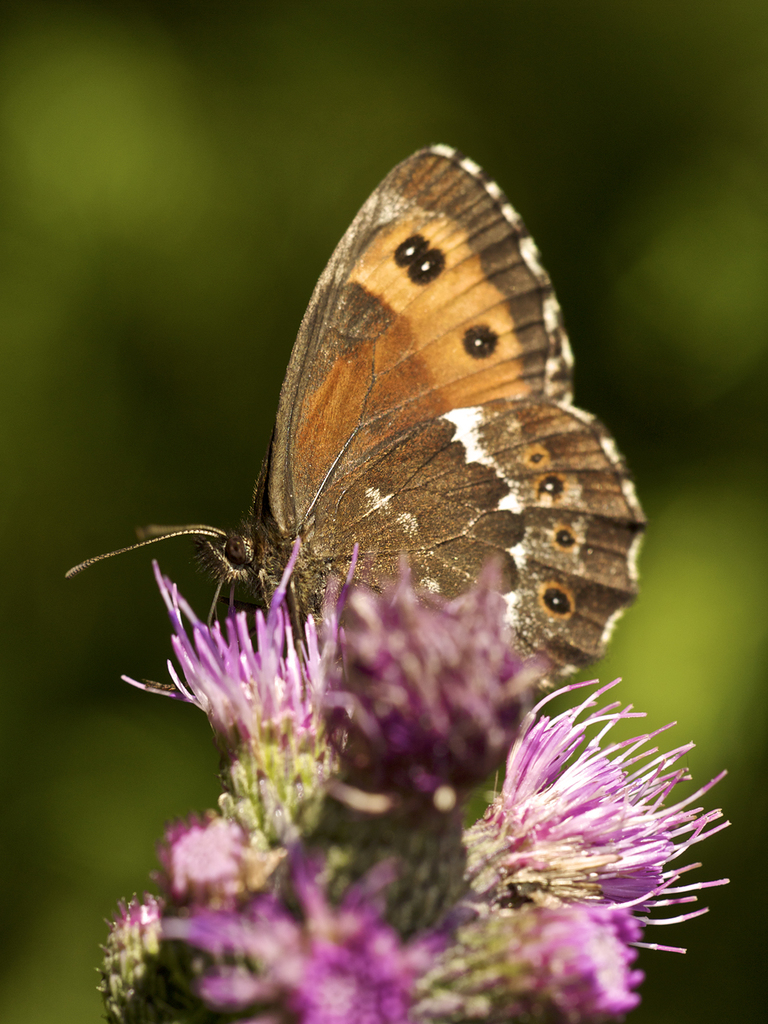
Arran Brown
Erebia ligea
Erebia ligea, the Arran brown, is a member of the subfamily Satyrinae of the family Nymphalidae. This brown is widespread in south-eastern and northern Europe. It prefers mixed woodlands at low altitudes. It is rarely seen in open areas. This species was first described by Carl Linnaeus in his 1758 10th edition of Systema Naturae, and the type locality is Sweden.
From the article Erebia ligea on Wikipedia (CC BY-SA), quoted section by section
Description
The Arran brown is a medium-sized butterfly with a wingspan of between 30 and 46 mm (1.2 and 1.8 in). Females tend to be a little larger than males. The upperside of both the forewings and hindwings is dark greyish brown with a reddish-orange strip near the margin along which runs a series of black spots. Many of the spots are small but some have white centres. The underside of the forewing is dark brown with a reddish strip with black, white-centred eyespots near the outer edge. The underside of the hindwing is brown, edged with a row of more or less distinct dark coloured eyespots. The basal side of these is close to the centre of wing and there are one or two patches of white. The basal part of the hindwing of the female is a darker brown than the rest of the wing. Wheeler (1903) gives a short description
This butterfly can be distinguished from the rather similar Lapland ringlet (Erebia embla) and the Arctic ringlet (Erebia disa) by the fact that it has white blotches on the under surfaces of the hindwing and those butterflies do not. It can also be distinguished from the Arctic ringlet by the fact that it always has eyespots on its hindwings while the upperside of the Arctic ringlet's wings are plain brown. …
What it does
Females lay their eggs on grasses and sedges. In Finland the larvae take two years to develop and overwinter twice as caterpillars. In that country the numbers fluctuate and recently have been more numerous in odd-numbered years.
== References ==
Wikipedia: “Life cycle”
Listen
Looking for field recordings…
Where it lives
Recorded sightings
—
geo-referenced records in GBIF, from museums, herbaria and field observers.
Drag the globe to turn it. Dots are where records exist, not a range map; darker means more records.
In the stacks
Searching the stacks…
Every page naming Erebia ligea in the Biodiversity Heritage Library →
This page is assembled live from iNaturalist, GBIF, Wikipedia, the Source Library and the Internet Archive. It is not yet part of the hand-edited codex. iNaturalist taxon 62381.