- Plants
- ›Vascular Plants
- ›flowering plants
- ›monocots
- ›Agaves, Orchids, Irises, and Allies
- ›Orchids
- ›Orchidoid Orchids
- ›Cranichideae
- ›Jewel Orchids
- ›Goodyera
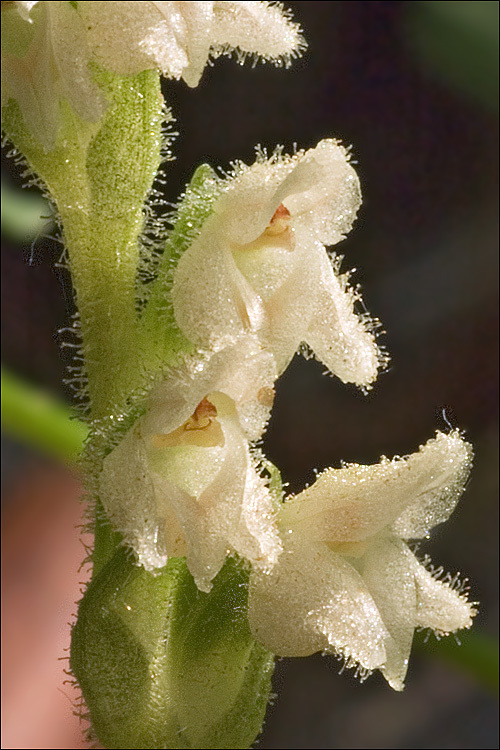
lesser rattlesnake plantain
Goodyera repens
Goodyera repens, a small forest orchid in the genus Goodyera. It is known by the common name creeping lady's-tresses in Anglophone Europe and dwarf rattlesnake plantain or lesser rattlesnake plantain in North America.
From the article Goodyera repens on Wikipedia (CC BY-SA), quoted section by section
Description
G. repens is a small, perennial orchid that emerges from short, shallow-rooted rhizomes. The evergreen basal leaves are either widely or narrowly egg-shaped, with either a narrow or blunt point at the tip. They are 1.1 to 3.2 cm (0.4–1.3 in) long and 0.5 to 1.8 cm (0.2–0.7 in) wide. Each plant will have at least two leaves, but can have as many as six. Many plants in North America will have silvery white or greenish white tissue around the lateral veins, but in some populations especially in Europe and Asia these markings are faint or missing. Scale-like leaves are arranged alternately on the pubescent stem. The inflorescence is a spike reaching 10–20 cm tall, with 7-36 small white or pale-green flowers arranged closely on one side of the raceme. The individual flowers have a concave, pouch-like labellum, and a curved hood-like petal over the column formed by the dorsal sepal and petals. Like other Goodyera species, the stem and sepals are covered in thin hairs. The flowers develop sequentially, with flowers on the bottom of the spike maturing first. The fruit is a capsule, about 1 cm long, containing numerous tiny seeds (0.003 milligrams in weight) that are wind-dispersed. Each seed consists of an undifferentiated embryo surrounded by a transparent seed coat. The period of flowering ranges from early-July to mid-September, depending on the latitude.
Range & habitat
G. repens is widely distributed at northern latitudes, with native populations found in Europe, Asia, and North America. It is associated with undisturbed, old-growth conifer and mixed forests. In North America, the species has a transcontinental range across Canada, with several discontinuous populations in the United States. The northern extent of its range occurs in Alaska, Yukon, and Newfoundland. In the eastern US, it extends as far south as North Carolina and Tennessee along the Appalachian Mountains. Disjunct populations occur in Arizona, New Mexico and Colorado. Historically, its native range in Europe has been limited to the Eastern, Northern, and Central regions, with populations in Western Europe being restricted to areas of high elevation. In the last century, however, its range has expanded. Secondary populations have become established in Denmark, the Netherlands, northern France, northern Germany, and eastern England. Goodyera repens is a protected species throughout most of its range. It does not survive fire, and does not soon reenter an area after fire or logging. It is generally found only in forests at least 95 years old.
Wikipedia: “Distribution and habitat”
What it does
Like other orchids, G. repens lives in symbiosis with mycorrhiza, rhizome-dwelling fungus (Ceratobasidium cornigerum or Rhizoctonia goodyearae-repentis). The mycorrhiza help the orchid absorb and assimilate nutrients. In its first heterotrophic and subterranean life stage, the plant is entirely dependent on these mycorrhizal fungi, as the tiny seeds contain only minimal amounts of energy reserves in the form of lipids. Bumblebees are an important pollinator for this species. Mature flowers produce nectar and have exposed stigmas, which aid in the transfer of pollen. Hoverflies and halictid bees are also common pollinators.
Wikipedia: “Ecology”
Where it lives
Recorded sightings
—
geo-referenced records in GBIF, from museums, herbaria and field observers.
Drag the globe to turn it. Dots are where records exist, not a range map; darker means more records.
In the stacks
Searching the stacks…
Every page naming Goodyera repens in the Biodiversity Heritage Library →
This page is assembled live from iNaturalist, GBIF, Wikipedia, the Source Library and the Internet Archive. It is not yet part of the hand-edited codex. iNaturalist taxon 62407.