- Animals
- ›Arthropods
- ›Hexapods
- ›Insects
- ›Winged and Once-winged Insects
- ›Beetles
- ›Water, Rove, Scarab, Long-horned, Leaf, and Snout Beetles
- ›Cucujiform Beetles
- ›Darkling Beetles and Allies
- ›Blister Beetles
- ›Meloinae
- ›Meloini
- ›Meloe
- ›Lampromeloe
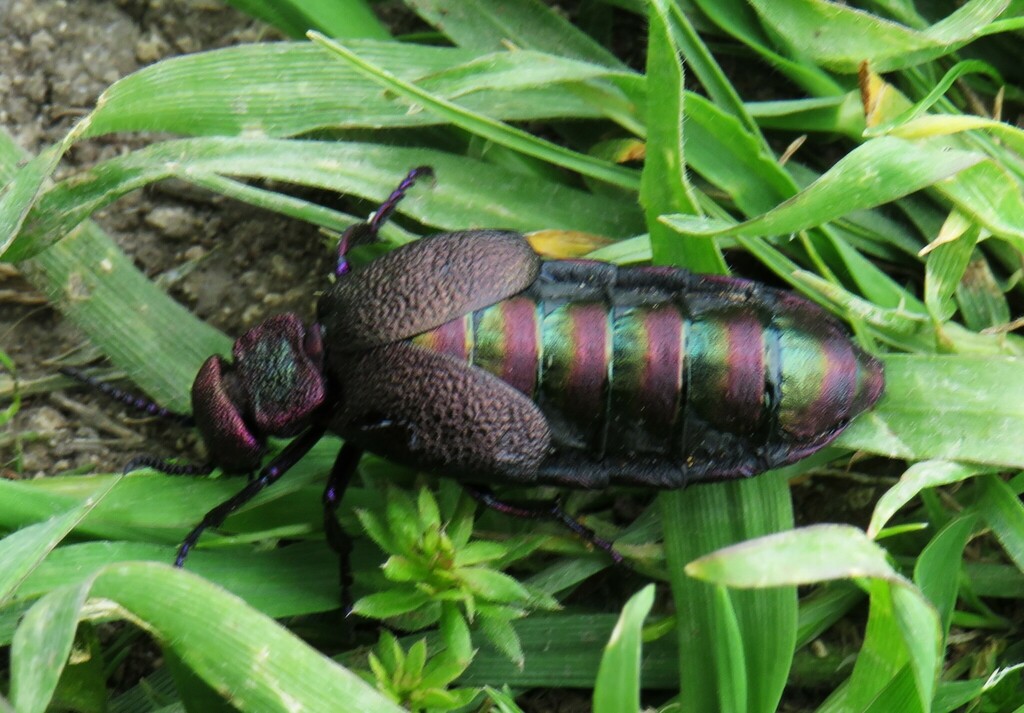
Meloe variegatus
Meloe variegatus is a European oil beetle. It is commonly known as the variegated oil beetle. Adult beetles feed on leaves and can be pests of crops, while the larvae are parasitic on solitary bees.
From the article Meloe variegatus on Wikipedia (CC BY-SA), quoted section by section
Description
It is flightless, with short elytra overlapping at the front. Its exposed abdominal segments are brightly coloured on the upper side. Like all member of the genus Meloe, it releases a smelly, oily fluid when alarmed.
Range & habitat
It is active between April and July in grassy places, chewing the leaves of various plants. They are considered pests of sugar beet, cabbage, and winter rye.
Wikipedia: “Habitat”
What it does
The larvae primarily parasitise the nests of solitary bees, although they have been recorded in a colony of social bees in Poland. After fertilized eggs have been laid, the first instar larvae hatch after 24 hours. The larvae climb to the top of a nearby blade of grass or a flower and remain immobile until they are able to attach to a passing bee with their mouthparts. The larvae puncture the bee's intersegmental membrances to feed on the haemolymph. Up to 15 larvae have been observed on one individual bee. Later stages of larvae growth of M. variegatus are not parasitic – they feed on the food stores gathered by the bees. The larvae pupate in the nest of solitary bees, but are rarely able to do so in larger colonies as they are removed by the worker bees.
Wikipedia: “Life cycle”
In medicine
In the early 19th century, this species was used in Germany as a fanciful cure for rabies (referred to as "hydrophobia" by William Elford Leach). The beetles were also hung up by the neck until dry, so that the oily secretion they gave off could be collected and administered. It was also considered to be a diuretic.
Wikipedia: “Use in traditional medicine”
Listen
Looking for field recordings…
Where it lives
Recorded sightings
—
geo-referenced records in GBIF, from museums, herbaria and field observers.
Drag the globe to turn it. Dots are where records exist, not a range map; darker means more records.
In the stacks
Searching the stacks…
Every page naming Meloe variegatus in the Biodiversity Heritage Library →
This page is assembled live from iNaturalist, GBIF, Wikipedia, the Source Library and the Internet Archive. It is not yet part of the hand-edited codex. iNaturalist taxon 627636.