- Animals
- ›Arthropods
- ›Hexapods
- ›Insects
- ›Winged and Once-winged Insects
- ›Flies
- ›Nematoceran Flies
- ›Mosquitoes and Midges
- ›Culicoidea
- ›Mosquitoes
- ›Culicine Mosquitoes
- ›Aedini
- ›Aedes
- ›Stegomyia
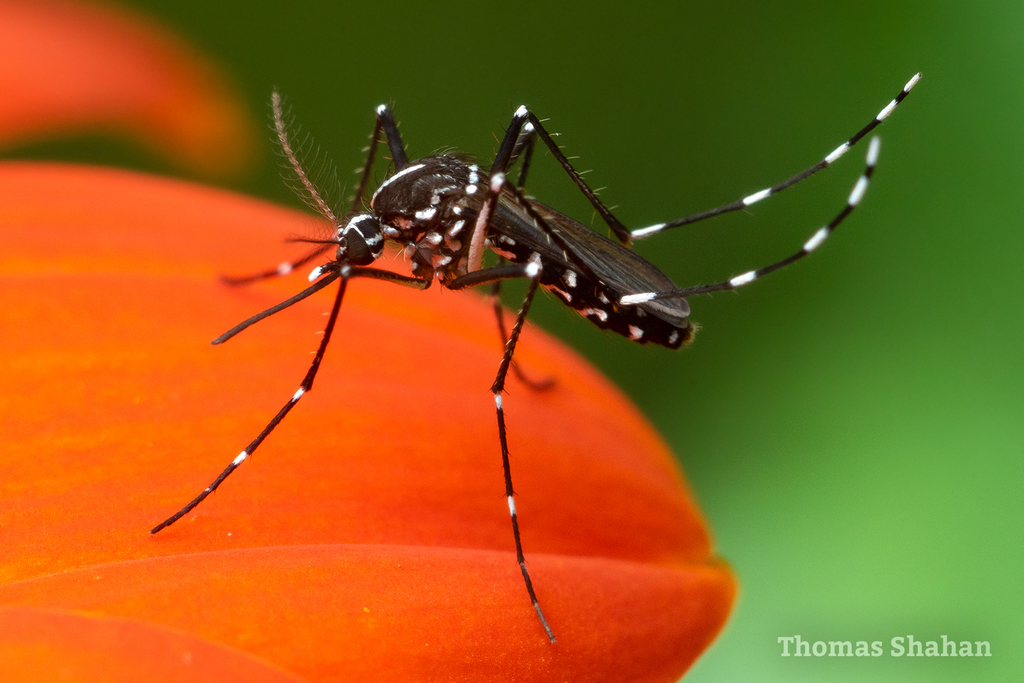
Asian Tiger Mosquito
Aedes albopictus
Aedes albopictus (synonym Stegomyia albopicta), from the mosquito (Culicidae) family, also known as the (Asian) tiger mosquito or forest mosquito, is a species of mosquito found in the tropical and subtropical areas of the world.
In the past few centuries, its distribution has expanded along with the expansion of international trade. This mosquito has become a significant pest in many communities because it closely associates with humans and typically flies and feeds in the daytime in addition to at dusk and dawn.
From the article Aedes albopictus on Wikipedia (CC BY-SA), quoted section by section
Description
The adult Asian tiger mosquito is less than 10 mm (0.39 in) long from end to end with a striking white and black pattern. The variation of the body size in adult mosquitoes depends on the density of the larval population and food supply within the breeding water. Since these circumstances are seldom optimal, the average body size of adult mosquitoes is considerably smaller than 10 mm. For example, the average length of the abdomen was calculated to be 2.63 mm (0.104 in), the wings 2.7 mm (0.11 in), and the proboscis 1.88 mm (0.074 in).
The males are roughly 20% smaller than the females, but they are morphologically very similar. However, as in all mosquito species, the antennae of the males in comparison to the females are noticeably bushier and contain auditory receptors to detect the characteristic whine, almost inaudible to humans, of the female. The maxillary palps of the males are also longer than their proboscis, whereas the females' maxillary palps are much shorter. (This is typical for the males of the Culicinae.) In addition, the tarsus of the hind legs of the males is more silvery. Tarsomere IV is roughly 75% silver in the males whereas the females' is only about 60% silver. The other characteristics do not differentiate between sexes. A single silvery-white line of tight scales begins between the eyes and continues down the dorsal side of the thorax. …
Wikipedia: “Characteristics”
What it does
Like other mosquito species, only the females require a blood meal to develop their eggs. Apart from that, they feed on nectar and other sweet plant juices just as the males do. In regards to host location, carbon dioxide and organic substances produced from the host, humidity, and optical recognition play important roles. The search for a host takes place in two phases. First, the mosquito exhibits a nonspecific searching behavior until it perceives host stimulants, whereupon it secondly takes a targeted approach. For catching tiger mosquitoes with special traps, carbon dioxide and a combination of chemicals that naturally occur in human skin (fatty acids, ammonia, and lactic acid) are the most attractive. The Asian tiger mosquito particularly bites in forests during the day, so has been known as the forest day mosquito. Depending upon region and biotype, activity peaks differ, but for the most part, they rest during the morning and night hours. They search for their hosts inside and outside human dwellings, but are particularly active outside. The size of the blood meal depends upon the size of the mosquito, but it is usually around 2 μl (6.8×10⁻⁵ US fl oz). Their bites are not necessarily painful, but they are more noticeable than those from other kinds of mosquitoes. Tiger mosquitoes generally tend to bite a human host more than once if they are able to. Ae. …
Wikipedia: “Diet and host location”
Listen
Looking for field recordings…
Where it lives
Recorded sightings
—
geo-referenced records in GBIF, from museums, herbaria and field observers.
Drag the globe to turn it. Dots are where records exist, not a range map; darker means more records.
In the stacks
Searching the stacks…
Every page naming Aedes albopictus in the Biodiversity Heritage Library →
This page is assembled live from iNaturalist, GBIF, Wikipedia, the Source Library and the Internet Archive. It is not yet part of the hand-edited codex. iNaturalist taxon 62984.