- Plants
- ›Vascular Plants
- ›flowering plants
- ›Dicots
- ›nightshades, bindweeds, gooseweeds, and allies
- ›nightshade family
- ›nightshades and allies
- ›nightshades and jaltomatas
- ›Solanum
- ›Leptostemonum
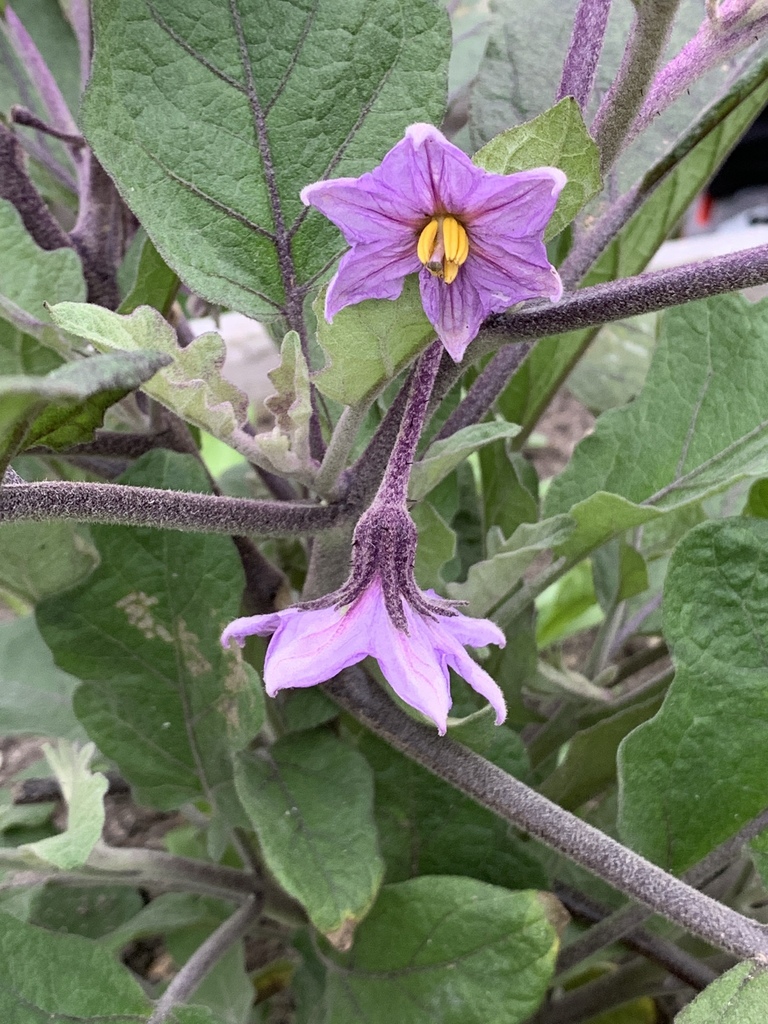
eggplant
Solanum melongena
Solanum melongena is a plant species in the nightshade family Solanaceae, grown worldwide for its edible fruit, typically used as a vegetable in cooking. It is known by a number of names, including eggplant, aubergine, and brinjal.
Most commonly purple, the spongy, absorbent fruit is used in several cuisines. It is a berry by botanical definition. As a member of the genus Solanum, it is related to the tomato, chili pepper, and potato, although those are of the Americas region while the eggplant is of the Eurasia region. Like the tomato, its skin and seeds can be eaten, but it is usually eaten cooked. Eggplant is nutritionally low in macronutrient and micronutrient content, but the capability of the fruit to absorb oils and flavors into its flesh through cooking expands its use in the culinary arts.
From the article Eggplant on Wikipedia (CC BY-SA), quoted section by section
Description
The eggplant is a delicate, tropical perennial plant often cultivated as a tender or half-hardy annual in temperate climates. The stem is often spiny. It grows 40 to 150 cm (1 ft 4 in to 4 ft 11 in) tall, with large, coarsely lobed leaves that are 10 to 20 cm (4 to 8 in) long and 5 to 10 cm (2 to 4 in) broad. Semiwild types can grow much larger, to 225 cm (7 ft 5 in), with large leaves over 30 cm (12 in) long and 15 cm (6 in) broad. The flowers are white to purple in color, with a five-lobed corolla and yellow stamens. Botanically classified as a berry, the fruit contains numerous small, soft, edible seeds that taste bitter because they contain or are covered in nicotinoid alkaloids, like the related tobacco. Some common cultivars have fruit that is egg-shaped, glossy, and purple with white flesh and a spongy, "meaty" texture. Some other cultivars are white and longer in shape. Wild eggplant fruits measure less than 3 cm (1+1⁄4 in) in diameter. The fruit flesh rapidly turns brown when in contact with the oxygen in the air.
At the table
Raw eggplant can have a bitter taste, with an astringent quality, but it becomes tender when cooked and develops a rich, complex flavor. Rinsing, draining, and salting the sliced fruit before cooking may remove the bitterness. The fruit is capable of absorbing cooking fats and sauces, which may enhance the flavor of eggplant dishes. Eggplant is used in the cuisines of many countries. Due to its texture and bulk, it is sometimes used as a meat substitute in vegan and vegetarian cuisines. Eggplant flesh is smooth. Its numerous seeds are small, soft and edible, along with the rest of the fruit, and do not have to be removed. Its thin skin is also edible, and so it does not have to be peeled. However, the green part at the top, the calyx, does have to be removed when preparing an eggplant for cooking. Eggplant can be steamed, stir-fried, pan fried, deep fried, barbecued, roasted, stewed, curried, or pickled. Many eggplant dishes are sauces made by mashing the cooked fruit. It can be stuffed. It is frequently, but not always, cooked with oil or fat.
East Asia. Korean and Japanese eggplant varieties are typically thin-skinned. In Chinese cuisine, eggplants are known as qiézi (茄子). They are often deep fried and made into dishes such as yúxiāng-qiézi ("fish fragrance eggplant") or di sān xiān ("three earthen treasures"). …
Wikipedia: “Culinary”
How it is grown
In tropical and subtropical climates, eggplant can be sown in the garden. Eggplant grown in temperate climates fares better when transplanted into the garden after all danger of frost has passed. Eggplant prefers hot weather, and when grown in cold climates or in areas with low humidity, the plants languish or fail to set and produce mature fruit. Seeds are typically started eight to 10 weeks prior to the anticipated frost-free date. S. melongena is included on a list of low flammability plants, indicating that it is suitable for growing within a building protection zone. Spacing should be 45 to 60 cm (18 to 24 in) between plants, depending on cultivar, and 60 to 90 cm (24 to 35 in) between rows, depending on the type of cultivation equipment being used. Mulching helps conserve moisture and prevent weeds and fungal diseases and the plants benefit from some shade during the hottest part of the day. Hand pollination by shaking the flowers improves the set of the first blossoms. Growers typically cut fruits from the vine just above the calyx owing to the somewhat woody stems. Flowers are complete, containing both female and male structures, and may be self- or cross-pollinated. Many of the pests and diseases that afflict other solanaceous plants, such as tomatoes, capsicums, and potatoes, are also troublesome to eggplants. …
Wikipedia: “Cultivation and pests”
In human culture
There is no consensus about the place of origin of eggplant; the plant species has been described as native to South Asia, where it continues to grow wild, or Africa. It has been cultivated in southern and eastern Asia since prehistory. The earliest known mention of the eggplant is in the 59 BCE "Slave's Contract" (僮約; tóng yuē) by Chinese poet Wang Bao (王褒); subsequently, the plant was mentioned in other later sources such as Qimin Yaoshu, an agricultural treatise completed in 544 CE. Eggplant was introduced to Europe through the Iberian Peninsula, where it became a staple among Muslim and Jewish communities. The presence of numerous Arabic and North African names for the vegetable, coupled with the absence of ancient Greek and Roman names, suggests that it was cultivated in the Mediterranean area by Arabs during the early Middle Ages, arriving in Spain in the 8th century. A book on agriculture by Ibn Al-Awwam in 12th-century Muslim Spain described how to grow aubergines. Records exist from later medieval Catalan and Spanish, as well as from 14th-century Italy. Unlike its popularity in Spain and limited presence in southern Italy, the eggplant remained relatively obscure in other regions of Europe until the 17th century. The aubergine is unrecorded in England until the 16th century. …
Wikipedia: “History”
Where it lives
Recorded sightings
—
geo-referenced records in GBIF, from museums, herbaria and field observers.
Drag the globe to turn it. Dots are where records exist, not a range map; darker means more records.
In the old herbals & bestiaries

Commentaries on the Six Books of Pedanius Dioscorides on Medical Matter
Pietro Andrea Mattioli · 1565 · p.1250

Book of Herbs
Hieronymus Bock (Tragus) · 1546 · p.707

Notable Commentaries on the History of Plants
Leonhart Fuchs · 1549 · p.565

On the Names of Plants
Hieronymus Bock (Tragus) · 1552 · p.966

Commentaries on the Six Books of Dioscorides
Pietro Andrea Mattioli · 1560 · p.695

History of Plants in Four Books
Valerius Cordus · 1561 · p.202

Commentaries on the Six Books of Dioscorides on Medical Matter
Pietro Andrea Mattioli · 1563 · p.640

A New Herbal, or History of Plants
Rembert Dodoens (trans. Henry Lyte) · 1578 · p.464

Six Groups of the History of Plants
Rembert Dodoens · 1583 · p.476

Compendium of Materia Medica: Illustrated Volume Middle of Middle
李時珍 · 1596 · p.113

Illustrated Herbal Primer
Chen Jiamo (陳嘉謨) · 1628 · p.239

Illustrated Herbal Primer
Chen Jiamo (陳嘉謨) · 1628 · p.240
In the stacks
Searching the stacks…
Every page naming Solanum melongena in the Biodiversity Heritage Library →
This page is assembled live from iNaturalist, GBIF, Wikipedia, the Source Library and the Internet Archive. It is not yet part of the hand-edited codex. iNaturalist taxon 63190.