- Animals
- ›Arthropods
- ›Hexapods
- ›Insects
- ›Winged and Once-winged Insects
- ›Ants, Bees, Wasps, and Sawflies
- ›Narrow-waisted Wasps, Ants, and Bees
- ›Ants, Bees, and Stinging Wasps
- ›Formicoidea
- ›Ants
- ›Myrmicine Ants
- ›Solenopsidini
- ›Solenopsis
- ›Solenopsis saevissima
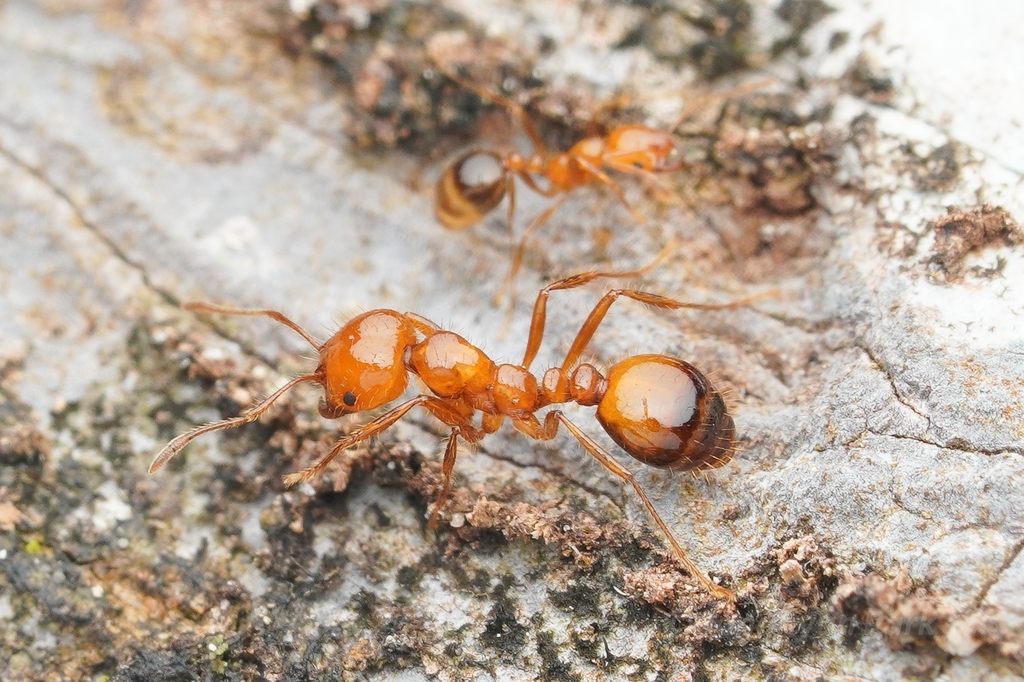
Solenopsis saevissima
Solenopsis saevissima, commonly known in Brazil as formiga-de-fogo 'fire ant', formiga-vermelha 'red ant', or formiga-lava-pés (lit. 'maundy ant'), is one of more than 185 species in the genus Solenopsis. It, along with 13 other species, is also a member of the Solenopsis saevissima species group which are popularly known as fire ants.
Although it is indigenous to South America, it has been apparently imported to Africa, Guadalupe and the Galápagos Islands. To date there is no evidence of it in the United States. S. saevissima is known for its powerful and painful sting, hence the name "fire ant". It is a pest in horticulture and one proposed method of control is to introduce the scuttle fly phorid into its habitat.
From the article Solenopsis saevissima on Wikipedia (CC BY-SA), quoted section by section
Description
S. saevissima belongs to the Solenopsis saevissima species group which includes 13 fire ant species that exhibit remarkably similar morphology, rendering morphological distinction nearly impossible without the aid of chemical characters. S. saevissima has polymorphic adult workers that differ in size depending on their castes: minor workers are generally smaller and major workers are relatively larger. The major workers also typically have trapezoidal heads and antennal scapes almost reaching their vertex; the minor workers have ovate heads and antennal scapes that extend past their heads. Like all species of the S. saevissima species group, S. saevissima has workers averaging 1.9 mm in length, antennae containing 10 segments, and mandibles with 4 or 5 teeth. Similarly to other species within Solenopsis, it has a conspicuous central hair on the front of its clypeus that extends beyond the outer margin of mandibles. Differently from most other species in the group, it lacks a well-developed medial clypeal tooth and its propodeum is rounded. Proper morphological identification of the species is complicated by interspecies breeding and the existence of a number of cryptic species in its native range. Currently it is believed that nominal S. saevissima actually comprises at least 5 cryptic species (i.e. of identical morphology) that can be separated using chemical characters.
Wikipedia: “Morphology”
Range & habitat
S. saevissima is native to the tropical and warm climate regions of South America, especially eastern Brazil (Pelotas). It is commonly found in the disturbed areas of grasslands and forest openings due to its workers' nature as excellent recolonizers. These disturbed sites can be manmade (farms or plantation) or natural (animal trails and riverbanks). S. saevissima prefers to build its colonies in sandy soil rather than clays. Mounds can reach up to 10 feet in length and have over one million residents.
Wikipedia: “Habitat”
Toxicity
Ants belonging to the genus Solenopsis are known as "fire ants" because of the pain caused by their stings, which inject venoms. The venoms of fire ants are characterized by a variety of alkaloids known as solenopsins (2-methyl-6-alkylpiperidines) that exhibit necrotic, hemolytic, antibiotic, and toxic properties. These venoms have very small amounts of proteins, which are mainly neurotoxins that can be highly allergenic. The queens of S. saevissima , like in other fire ant species, mainly produce the alkaloid compound isosolenopsin A (cis-2methyl-6-undecylpiperidine) while the workers mainly produce trans-2methyl-6-undecylpiperidine. This shows that the assortment of alkaloid production is specific to each caste and therefore suggests that the recognition of the various configuration of alkaloid venom may be important for distinguishing the castes.
Wikipedia: “Venom”
In human culture
The scientific name for Solenopsis saevissima comes from the Greek: solen, which means pipe or channel, opsis, which means appearance or sight and the Latin saevissima, which means "the very cruel". Its name derive of early accounts of its viciousness as reported from the Amazon forest. S. saevissima is named so because it is known to be even more vicious than S. invicta the red imported fire ants, which costs the United States millions of dollars per year in agricultural, medical, and traffic-related damage.
Wikipedia: “Etymology”
Listen
Looking for field recordings…
Where it lives
Recorded sightings
—
geo-referenced records in GBIF, from museums, herbaria and field observers.
Drag the globe to turn it. Dots are where records exist, not a range map; darker means more records.
In the stacks
Searching the stacks…
Every page naming Solenopsis saevissima in the Biodiversity Heritage Library →
This page is assembled live from iNaturalist, GBIF, Wikipedia, the Source Library and the Internet Archive. It is not yet part of the hand-edited codex. iNaturalist taxon 633842.