- Plants
- ›Vascular Plants
- ›flowering plants
- ›Dicots
- ›Nances, Willows, and Allies
- ›St. John's wort family
- ›St. John's worts tribe
- ›Hypericum
- ›Myriandra
- ›Centrosperma
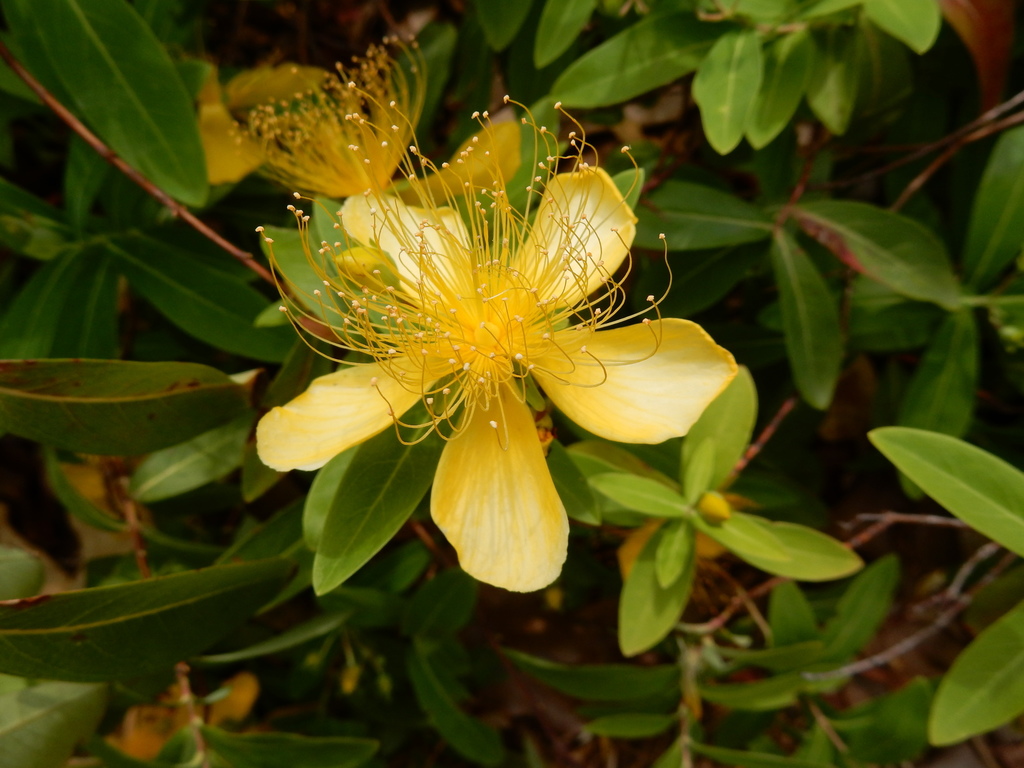
cedarglade St. John's Wort
Hypericum frondosum
Hypericum frondosum, the cedarglade St. Johnswort or golden St. John's wort, is a species of flowering plant in the St. John's wort family, Hypericaceae. It is native to the central and southeastern United States in dry, rocky habitats.
From the article Hypericum frondosum on Wikipedia (CC BY-SA), quoted section by section
Description
It is a medium-sized shrub, growing 0.6–3 meters (2.0–9.8 ft) in height with a highly-branching form. The stems are green when young, becoming reddish brown and peeling or plating with age. The opposite leaves are sessile, up to 65 mm (2.6 in) long and 22 mm (0.87 in) across with an oblong to lanceolate shape. The flowerheads have up to seven golden yellow flowers, each 25–45 mm (0.98–1.77 in) in diameter with five petals. It flowers between late May and August. Each flower has numerous stamens (up to 650) and three-parted ovaries which, at maturity, form an ovoid capsule and blackish-brown seeds.
Range & habitat
Cedarglade St. Johnswort is found in the southeastern and central United States, from North Carolina to Florida, west to Texas. It occurs in dry, rocky areas such as cedar glades, rocky woodlands, and also in dry, disturbed areas. It has been introduced further north, including New York, Massachusetts, and Connecticut. Records from South Carolina and Virginia may be misidentifications of Hypericum prolificum, another species in the subsection Centrosperma (section Myriandra).
Wikipedia: “Distribution and habitat”
Where it lives
Recorded sightings
—
geo-referenced records in GBIF, from museums, herbaria and field observers.
Drag the globe to turn it. Dots are where records exist, not a range map; darker means more records.
In the stacks
Searching the stacks…
Every page naming Hypericum frondosum in the Biodiversity Heritage Library →
This page is assembled live from iNaturalist, GBIF, Wikipedia, the Source Library and the Internet Archive. It is not yet part of the hand-edited codex. iNaturalist taxon 635334.