- Plants
- ›Vascular Plants
- ›flowering plants
- ›monocots
- ›Agaves, Orchids, Irises, and Allies
- ›Orchids
- ›Orchidoid Orchids
- ›Diurideae
- ›Drakaeinae
- ›Drakaea
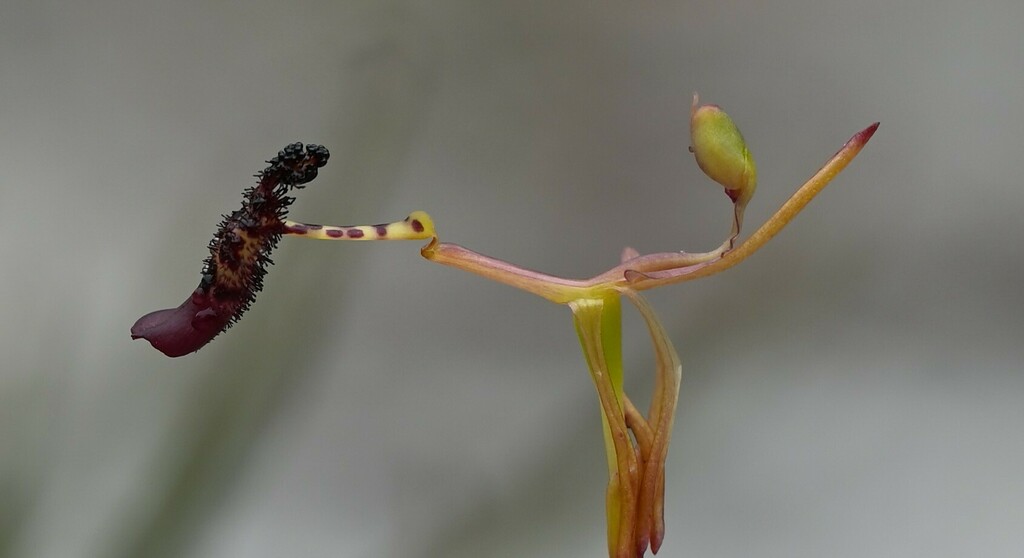
Lost Hammer Orchid
Drakaea andrewsiae
Drakaea andrewsiae, commonly known as the lost hammer orchid is a species of orchid endemic to the south–west of Western Australia. The species was first collected in 1930, has only been collected on two other occasions and photographed a few other times. It was, however, not formally described until 2007. No living examples of this species have been observed since 6 October 2000.
From the article Drakaea andrewsiae on Wikipedia (CC BY-SA), quoted section by section
Description
Drakaea andrewsiae is only known from photographs and a few specimens of the flower and stem. Presumably it is similar to others in the genus in having a single, ground hugging leaf and an underground tuber. The stem is 20–22 centimetres (8–9 in) long and the stalk of the single flower is 10–12 millimetres (0.4–0.5 in) long. Its flower is also similar to those of other hammer orchids in that the labellum resembles a flightless female thynnid wasp however it can be distinguished by having a spine on the column, a labellum with an erect tip on the end of the "tail", and a "body" that is spotted and densely covered with hair. The sepal at the back of the flower is 10–11 millimetres (0.39–0.43 in) long and the two at the sides are 9–11 millimetres (0.35–0.43 in). The petals are also 9–11 millimetres (0.35–0.43 in) long. The insect-like labellum has a head about one-quarter as long as the body and its stalk. Collections were made and photographs taken in September or the first week of October, reflecting the most likely flowering period.
Range & habitat
The lost hammer orchid is only known from areas between Gnowangerup and Tunney. It presumably grows in sandy soil, as do all the other Drakaea, and from evidence in photographs, possibly near granite rocks.
Wikipedia: “Distribution and habitat”
Where it lives
Recorded sightings
—
geo-referenced records in GBIF, from museums, herbaria and field observers.
Drag the globe to turn it. Dots are where records exist, not a range map; darker means more records.
In the stacks
Searching the stacks…
Every page naming Drakaea andrewsiae in the Biodiversity Heritage Library →
This page is assembled live from iNaturalist, GBIF, Wikipedia, the Source Library and the Internet Archive. It is not yet part of the hand-edited codex. iNaturalist taxon 636314.