- Animals
- ›Arthropods
- ›Chelicerates
- ›Arachnids
- ›Spiders
- ›Mygalomorphs
- ›Avicularioidea
- ›Open-holed Trapdoor Spiders
- ›Diplothelopsinae
- ›Stanwellia
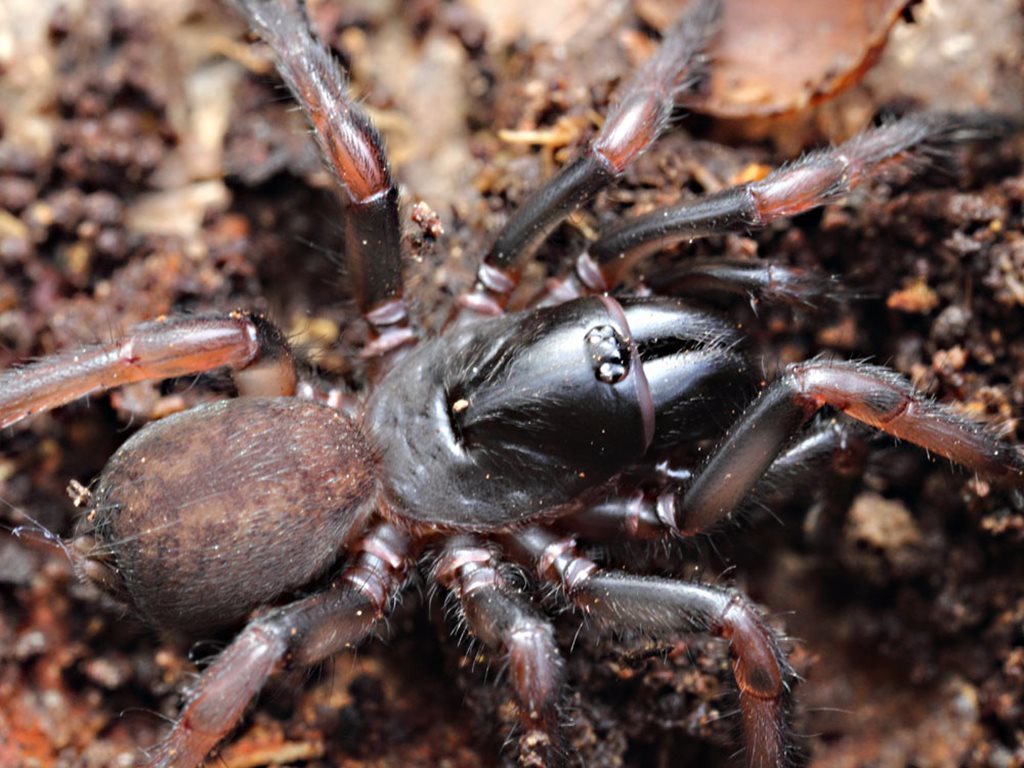
Melbourne Trapdoor Spider
Stanwellia grisea
Stanwellia grisea, also known as the Melbourne trapdoor spider, is a species of mygalomorph spider in the Pycnothelidae family. It is endemic to Australia. It was described in 1901 by British arachnologist Henry Roughton Hogg.
From the article Stanwellia grisea on Wikipedia (CC BY-SA), quoted section by section
Description
Female spiders grow up to 35 mm in body length; males to 25 mm. The body is brown; the abdomen may be paler with a darker, rib-like pattern on the upper surface. Large cheliceral fangs are displayed when the spider feels threatened.
Range & habitat
The spiders are found in southern Victoria in tall open forest habitats. Their range includes the environs of the city of Melbourne and the Grampian Mountains. The type locality is Macedon.
Wikipedia: “Distribution and habitat”
What it does
The spiders are fossorial, terrestrial predators. Both males and females dig individual silk-lined burrows, up to 40 cm deep in soft earth, with silk threads radiating from the entrances. They ambush insects and other small prey at night from the burrow entrances which, despite the common name, do not have trapdoors. During autumn and early winter, males leave their burrows and wander widely in search of mates.
Interactions with humans. The spiders, especially the roaming males, can be encountered in gardens and urban areas. Their fangs are capable of delivering a deep and painful bite, which may cause a local reaction.
== References ==
Wikipedia: “Behaviour”
Where it lives
Recorded sightings
—
geo-referenced records in GBIF, from museums, herbaria and field observers.
Drag the globe to turn it. Dots are where records exist, not a range map; darker means more records.
In the stacks
Searching the stacks…
Every page naming Stanwellia grisea in the Biodiversity Heritage Library →
This page is assembled live from iNaturalist, GBIF, Wikipedia, the Source Library and the Internet Archive. It is not yet part of the hand-edited codex. iNaturalist taxon 636582.