 NL·0094
Herbarium of the Nature Library
- Name
- Durio zibethinus
- Family
- Malvaceae
- Native to
- Borneo, Sumatra and the Malay Peninsula; cultivated across Southeast Asia
- Habitat
- Tropical lowland rainforest, Orchards
Durian
Durio zibethinus
Also calledDurian (Malay/Indonesian) · Thurian (Thai) · Sầu riêng (Vietnamese) · Liúlián (Chinese) · Du-yin (Burmese) · King of Fruits (English epithet)
A towering Southeast Asian rainforest tree famous for spiky fruit with a smell banned on many trains and hotels, yet a custardy flesh revered as the 'king of fruits'. Its flowers open at dusk and are pollinated mainly by fruit bats.
Durio zibethinus is the most common tree species in the genus Durio, commonly known as durian, and has edible fruits by the same name. Wikipedia
What it can do
- iPollinated chiefly by nectar bats such as the cave nectar bat (Eonycteris spelaea)
- iiOdour comes from dozens of volatile sulphur compounds and esters
- iiiTrees grow 25–50 m tall in the wild
- ivRipe fruit falls from the tree on its own — it is gathered from the ground
At the table
Eatenaril (flesh) · seeds (boiled or roasted) · unripe fruit (cooked)
Flesh and cooked seeds are eaten; raw seeds are not. Traditional belief, with some lab support, warns against combining durian with alcohol, as it may inhibit alcohol breakdown.
In the medicine cabinet
| Tradition | Use |
|---|---|
| Malay traditional medicine | Leaf and root decoctions given for fever and jaundice |
| Southeast Asian folk belief | Considered a 'heating' food, balanced by eating 'cooling' mangosteen |
Weight of evidence
Traditional. Long historical use; little or no modern clinical evidence.
Active compounds
ethanethiol and related sulphur volatiles, ethyl 2-methylbutanoate, tryptophan
Fruit & seed


Fruit
Capsule (loculicidal)
Ripens: Varies; main seasons June–August in Malaysia and Thailand
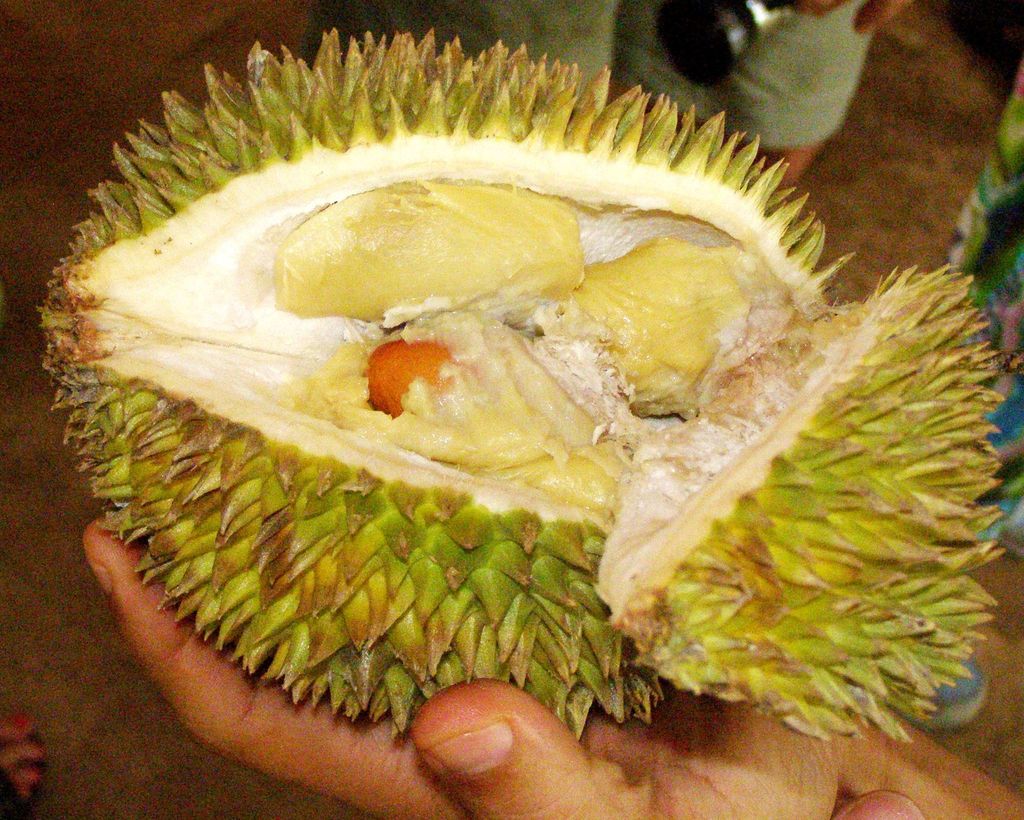
Oval to round fruit 15–30 cm and 1–3 kg, covered in hard pyramidal thorns, green to brown; splits into five sections with creamy yellow, custard-like arils that smell strongly of onion, cheese and fruit.
Seed
2–4 cm
Glossy, chestnut-brown, oval to kidney-shaped seeds 2–4 cm long, enclosed in the soft aril; 1–7 per section
- Dispersal
- Orangutans, elephants, tigers, bears and other large mammals
- Germination
- Recalcitrant — sow fresh within days, 1–2 cm deep, at 25–30 °C; sprouts in 1–3 weeks
Photographs from Wikimedia Commons under open licences; hover for the photographer, click for the file.
How to grow it
Hardiness (USDA zones)
Tropical only (USDA 11–12; damaged below about 10 °C). Survives winters down to about 4 °C.
- Light
- Full sun when mature; shade for young plants
- Water
- High, with a short dry spell to trigger flowering
- Soil
- Deep, well-drained, rich loam, pH 5–6.5
- Propagation
- Grafting (cleft, approach) of named cultivars such as 'Musang King' or 'Monthong' onto seedling rootstock
- To harvest
- 4–6 years from graft; 8–15 years from seed
- Climates
- Humid equatorial tropical
- 1Buy a grafted tree of a named clone; plant 8–10 m apart in deep soil with excellent drainage, as durian is prone to Phytophthora root rot.
- 2Shade young trees for the first 1–2 years and keep the soil mulched and moist.
- 3Feed regularly with compost and balanced fertiliser; plant other durian clones nearby for better cross-pollination.
- 4Prune to a single leader with well-spaced lateral branches for fruit to hang on.
- 5Collect fruit as it falls (or tie fruit to branches with nets), and eat within 2–3 days.
Can it grow where you are?
Where it lives
Recorded sightings
—
geo-referenced records in GBIF, from museums, herbaria and field observers.
Native range
Borneo, Sumatra and the Malay Peninsula; cultivated across Southeast Asia
Drag the globe to turn it. Dots are where records exist, not a range map; darker means more records.
In the old herbals & bestiaries
Woodcuts and engravings matched from the Source Library’s scanned books by name. Plates marked “relative” show a close kin rather than this exact species. Click a plate to read the page it came from, with translation.

Itinerary, Voyage or Ship-travel to the East or Portuguese Indies
Jan Huyghen van Linschoten · 1595 · p.209

Kircher: China Illustrata (1667)
Athanasius Kircher · 1667 · p.254

Itinerary: Voyage to the East or Portuguese Indies
Jan Huyghen van Linschoten · 1596 · p.169

Tractado de las Drogas y Medicinas de las Indias Orientales
Cristóvão da Costa · 1578 · p.262

The Ambonese Herbal (Herbarium Amboinense), Vol. 1
Georg Eberhard Rumphius · 1741 · p.170

De Indiae utriusque re naturali et medica
Willem Piso · 1658 · p.521

De Indiae utriusque re naturali et medica
Willem Piso · 1658 · p.520
In the stacks
Searching the stacks…
Every page naming Durio zibethinus in the Biodiversity Heritage Library →
Marginalia
Naturalist Alfred Russel Wallace wrote in 1856 that eating durian was 'a new sensation worth a voyage to the East'. Singapore's Esplanade concert hall is nicknamed 'the Durian' for its spiky roof.
Curiosity
Durian is banned on Singapore's metro trains, where signs show it alongside smoking and flammable goods.
Kinship



Photographs: iNaturalist contributors under the licences shown. Records: GBIF.org. Historical plates: Source Library (CC BY-SA 4.0; originals public domain). Summary text: Nature Library editors and Wikipedia (CC BY-SA). Medicinal and edibility notes are historical and educational, not advice. iNaturalist taxon 64443.