- Animals
- ›Arthropods
- ›Hexapods
- ›Insects
- ›Winged and Once-winged Insects
- ›Butterflies and Moths
- ›Butterflies
- ›Gossamer-winged Butterflies
- ›Aphnaeinae
- ›Aphnaeini
- ›Aloeidina
- ›Aloeides
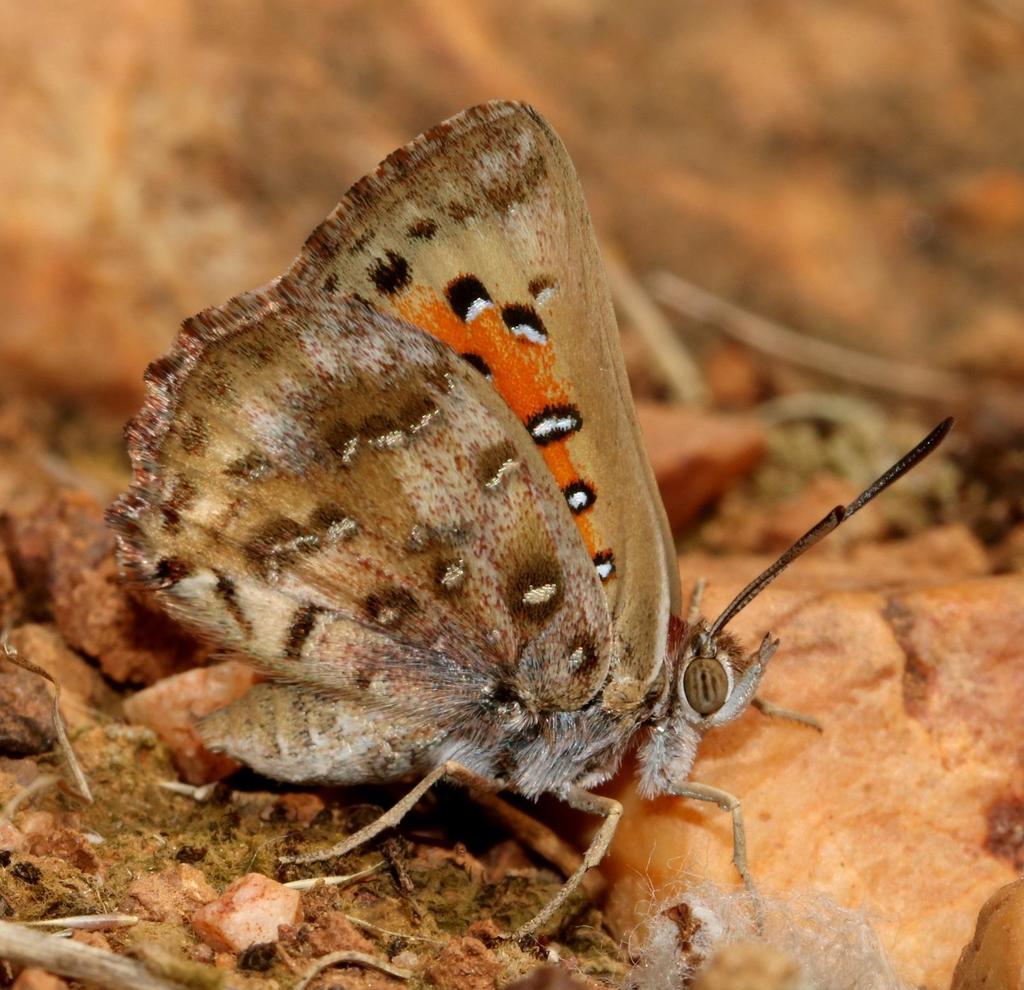
Veined Russet
Aloeides pierus
Aloeides pierus, the dull copper, is a butterfly of the family Lycaenidae. It is found in South Africa, where it is found in the Western, Northern and Eastern Cape, as well as the Free State.
From the article Aloeides pierus on Wikipedia (CC BY-SA), quoted section by section
Description
This butterfly species inhabits grassy areas with bare patches, such as grassy fynbos in the western and eastern cape, or highvield grasslands in other provinces. The wingspan is 25–30 mm (0.98–1.18 in). Adults are on wing from September to April, with peaks in October and February. There are multiple generations per year. There are 12 veins on forewing, while hindwing lacks tail. The males of Aloeidis exhibit territorial behavior, claiming specific areas on road verges and unsurfaced roads where they can counter females and mate. Chinitinous spicules are present at the distal end of tibia in a f-f-a configuration, with a well-developed spur at the lower extremities. Males have a sharp foretarsal claw. A. pierus feature long palpi, a robust thorax, and a mesofur almost twice the length of tibia. Females lack dense tuft of specialized scales on their abdomen. The genitalia are very similar among species of this genus, and not very useful when distinguishing. The uncus is in the form of a narrow strip, overlaying the large tegumen, with its distal edge slightly convex when flattened, while the subunci are short and exhibit bulging at their bases. The tegumen extends proximally to the eighth abdominal segment. There adeagus is short with slight dorsal swelling, curving slightly downwards. It features some lateral fine spines on its external region. …
Range & habitat
The Dorsal Nectary Organ (DNO) develops in larvae later stages, mostly the third and subsequent instars. The larvae feed on Aspalathus species. They shelter in the nests of Lepisiota capensis ants during the day.
== References ==
Wikipedia: “Habitat and behavior”
Listen
Looking for field recordings…
Where it lives
Recorded sightings
—
geo-referenced records in GBIF, from museums, herbaria and field observers.
Drag the globe to turn it. Dots are where records exist, not a range map; darker means more records.
In the stacks
Searching the stacks…
Every page naming Aloeides pierus in the Biodiversity Heritage Library →
This page is assembled live from iNaturalist, GBIF, Wikipedia, the Source Library and the Internet Archive. It is not yet part of the hand-edited codex. iNaturalist taxon 648859.