- Animals
- ›Arthropods
- ›Chelicerates
- ›Arachnids
- ›Spiders
- ›Typical Spiders
- ›Entelegyne Spiders
- ›Salticoid Spiders
- ›Jumping Spiders
- ›Typical Jumping Spiders
- ›Ant-like Jumping Spiders
- ›Myrmarachnina
- ›Belippo
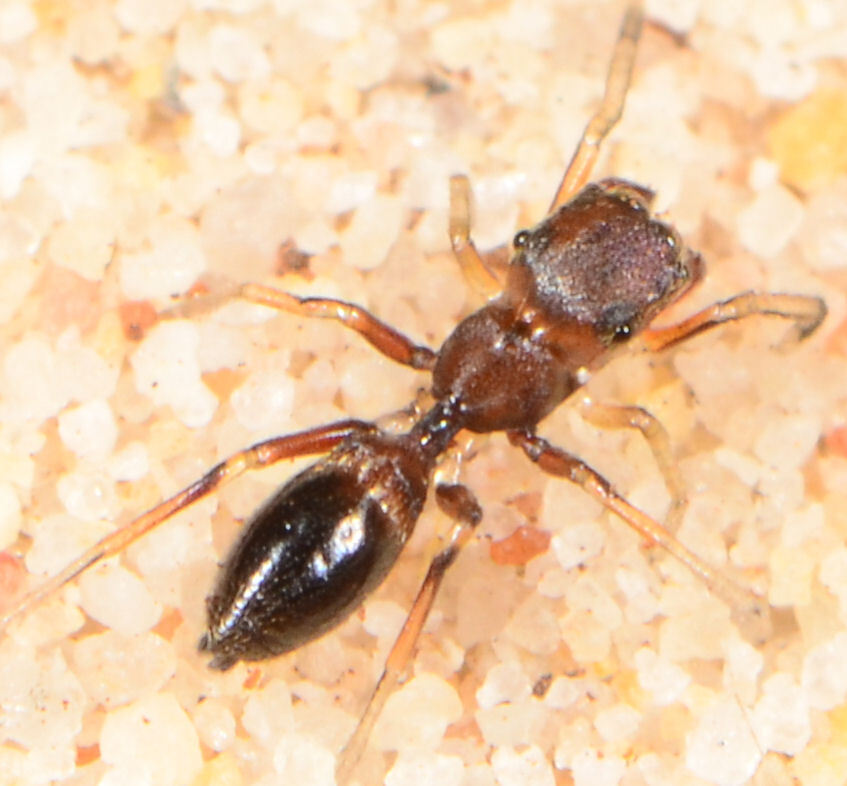
Belippo meridionalis
Belippo meridionalis, the Ophathe Belippo Jumping Spider, is a jumping spider species that lives in South Africa. A member of the genus Belippo, the spider is small, with a cephalothorax that is between 1.5 and 1.8 mm (0.06 and 0.07 in) long and an abdomen between 16 mm (0.63 in) and 1,8 mm long. The female is generally lighter than the male, both resembling ants of the genus Crematogaster. The male can be distinguished from other members of the genus by the arrangement of its teeth in its chelicerae. Unlike most other Belippo spiders, Belippo meridionalis has no teeth at the front and two at the back. It also has a spur that protrudes from the side of its chelicerae. The female has four teeth on the front and five on the back. It can be distinguished by its epigyne, the external part of its copulatory organs, which lacks the pouches that can be seen on other species. Internally, it has very long membranous semination ducts and spherical spermathecae.
From the article Belippo meridionalis on Wikipedia (CC BY-SA), quoted section by section
Description
Belippo are relatively small ant-like spiders. They often mimic ants of the genus Crematogaster. Their body is divided into two main parts: a forward section known as a cephalothorax and, behind that, another section called an abdomen. The male Belippo meridionalis has a cephalothorax that is typically 1.8 mm (0.07 in) long and 0.7 mm (0.03 in) wide. Its carapace, the hard upper part of the cephalothorax, is pitted and dark brown apart from the very front of its eye field, which is even darker. There is a shallow constriction at the back of the spider's eye field and colourless bristles around the front row of eyes. A scattering of white scales can be seen on the thorax. The underside of its cephalothorax, or sternum, is brown. The spider's face, or clypeus, is very low. Its mouthparts are brown and its large chelicerae are brownish-orange. It has a backward-pointing spur on the side its chelicerae. Inside, there are no teeth on the front and two teeth to the back. It is the lack of front teeth that distinguishes the species from the related Belippo cygniformis. Its chelicerae are also similar to the related Belippo pulchra, which also has no teeth at the front but has five to the back. The male's abdomen is also 1.8 mm long and 09 mm (0.35 in) wide. It is oval, widest at the back, with a slight constriction about a third of the way back. …
Range & habitat
Belippo spiders live in the Afrotropical realm. Belippo meridionalis is endemic to South Africa. It has been found in Gauteng, KwaZulu-Natal and Limpopo Provinces, living at altitudes of between 405 and 1,411 m (1,329 and 4,629 ft) above sea level. It is likely to be undersampled and to have a wider species distribution. The holotype was found in 2008 in the eMakhosini Ophathe Heritage Park. It was seen living in leaf litter amongst ants of the genus Crematogaster. The species has also been found in other nature reserves, including the Lhuvhondo, Ngome, Nylsvley and Roodeplaat Nature Reserves.
Wikipedia: “Distribution and habitat”
Where it lives
Recorded sightings
—
geo-referenced records in GBIF, from museums, herbaria and field observers.
Drag the globe to turn it. Dots are where records exist, not a range map; darker means more records.
In the stacks
Searching the stacks…
Every page naming Belippo meridionalis in the Biodiversity Heritage Library →
This page is assembled live from iNaturalist, GBIF, Wikipedia, the Source Library and the Internet Archive. It is not yet part of the hand-edited codex. iNaturalist taxon 652776.