- Animals
- ›Arthropods
- ›Chelicerates
- ›Arachnids
- ›Spiders
- ›Typical Spiders
- ›Entelegyne Spiders
- ›Salticoid Spiders
- ›Jumping Spiders
- ›Typical Jumping Spiders
- ›Plexippini
- ›Plexippina
- ›Evarcha
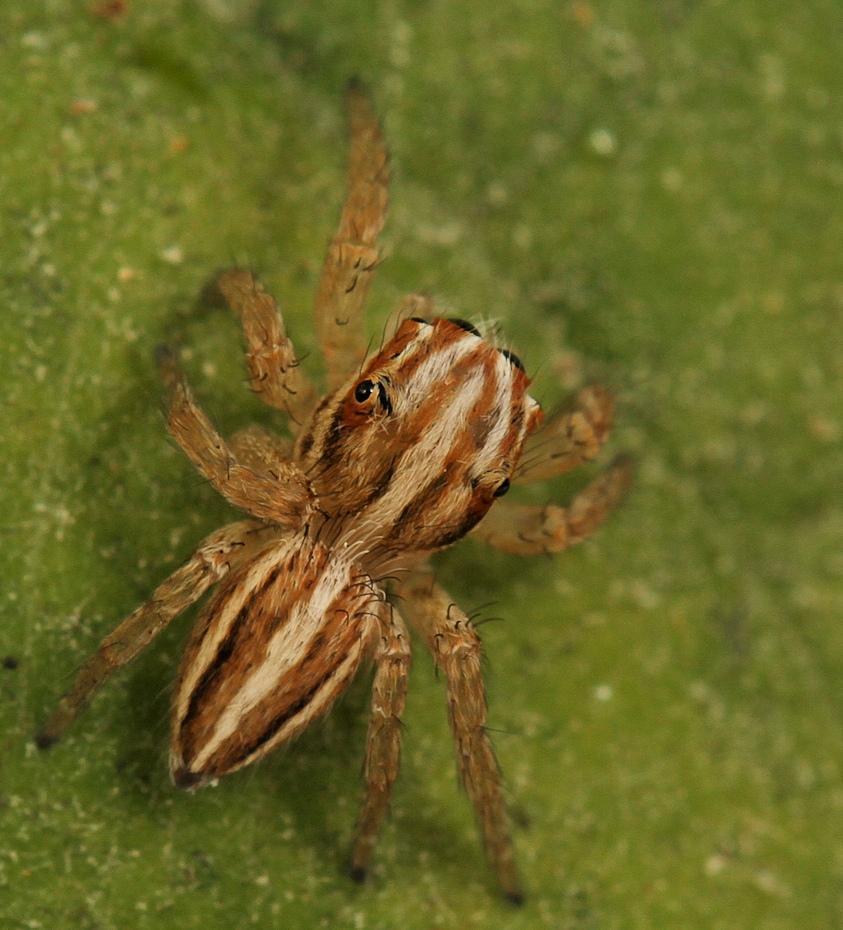
Bluelip Evarcha Jumping Spider
Evarcha flagellaris
Evarcha flagellaris is a species of jumping spider in the genus Evarcha that lives in Ghana, Kenya, South Africa and Zimbabwe. First described in 2011 by Charles R. Haddad and Wanda Wesołowska, the spider is small, with a front section, or carapace, measuring between 2.0 and 2.4 mm (0.08 and 0.09 in) long and, behind that, an abdomen that is between 1.9 and 3.6 mm (0.07 and 0.14 in) long. The female is larger than the male, particularly in the size of its abdomen. Both have stripes on their abdomens, the male being more distinct with four brown stripes contrasting with a yellow background. This is similar to the related Evarcha striolata, from which it can be distinguished by the presence of an orange shield, or scutum. It can also be identified by its copulatory organs. The female has very wide looping insemination ducts that lead to heavily sclerotized multi-chambered spermathecae. The male has a long straight projection from its tibia, or tibial apophysis, and a whip-like embolus. It is after the latter feature that it is named.
From the article Evarcha flagellaris on Wikipedia (CC BY-SA), quoted section by section
Description
Evarcha flagellaris is small with features that are typical for the genus. The male has a carapace that is between 2.0 and 2.1 mm (0.08 and 0.08 in) long and 1.5 and 1.6 mm (0.06 and 0.06 in) wide. It is oval, high and sloping. The top is brown with an indistinct lighter streak in the middle, to the rear of which can be found dark patches made up of brown hairs. The eye field is black with white hairs at the front. White hairs can also be found on the spider's face or clypeus. The underside, or sternum, is yellow. The mouthparts are distinctive with light brown chelicerae, yellow labium and yellow maxillae. The male spider's abdomen is smaller than its carapace, measuring between 1.9 and 2.0 mm (0.07 and 0.08 in) in length and having a width of typically 1.2 mm (0.05 in). It is yellow on top with four brown stripes. The front portion is covered with an orange scutum fringed with thick brown bristles at the rear. The underside is pale. The spider has grey spinnerets. The yellow legs have dark stripes, brown hairs, and many spines. The copulatory organs are distinctive. The pedipalp has a long straight projection from its tibia called a tibial apophysis. …
Range & habitat
Evarcha spiders live across the world, although those found in North America may be accidental migrants. The genus is found across Africa. Evarcha flagellaris lives in Ghana, Kenya, South Africa and Zimbabwe. The male holotype for the species was found in the Erfenis Dam Nature Reserve in Free State in 2009. Examples have also been found across the state in Willem Pretorius Game Reserve. Other specimens have been collected in the Rustenburg Nature Reserve, North West, within the Magaliesberg Biosphere Reserve in 1977 and 1980 and near Winterton, KwaZulu-Natal, in 2007. The first example to be found in Kenya was discovered on the east slope of Mount Elgon in 1948 at an altitude of 2,050 m (6,730 ft) above sea level. It is only found in Trans-Nzoia County in the country. The spider thrives in grasslands and woodlands. The holotype was found amongst Vachellia karroo trees. Other examples have been found in open fields, such as the edges of a plantation of kenaf crops.
Wikipedia: “Distribution and habitat”
Where it lives
Recorded sightings
—
geo-referenced records in GBIF, from museums, herbaria and field observers.
Drag the globe to turn it. Dots are where records exist, not a range map; darker means more records.
In the stacks
Searching the stacks…
Every page naming Evarcha flagellaris in the Biodiversity Heritage Library →
This page is assembled live from iNaturalist, GBIF, Wikipedia, the Source Library and the Internet Archive. It is not yet part of the hand-edited codex. iNaturalist taxon 666102.