- Animals
- ›Arthropods
- ›Chelicerates
- ›Arachnids
- ›Spiders
- ›Typical Spiders
- ›Entelegyne Spiders
- ›Salticoid Spiders
- ›Jumping Spiders
- ›Typical Jumping Spiders
- ›Plexippini
- ›Plexippina
- ›Evarcha
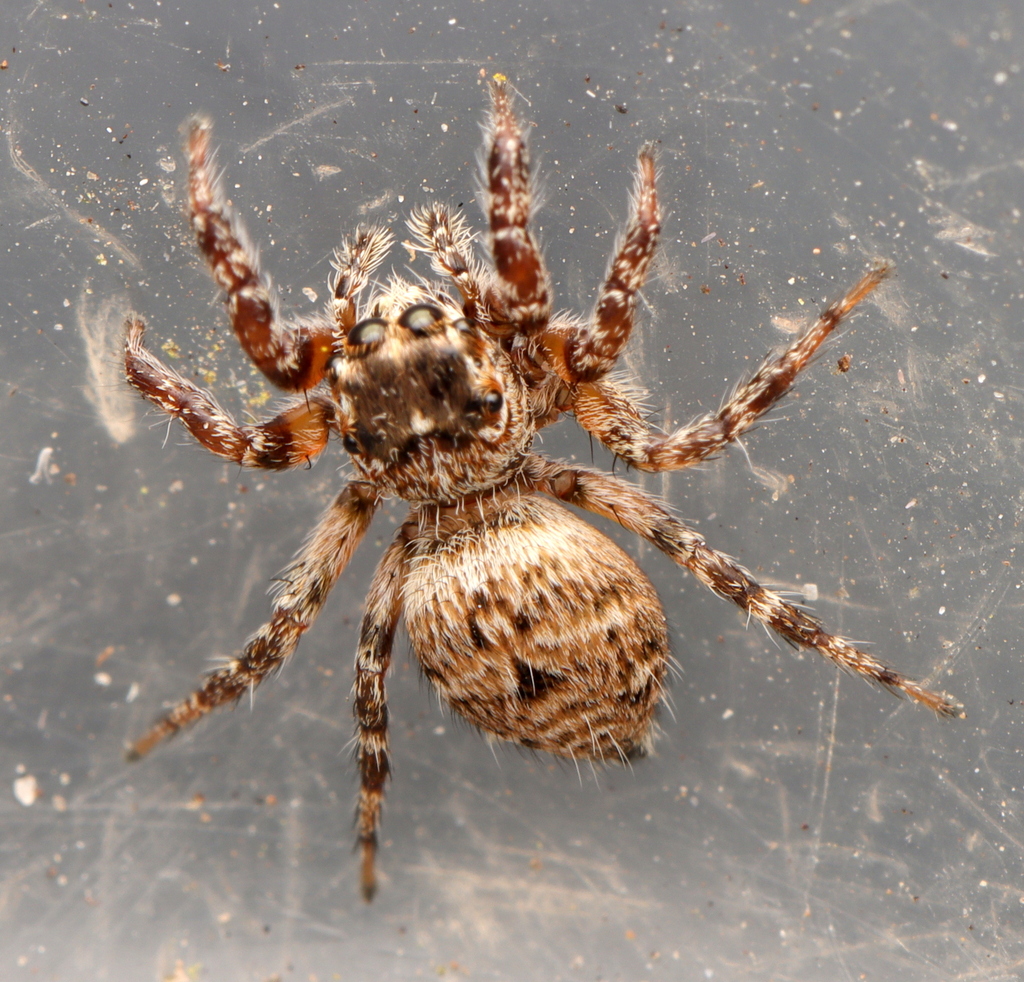
Evarcha karas
Evarcha karas is a species of jumping spider in the genus Evarcha that was first described in 2011 by Wanda Wesołowska. Originally only found in Namibia, it has also been discovered living in South Africa. It is a ground-dwelling spider that mainly lives in dry Nama Karoo shrublands. Only the male has been described. It is small, with an oval dark brown to black cephalothorax and a thinner ovoid abdomen that are each between 2.2 and 2.6 mm (0.09 and 0.10 in) in length. The abdomen has thin white stripes along its middle and sides, which helps differentiate it from the related Evarcha flagellaris that also lives in the same area of the world. It can also be distinguished by its copulatory organs, including the long spike on its palpal tibia, or tibial apophysis, that has a tip with two points, and its very long thin embolus.
From the article Evarcha karas on Wikipedia (CC BY-SA), quoted section by section
Description
Evarcha karas is a small spider, similar in shape to others in the genus, with a body divided into two main parts: an oval cephalothorax and an ovoid abdomen. The male has a cephalothorax, that is between 2.2 and 2.6 mm (0.09 and 0.10 in) long and 1.7 and 1.9 mm (0.07 and 0.07 in) wide. The hard upper part of the cephalothorax, or carapace, is high and dark brown to black, covered in greyish-white or white hairs. There are long brown bristles on the black eye field, some of them in tufts alongside a pattern of lines formed of white hairs near the eyes themselves. The tufts of hair are reminiscent of horns. The sides have a covering of short white hairs. The underside of the cephalothorax, or sternum, is yellowish-orange in Namibian examples and darker in those from South Africa. The spider's face, or clypeus, is moderately high and brownish with a covering of white hairs to the base. The chelicerae also feature white hairs, while the remainder of the mouthparts, including the labium and maxillae, are brown. The spider's abdomen is similar in length to the carapace but narrower, 1.6 and 1.8 mm (0.06 and 0.07 in) in width, and more rounded. The top is generally black with thin white stripes down the middle and along the sides. …
Range & habitat
Evarcha spiders live across the world, although those found in North America may be accidental migrants. Evarcha karas lives in Namibia and South Africa. The male holotype was discovered in 2003 near Keetmanshoop. The first example to be found in South Africa were found in 2015 in Laingsburg Local Municipality in Western Cape. It is a ground-dwelling spider that thrives in a wide range of environments. It has been seen both in open ground and living under rocks. Some have been discovered living near water, such as the Floriskraal Dam. It is particularly common in dry Nama Karoo shrublands.
Wikipedia: “Distribution”
Where it lives
Recorded sightings
—
geo-referenced records in GBIF, from museums, herbaria and field observers.
Drag the globe to turn it. Dots are where records exist, not a range map; darker means more records.
In the stacks
Searching the stacks…
Every page naming Evarcha karas in the Biodiversity Heritage Library →
This page is assembled live from iNaturalist, GBIF, Wikipedia, the Source Library and the Internet Archive. It is not yet part of the hand-edited codex. iNaturalist taxon 666104.