- Animals
- ›Arthropods
- ›Chelicerates
- ›Arachnids
- ›Spiders
- ›Typical Spiders
- ›Entelegyne Spiders
- ›Salticoid Spiders
- ›Jumping Spiders
- ›Typical Jumping Spiders
- ›Plexippini
- ›Plexippina
- ›Evarcha
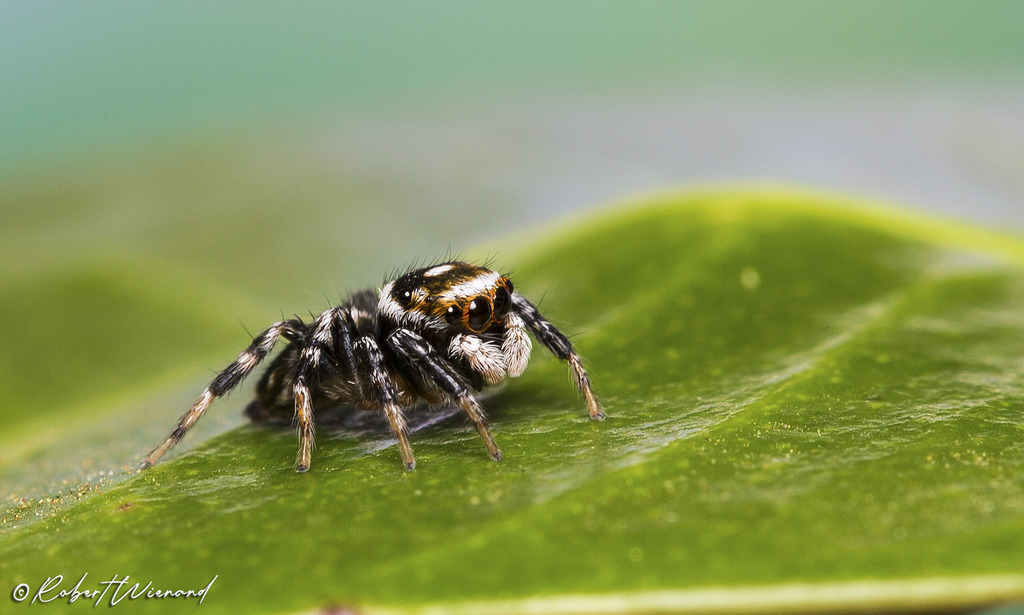
Evarcha mirabilis
Evarcha mirabilis is a species of jumping spider in the genus Evarcha that lives in South Africa. The species was first described in 2009 by Wanda Wesołowska and Charles Haddad. The spider is small, with a dark brown carapace measuring typically 1.9 mm (0.07 in) long and a russet-brown abdomen that is typically 1.7 mm (0.07 in) long. It is similar to related species in the genus, particularly Evarcha maculata and Evarcha patagiata. The spider has a yellow pattern on the top of its abdomen, its underside being a uniform yellow, while the underside of the carapace is orange. The legs individually have a pattern of yellow, black, yellow. The pedipalps are similarly yellow and black. The male can be distinguished from others in the genus by its copulatory organs, particularly the shape of the projection from its palpal tibia or tibial apophysis, which is short and sharp and connected to the tibia through a large base. The female has yet to be described.
From the article Evarcha mirabilis on Wikipedia (CC BY-SA), quoted section by section
Description
Evarcha mirabilis is small with looks that are typical for the genus. The male has a carapace that is typically 1.9 mm (0.07 in) long and 1.4 mm (0.06 in) wide. It is rather high high and generally dark brown on top apart from two lighter semicircular areas towards the front. The eye field is similar, with long brown bristles near the eyes, fawn scales around the foremost eyes, while white scale-like hairs cover much of the entire surface. The spider's clypeus, or face, is similarly dark brown. The mouthparts are distinctive with a chelicerae that have a single tooth and a brown labium. The underside, or sternum, is orange. The male spider's abdomen is smaller than its carapace, measuring typically 1.7 mm (0.07 in) in length and having a width of typically 1.1 mm (0.04 in). The topside is russet-brown with a yellow pattern of three thin stripes that cross the body, interrupted by a pattern of a very deep chevron tessellating with the wings of a dove. The underside is dark yellow. The spider has grey spinnerets. The legs yellow to the top and bottom with a central black portion. The copulatory organs have a similar pattern. The pedipalps are likewise yellow and black. The palpal femur is yellow, much of the remainder black. The palpal tibia has a projection with a very broad-base and sharp tip called a tibial apophysis. It has small teeth visible on its sides. …
Range & habitat
Evarcha spiders live across the world, although those found in North America may be accidental migrants. The genus is found across Africa. Evarcha mirabilis is endemic to South Africa. The holotype for the species was found in the Ndumo Game Reserve in KwaZulu-Natal in 2005. It has also been found in Western Cape. The first example was discovered in 2017 in Rawsonville. The spider lives on the ground in broadleaf forests. It particularly thrives in fynbos and savanna.
Wikipedia: “Distribution and habitat”
Where it lives
Recorded sightings
—
geo-referenced records in GBIF, from museums, herbaria and field observers.
Drag the globe to turn it. Dots are where records exist, not a range map; darker means more records.
In the stacks
Searching the stacks…
Every page naming Evarcha mirabilis in the Biodiversity Heritage Library →
This page is assembled live from iNaturalist, GBIF, Wikipedia, the Source Library and the Internet Archive. It is not yet part of the hand-edited codex. iNaturalist taxon 666105.